
Why Did St. Francis of Assisi Call Death His Sister?

Eight hundred years after his death, St. Francis' remarkable peace — captured in the Franciscan Transitus tradition and reflected in a painting by Peter Paul Rubens — invites us to confront our own mortality with courage, faith and hope.
I have recently learned that on October 3, Franciscans commemorate the Transitus of St. Francis, his passing from earthly life into eternal life, with a vigil memorial service. The prayers and readings recount the words he spoke to his brothers and those gathered around him at the hour of his death. Here is a small excerpt:
The Narrative of the Death of St. Francis
Reader 1: St. Francis was lying grievously ill and in pain in the Bishop’s House in Assisi when a doctor was called for the last time. He said to Francis:
Reader 2: “I must tell you that, according to our science, your malady is incurable, and in my opinion, you will die at the end of September or the beginning of October.”
Reader 1: Raising his arms to heaven, the sick man joyfully cried out:
Leader: “You are welcome, welcome, my dear sister Death.”
Reader 1: Then, turning to a friar, he asked that Brother Angelo and Brother Leo be called to help him share this good news by singing beside his bed. In spite of their tears, the two brethren began to intone the Canticle of Brother Sun:
All stand and sing:
All creatures of our God and King,
Lift up your voices, let us sing:
Alleluia! Alleluia!
Bright burning sun with golden beams,
Soft silver moon that gently gleams,
O praise him, O praise him,
Alleluia! Alleluia! Alleluia!
“You are welcome, welcome, my dear sister Death.” Later, Francis would express his understanding of her role in his journey: “It is she who is going to introduce me to eternal life.”
St. Francis, what a truly sublime thing to say!
I don’t know about you, but I can only hope and pray that these are the words that come readily to my lips at my own hour of death. Today I feel far from such a sentiment, and yet there is something in Francis’ words that gives me both hope and courage. I can feel it in my chest.
Death is one of humanity’s greatest fears, often appearing on the same list as public speaking. And here we see a brother who has gone before us, a saint showing us the way. He does not merely face death without fear; he welcomes her as a beloved friend who will usher him into eternal life.
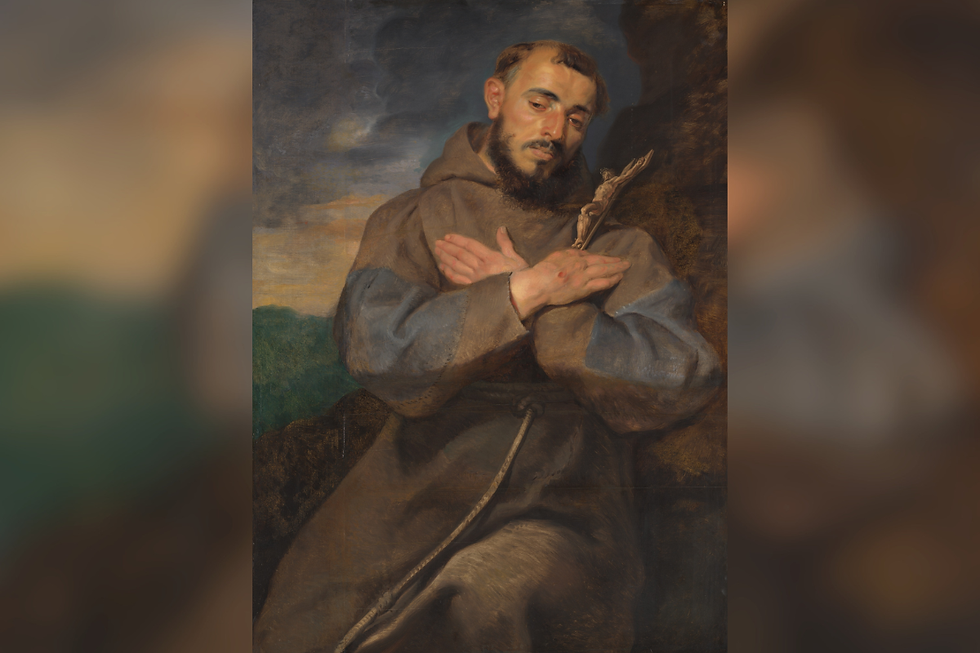
Peter Paul Rubens offers a glimpse of this spirit of memento mori (the Christian motto calling us to remember death) that St. Francis embodied so beautifully. Here we see the saint is alive and well, wholly absorbed in prayer. He seems to have climbed to a secluded place to be with God, contemplating the cross, meditating on Christ’s wounds and uniting himself to Christ in this intimate moment of devotion.
It feels as though we are glimpsing a scene we were never meant to witness, and yet here we are, the viewers, invited to enter into his meditation. How lovingly and gently he holds the cross. How lightly he rests his hands across his chest, his gaze lowered, his thoughts seemingly drawn into the stormier reaches of the sky, while his whole being is illuminated by the warmth of heavenly light.
It is a masterful composition, one that holds me long after I begin sitting with it.
The lives of the saints can sometimes seem unattainable, their holiness so extraordinary that we are tempted to admire them from a distance rather than follow their example. But I don’t believe — or rather, I can’t believe — that this is the truth. We should all strive to become saints, to live lives of holiness in our own towns and in our own particular ways. We may not be called to follow the exact path of St. Francis, but we are each called to follow Christ with the same courage, humility and love.
In an address this month, Pope Leo XIV reflected on the life of St. Francis: “On the eighth centenary of his death, I wish to recall a laborer who worked with great fruitfulness in the Lord’s vineyard: St. Francis of Assisi, whom Jesus himself asked to repair his Church.”
Referring to the parable of the vineyard, Pope Leo explained that “the vineyard to be cultivated with justice is the Church, which we build up or damage through our choices.”
The choices we make every day are, quite literally, building up the Church around us or damaging it and tearing it down. Jesus has blessed his Church with the example of this great saint for a reason: not to offer us a false promise of peace, but to show us a path toward it through a life given entirely to him.
Pope Leo has given us a prayer for this Jubilee Year of St. Francis, and I invite you to pray it as you contemplate this stunning work of art by Rubens. Perhaps print both (the image is free of copyright) and hang them in a prominent place in your home for the rest of the month.
St. Francis, our brother, you who eight hundred years ago went to meet Sister Death as a man at peace, intercede for us before the Lord.
You recognized true peace in the Crucifix of San Damiano, teach us to seek in him the source of all reconciliation that breaks down every wall.
You who, unarmed, crossed the lines of war and misunderstanding, give us the courage to build bridges where the world raises up boundaries.
In this time afflicted by conflict and division, intercede for us so that we may become peacemakers: unarmed and disarming witnesses of the peace that comes from Christ.
Amen.
“My task is done, may Christ teach you to do yours.” — St. Francis, the Poverello of Assisi