
Economic Justice, Poverty and Welfare: Upholding Human Dignity and the Common Good

From caring for the poor to protecting workers and promoting economic opportunity, Catholic social teaching offers a framework for building a just society. Here's what that means for Catholics in Colorado.
Part 4 of a 10-part series on the Colorado bishops' public policy priorities
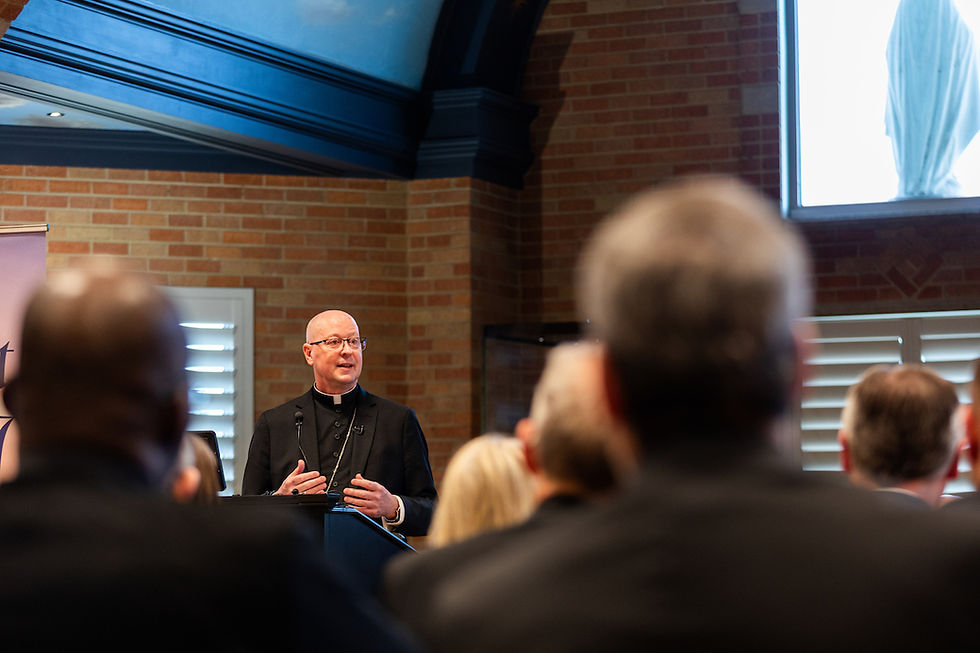
Economic decisions should respect human dignity and express a preferential option for helping the poor and vulnerable through safety nets and opportunities for upward mobility.
The Catholic Church teaches that society has a moral obligation to care for its most vulnerable members, grounding its approach to poverty and welfare in human dignity, justice and love for the poor.
As the Catechism of the Catholic Church explains, Jesus identifies himself with the poor of every kind and “makes active love toward them the condition for entering his kingdom” (CCC 544).
At the heart of Catholic teaching is the “preferential option for the poor,” which requires that the needs of the marginalized be prioritized in public and private decisions.
This principle is grounded in the universal destination of goods, which teaches that the earth's resources are meant for everyone, and that private property carries a social responsibility. Therefore, aiding those in need is not merely an act of voluntary charity, but a matter of justice.
To uphold this responsibility, the state has a legitimate duty to use social welfare programs and tax funds as safety nets, a practice supported by the principle of solidarity.
However, the principle of subsidiarity directs that decisions affecting a community are best made by those closest to it. Government intervention must not replace personal Christian charity or diminish the vital roles of families and local community groups, which remain primary agents of care.
The Church's Teaching on Economic Justice
The Church's teaching on economic justice has been developed through more than a century of papal encyclicals addressing the dignity of workers, private property and the relationship between economic systems and the common good.
Pope Leo XIII's 1891 encyclical Rerum Novarum is among the most frequently cited Church documents on economic justice. It rejected both unbridled capitalism and state socialism, defended the rights of workers and established that God has a special concern for the marginalized.
A century later, Pope St. John Paul II addressed many of the same concerns in Centesimus Annus (1991), written on the 100th anniversary of Rerum Novarum.
In the encyclical, Pope St. John Paul II explored the relationship between private property and the universal destination of goods, as well as the ways different economic systems reflect truths about human nature and man's relationship with God.
According to Pope St. John Paul II, the universal destination of goods requires the protection of private property. This is particularly important in an era of technological innovation, where knowledge itself has become a commodity. When a person's property is protected by law and workers are justly compensated for their labor, their dignity is upheld and wealth can be generated to support families, charitable efforts and the wider community.
For this reason, Pope St. John Paul II argued that communism undermines human dignity by increasing alienation and treating the person as a means rather than an end. Similarly, unbridled capitalism can treat people as a means to profit, exploiting their labor to the detriment of families and society.
In the modern age, he recognized, the world needs an economy that acknowledges the positive role of business, the market, private property and human creativity, while remaining accountable to the dignity of workers and the common good.
Economic Justice in Colorado
Colorado offers many services to help the poor and vulnerable, including programs that Catholic Charities uses to provide compassionate and comprehensive care to the community.
The primary avenues of support include tax credits, workforce development, family assistance, affordable housing measures and medical assistance.
Tax credits such as the Homeless Contribution Tax Credit and Earned Income Tax Credit, along with other means-tested programs for low-income families, are consistent with the Church's teaching on economic justice and the role of the state in providing preferential assistance to the poor.
In recent years, Colorado lawmakers have focused on workforce development to boost the state’s economy, enacting new laws to create opportunities in communities with low workforce participation and among recent college graduates.
Affordable housing has also been a critical focus for Colorado lawmakers over the past five years, expanding local governments’ authority to streamline affordable housing projects and providing millions of dollars in funding.
While some measures seek to expand housing opportunities, other laws, including HB26-1001 HOME Act, have raised concerns regarding the Catholic principle of subsidiarity, which calls us to make social, political and economic decisions at the most local level possible. In the case of recent affordable housing laws, including the HOME Act, restrictions on the rights of local government, education institutions, nonprofits and renter property may create unintended consequences, even when the intention is to provide more housing opportunities.
It is imperative that the state engage on issues of economic justice while recognizing the potential dangers of an expansive welfare state that can restrict human flourishing and upward mobility.
Providing preferential assistance to low-income families is crucial. Drawing from Pope St. John Paul II's teaching, the Colorado Catholic Conference emphasizes the importance of a free-market economy complemented by a state safety net that supports human dignity, economic opportunity and upward mobility.
Putting the Church's Teaching into Practice
For Catholics, the Church's teaching on poverty and welfare stems from the core message of the Gospel. It combines a direct duty of charity, the principle of justice and a broader understanding of economic systems rooted in Catholic Social Teaching.
In everyday conversations, Catholics can shift discussions of poverty and welfare away from political gridlock and toward a Gospel-centered mission focused on the inherent dignity of every human person.
This means recognizing society's obligation to care for the poorest and most vulnerable while supporting opportunities for people to work, provide for their families and participate in community life.
When engaging lawmakers, Catholics should share their own experiences and stories related to economic justice, poverty and welfare. The Church's teaching can serve as a nonpartisan moral compass for evaluating public policy based on how it affects human dignity.
In advocating for policies that support the poor, Catholics can emphasize the importance of both solidarity and subsidiarity, recognizing society's responsibility to care for those in need while protecting the roles of families, local communities and charitable organizations.
Ultimately, promoting economic justice means building a society in which the dignity of workers is respected, the needs of the poor are prioritized and individuals and families have meaningful opportunities to flourish.