

When Mercy Calls Our Name: An Art Reflection on St. Mary Magdalene

Mary Magdalene's story reminds us that even after we stumble, Christ never stops calling us back to himself.
I was hesitant to watch The Chosen. I grew up with an image of Jesus burned into my mind from watching Jesus of Nazareth, starring Robert Powell. It was a powerful and beautiful portrayal, but it took me years to realize that Jesus didn't necessarily look like Mr. Powell. In fact, he almost certainly didn't!
Human beings are profoundly shaped by what we see. It's believed that around ninety percent of what we learn as children comes through our sense of sight. Whether the exact number is accurate or not, the point remains: visual images have a remarkable ability to imprint themselves on our minds. There is good reason for that, but it also reminds us to be discerning about what we allow into our precious sensory world.
All of this is to say, I wasn't sure I wanted Jonathan Roumie's face to become my mental image of Jesus — lovely as his face is. It wasn't until I watched the Prime documentary Jonathan and Jesus that my heart began to soften toward The Chosen. Seeing Jonathan speak about his faith and his work helped me separate the actor from the role. I could see him simply as a man — a gifted actor who had been thoughtfully chosen for the part, but a man nonetheless.
I am so glad I decided to watch the series. It has been unexpectedly life-changing. Rather than replacing my image of Christ, it has drawn me more deeply into the Gospels and has helped me encounter the humanity of those who walked beside him. Who would have thought?
The first character I fell in love with in the series was Mary Magdalene. We meet her at her lowest moment. She is living as a prostitute who is possessed by seven demons. While we do know that Mary Magdalene had been possessed, there is no proof that she was also the prostitute woman mentioned in the Bible. It has, however, been held as tradition that these two people were the same, so I’ll take it.
The opening scene skillfully switches back and forth between Mary learning to pray Isaiah 43 (“Thus says the Lord who created you, O Jacob, and he who formed you, O Israel: Fear not, for I have redeemed you; I have called you by name; and you are mine.”) from her sick father and her being assaulted by Roman guards and tortured by demons. The juxtaposition of her shown as a scared little girl and her as a deeply wounded and suffering woman is enough to rip your heart right out.
The beauty of sacred art and iconography is that stories and images are preserved as they get handed down through the centuries. The danger in summarizing anyone’s story into a snippet of eight prominent scenes is that their humanity can begin to disappear. The Chosen has never claimed that every conversation or event is historically or biblically exact. What it has offered instead is an artistic meditation on the personal lives of the people we encounter in Scripture. That is one of the greatest gifts art can give us — not to replace the truth, but to help us see it more fully.
In one of these prominent scenes, Mary is interrupted at the bar, mid-drink, by the Savior of the world, who has just quietly walked in. The one whom her father taught her about, the one who “formed her and calls her by name,” stands before her. Jesus calls, “Mary,” a name that she hasn’t heard since childhood, it seems, and she collapses in his arms. I became a puddle on the floor right beside her.
A few episodes into the series, we see that Mary has a relapse. It was a turn I never expected. Surely, once she had encountered Christ, she was a new creation — and she was. But Mary was human after all.
I found this addition to the story incredibly moving. Mary begins listening to the wrong voices. She remembers her sins more vividly than the forgiveness she has received. Convinced that she is unworthy to walk alongside Jesus and his companions, she returns to the city to gamble and drink, slipping back into the life she thought she had left behind.
When Jesus realizes she is gone, he sends Matthew and Simon to find her. After she returns to camp, she has a beautiful conversation with Mary, the Mother of God — a subtle but lovely nod to the idea of ad Jesum per Mariam, "to Jesus through Mary." Encouraged by Our Lady's quiet wisdom, Mary Magdalene goes back to Jesus, where she is welcomed and forgiven once again. Oh, the relatability of it all!
That scene struck me deeply because it is so profoundly human. How often do we remember our failures more readily than God's mercy? How often do we convince ourselves that we've fallen too far, that we've exhausted his patience or that we no longer deserve to be among his followers? Mary's story reminds us that the Christian life is rarely a straight line. We stumble. We listen to the wrong voices. We wander. And every time we turn back, Christ receives us with the same mercy he offered the first time.
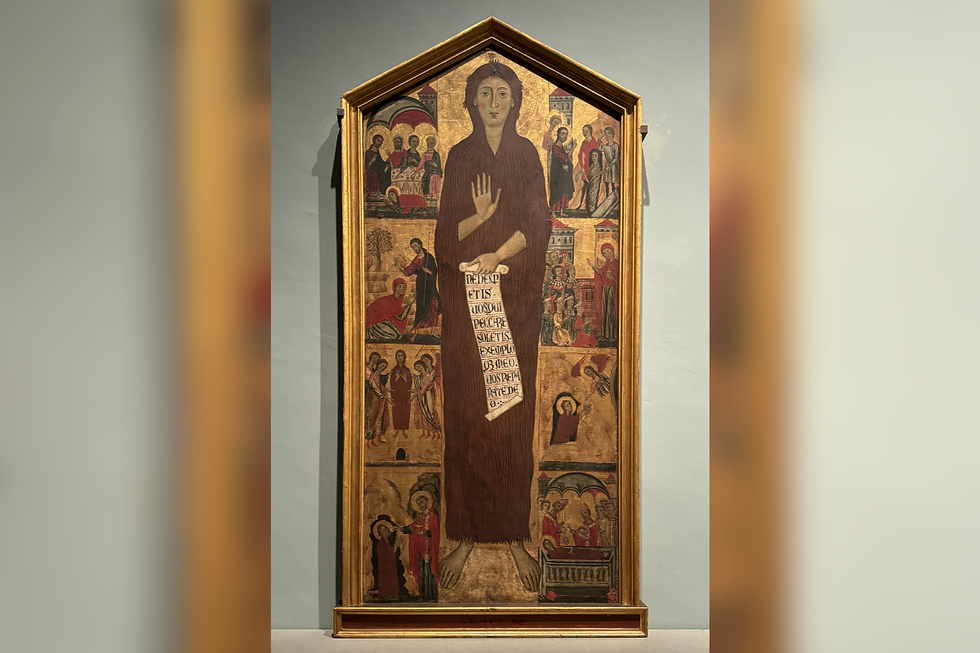
This stunning icon of Mary Magdalene was believed to have hung near the tramezzo of the church. The tramezzo was the area where a large screen (analogous to the iconostasis of the Eastern rite churches and to the rood wall, which became the altar railing of the Roman church) separated the faithful laity from the monks or clergy and the altar. The scroll in Mary’s hand translates to "Do not despair, you who are accustomed to sin, and by my example, restore yourselves to God." She is shown here living as a hermit in a cave, having given up all worldly possessions, and is clothed only by her own hair. According to our records, Mary spent her final 30 years of life this way. While in the cave, it was believed that angels ministered to her, feeding her spiritually and physically with the Body of Christ.
Mary has always been a powerful example of conversion and of a deep, selfless love for Christ. She shows us what it means to give everything to him, trusting that when we do, he will set our hearts ablaze. May we follow in her footsteps and seek the same love and devotion.