
Journey Towards God: Encounter, Accompaniment, Evangelization

Updated: May 8
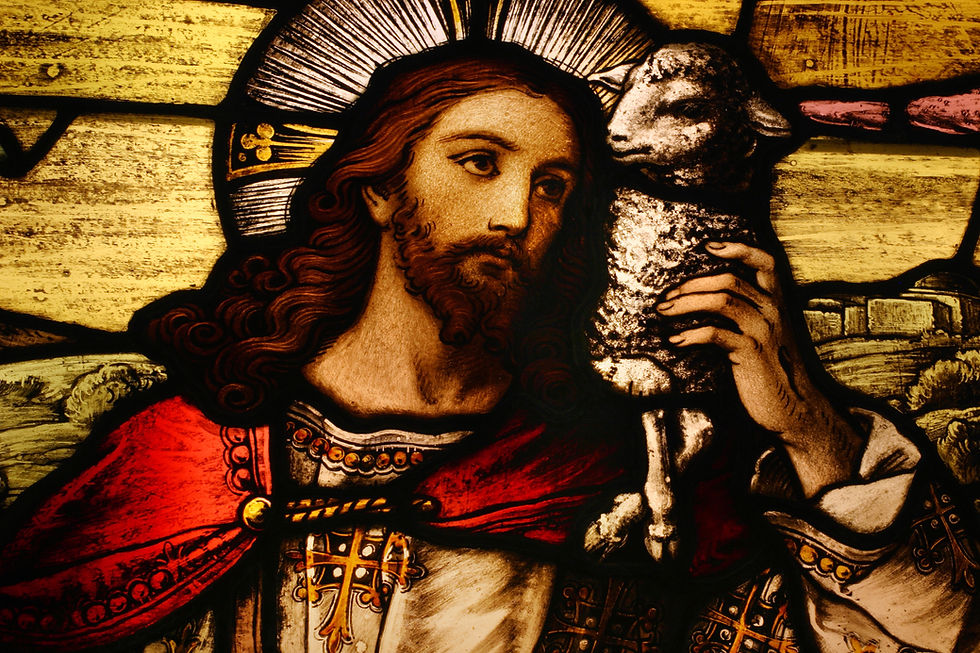
"You are the light of the world. … You are the salt of the earth.” Matthew 5:13-14
When Jesus speaks these words, he is not addressing an elite few. He is speaking to ordinary disciples, to people with families, jobs, limitations, fears and questions. People like you and me.
Every baptized Catholic shares in the mission of Christ. We are invited, indeed privileged, to go in search of the lost sheep, to bring light into darkness and to offer hope to those who are suffering. And yet, for many of us, evangelization can feel stressful, overwhelming or even intimidating. We quietly assume that it is all up to us, that we must have airtight arguments, theological expertise or a dramatic conversion story ready at a moment’s notice.
But conversion has never been our job. God is the one who does the work of conversion. Our role is much simpler than we often imagine. We are called to be present, to love well and to respond to the small openings God places in front of us.
Two of the most common and accessible openings are already in our lives: people who are spiritually curious and people who are suffering. To engage them well, it helps to understand how people typically move toward faith. That is where the “thresholds of conversion” become a helpful guide.
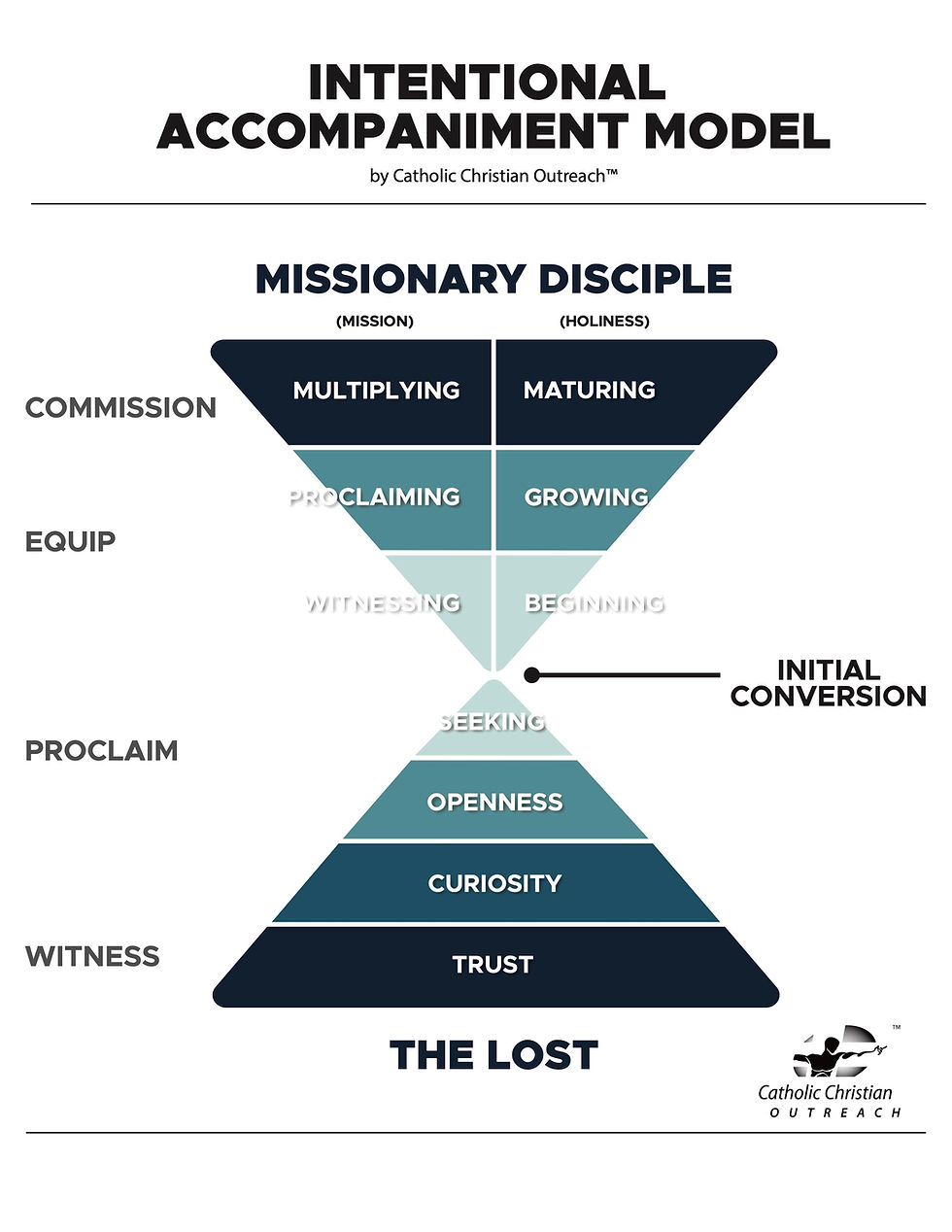
Understanding the Thresholds of Conversion
In the book I Once Was Lost by Don Everts and Doug Schaupp, and later popularized in Catholic circles through Sherry Weddell’s Forming Intentional Disciples, we are given a framework often referred to as the “Thresholds of Conversion.” It outlines the stages many people pass through on their way toward becoming intentional disciples of Jesus Christ.
Before someone makes a conscious decision to follow Christ, they often move through several thresholds: trust, curiosity, openness and seeking. Only after these does the decision to follow Jesus typically emerge. Many people in our lives are at the beginning of the journey towards faith. They are not yet ready to convert. They are not asking for systematic theology. But the Holy Spirit is working, and the journey towards intentional faith is beginning even if they don’t perceive it.
This perspective is freeing. It prevents us from expecting commitment before curiosity, or clarity before trust. It also helps us notice that the Holy Spirit is often at work long before anyone sets foot in a parish office.
Let’s look a little closer at the first two steps (“thresholds”) people normally take on their way towards intentional faith.
The first threshold is trust. Before someone trusts the Church, they usually come to trust an individual Catholic. That means evangelization often begins not with doctrine but with relationship. When someone experiences us as patient, honest, joyful, consistent and genuinely interested in their lives, they begin to associate faith with credibility. Trust grows slowly: through shared meals, kept promises, authentic conversations, quiet acts of service. When someone seeks your advice, shares personal struggles or feels safe being transparent with you, something important is happening. This is not “pre-evangelization.” This is evangelization.
Once personal trust is established, curiosity is the next natural step.
Entering the Experience of the Curious
Curiosity can be a fragile and beautiful stage. It can arise quietly. A friend might begin asking why you go to Mass every week, what prayer actually does or how you see suffering. Sometimes curiosity surfaces as direct questions. Other times it appears more subtly. It can express itself with a renewed interest in meaning, beauty or transcendence.
What is happening in the heart of someone who becomes curious?
For some, it begins as quiet restlessness. Life may look stable on the outside (career, relationships, accomplishments), but something still feels incomplete. Questions that once seemed irrelevant resurface: Why am I here? Is there more than what I see? What happens after death?
For others, curiosity takes the form of attraction to beauty. They feel drawn to silence, sacred music, nature and moments that seem charged with something beyond themselves. They may not yet be curious about doctrine, but they sense that life has a depth they have not fully explored.
Curiosity is rarely pure enthusiasm. It often carries mixed emotions. There may be excitement at discovering something new, but also skepticism, fear of change or lingering wounds from past religious experiences. A person may feel both hope and hesitation at the same time. Recognizing these nuances helps us approach their curiosity with reverence rather than urgency.
Meeting the Curious
If someone in your life is beginning to ask questions about faith, pause long enough to thank God. That spark did not originate with you. The Holy Spirit has already been stirring in them.
Our task is not to overwhelm that spark but to protect it. That often means matching their pace. If they ask one sincere question, answer that question simply and honestly. Resist the temptation to deliver a comprehensive explanation of every related teaching. Curiosity grows when it is respected.
Recently, at a family dinner, God created an opportunity for me to share my faith. A family member, after finding out that I work for the Church and teach the New Testament, began asking me question after question about Scripture. Our conversation ranged from questions about the book of Revelation to the Shroud of Turin and the Jewish cultural backdrop to the Gospels. Because of my training and education, I was able to answer every question on the spot. I felt so proud! My family member left with all their questions answered.
So often we mistakenly think that this is what it means to be “able to evangelize.”
Only afterwards did the Holy Spirit show me just how naïve I had been! Instead of stoking my. family members’ curiosity, I totally satiated it. During all the questions and dialogue, I didn’t ask my family member a single question. I should have left them with a question that would have stuck in the heart and mind. One that would have driven them to seek more, to think about Jesus, to lead them deeper. Instead, I closed the door on their curiosity by answering everything.
Even worse, I came to realize that the example I had shown of what it means to be a “faithful Catholic” was impossible to follow. Through my actions, I had implied that to be a faithful Catholic, you need to answer every question accurately, immediately and off the top of your head, which is simply not true.
It is important to keep the focus where it belongs: on Jesus Christ. The heart of our faith is not primarily a moral code, a set of doctrines or interesting biblical facts. It is a person who died and rose out of love for them. When someone is curious, one of the most fruitful things we can do is to invite them to encounter Jesus directly. This can happen by inviting them to “try on” praying every day for a month, by reading one of the Gospels together or by bringing them to Eucharistic Adoration. These small steps often move someone forward more than a long theological explanation ever could.
Small, tangible invitations matter. Suggesting that they pray for five minutes a day for a month, attend Eucharistic Adoration once or serve the poor alongside you can help move curiosity toward deeper openness. Curiosity changes a person when they begin to act on it.
Walking With Those Who Are Suffering
A second powerful opportunity to bring the light of Christ is found in suffering.
Illness, grief, betrayal, anxiety, loss of identity, failure… these experiences often crack open the deeper questions of the human heart. Even those who have not considered faith in years may begin to wonder whether there is meaning, whether they are alone, whether hope is possible.
Suffering often brings with it a sense of “losing control.” Consider for a minute what your experience has been when you’ve suffered in your life.
Confident people can suddenly feel small and exposed. Someone who once saw themselves as strong or independent may now feel weak or disoriented.
In these moments, people are especially sensitive to tone and authenticity. They can quickly sense whether they are being treated as a person or as a project.
This is where we must be careful. Evangelization is never about “using” someone’s pain as an opportunity. If love is not our singular motivation, they will feel it. We share Christ because we have encountered his mercy, closeness and love when we’ve suffered in our own lives — and we want others to experience the same.
Here are some tips for bringing the light and love of Jesus to those who are suffering.
First, we lead with compassion, not a strategy. Our goal should be to bring Jesus into the situation, not to use the situation. We want to love the person well, regardless of what hap- pens spiritually.
Second, we want to enter their story before sharing ours. We should seek first to understand before seeking to be understood. When someone feels deeply heard, they become far more open to spiritual conversations.
Third, don’t rush to explain their suffering. Do your best to avoid leading with statements like “God has a plan” or “Everything happens for a reason.” Even if theologically true, these statements can feel patronizing or can seem to minimize the pain they are feeling. Remember Jesus with Martha and Mary after Lazarus had died? He wept before he explained the situation to them.
We may not often think to do this, but asking for permission to pray for them communicates a deep respect for the other person.
When you go to share hope with them, share it as a personal testimony and not as a theological argument. When people suffer, they are rarely asking for a debate; instead, they are asking, “Is there hope?” So speak from experience. Witnessing to what God has done is very different than attempting to persuade someone to believe something you believe.
In moments of suffering, presence is usually more powerful than proclamation. When people suffer, they are often asking, consciously or not: Am I alone? Do I still matter? Is there meaning beyond this? The Gospel speaks directly to those questions. But it is most powerfully heard when it is embodied.
The Freedom of Trusting the Holy Spirit
As we consider the curious and the suffering in our lives, one truth must anchor us: conversion is not our work. God isn’t concerned with our “success” but rather our faithfulness to his command to be “salt and light” to others.
The Holy Spirit is already at work long before we enter the conversation. He creates the restlessness. He stirs the curiosity. He draws near when someone suffers. He gives us the words to speak when they are needed and guides us to keep silent when that’s wiser.
Our part is to build trust, to notice small openings, to love sincerely and to offer simple invitations. We do not need to be experts. We need to be available.
You are already placed in relationships that no priest or parish staff member will ever have (in your workplace, your extended family, your neighborhood, your friendships). God has entrusted you with real people whose stories intersect with yours for a reason.
The world does not need more professional evangelizers. It needs faithful Catholics willing to be salt and light in ordinary moments. When you listen to a struggling friend, answer a sincere question with humility, invite someone to pray or simply remain present in suffering, you participate in Christ’s mission.
And the Holy Spirit does the rest.