
How to Get THREE Plenary Indulgences this Triduum

It’s the holiest time of the year, as we prepare to enter into Jesus’ suffering, death and resurrection anew. As we prepare for the Holy Triduum — Holy Thursday, Good Friday, Holy Saturday and Easter Sunday — we not only remember the Paschal Mystery as historical actions 2,000 years ago, but as real, life-changing events today.
In that vein, the Church offers us a few opportunities for major grace during these sacred days with THREE chances to earn plenary indulgences!
Holy Thursday
The first opportunity comes on Holy Thursday, as we remember the Last Supper. On that holy evening more than 2,000 years ago, Jesus gave us the Holy Eucharist — his abiding presence, Body, Blood, Soul and Divinity — and the holy priesthood.
Today, and each Holy Thursday, the Church gathers to remember and re-live this sacred moment in the evening Mass of the Lord’s Supper. In this ancient liturgy, a few special things occur.
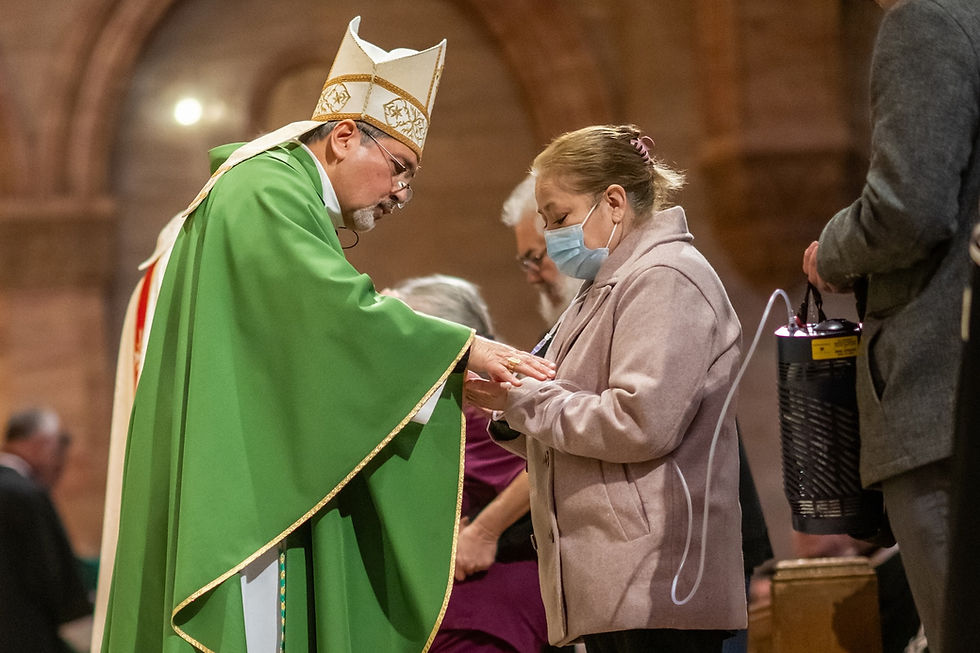
First, the priest celebrating the Mass of the Lord’s Supper, following Jesus’ example in the Gospel of John, stoops to wash the feet of several individuals, standing in place of the apostles (John 13). This act of service is powerful and reminds us of our call to love our neighbor always and everywhere.
Second, following the distribution of Holy Communion, a ciborium containing the Blessed Sacrament remains on the altar. There is a time of Adoration and a solemn procession to a place of repose outside of the normal tabernacle. This symbolizes Jesus’ own procession to the Garden of Gethsemane, from which he is arrested and taken away. Many parishes across the archdiocese host Eucharistic Adoration on Holy Thursday evening, encouraging the faithful to “remain here and keep watch with me,” as Jesus urges the apostles in the Gospels (Matthew 26:38).
On this evening, the Church grants a plenary indulgence to the faithful who piously recite the verses of the Tantum Ergo, a Eucharistic hymn of praise written by St. Thomas Aquinas, after the Mass of the Lord’s Supper during the solemn reposition of the Most Blessed Sacrament, under the normal conditions listed below.
Good Friday
The second opportunity comes on Good Friday, the day on which our salvation is won from the Cross. This day that is called “good” is permeated by suffering, as Jesus makes his way through various sham trials, beatings, mockeries and, eventually, the Way of the Cross up to Calvary. From that mount, he offers his life to the Father as a free gift to save humanity from our sins, to rescue us that we might have abundant life for the glory of the Father.
As the Church gathers to remember and re-live this salvific moment, we celebrate the Lord’s Passion — another odd word choice at first hearing, to be sure. In this ancient liturgy, often celebrated at 3:00 p.m., the time associated with Jesus’ death, the faithful pray in a special way with little music, deep solemnity and beautiful elements only seen at this liturgy.
First, as they enter to begin the liturgy, the clergy prostrate themselves before the altar for a few moments of silent prayer. This simple, solemn act of reverence signifies both the abasement of “earthly man,” and also the grief and sorrow of the Church.
Second, there are series of solemn intercessions, often chanted, for the needs of the Church, the world and our neighbors. Each intercession includes an intention, a period of silent prayer and a spoken prayer by the priest. In this way, we draw near to the Crucified Christ like the dying thief did, to plead his grace in our world.
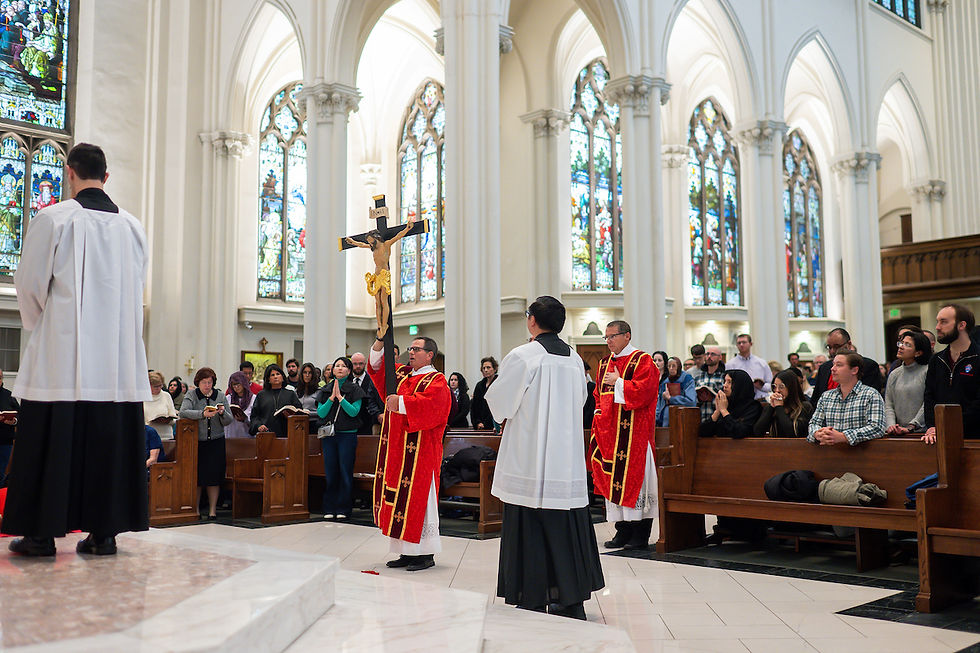
Third, a procession with the Cross takes place. As it’s shown to the people, the priest or deacon chants, “Behold the wood of the Cross, on which hung the salvation of the world.” The Cross is then placed prominently for adoration. The priest celebrating the liturgy removes his vestments and shoes before adoring it — a deep act of humility and reverence. The faithful are then invited forward to adore the Cross, though we can keep our shoes on.
On this day, the Church grants a plenary indulgence to the faithful who devoutly assist at the adoration of the Cross in this solemn liturgical action of Good Friday, under the normal conditions listed below.
Holy Saturday
The third opportunity comes on Holy Saturday, a day of holy waiting as Jesus sleeps in death, awaiting his triumphant resurrection. On this day, tradition says that Jesus “harrows” hell, freeing all those who died in original sin after Adam and Eve and before that sin was conquered in his death. Some icons even depict Jesus, the New Adam, rescuing Adam and Eve themselves!
On this day of quiet anticipation, the Church prepares to celebrate Jesus’ life- and world-changing victory over sin and death through his Resurrection. As the sun sets, faithful gather for the Easter Vigil — an ancient and robust liturgy that traces the history of God’s saving action over the millennia. We hear, through the many Scripture readings, the story of God’s faithfulness to his people, from creation to the fall to the many ways he tried to bring us close to him in the Old Covenant up to the coming of his own Son, Jesus Christ.
At this same special liturgy, hundreds of faithful across the archdiocese receive sacraments and enter the Catholic Church, sharing and amplifying the Church’s Easter joy!
Just as new Catholics are baptized, more seasoned Catholics are invited to renew their baptismal promises during the Easter Vigil, recommitting themselves to following Jesus ever more closely and sharing him with all those we meet.
Through that action, the Church grants a plenary indulgence to the faithful who renew their baptismal promises at the celebration of the Easter Vigil.
What is a plenary indulgence, and how do I receive one?
According to the Catechism of the Catholic Church (1471) and the Code of Canon Law (canon 992), “an indulgence is a remission before God of the temporal punishment due to sins whose guilt has already been forgiven, which the faithful Christian who is duly disposed gains under certain prescribed conditions through the action of the Church which, as the minister of redemption, dispenses and applies with authority the treasury of the satisfactions of Christ and the saints.”
In other words, an indulgence removes at least some of the penitential punishment for sins that have already been forgiven, through the “treasury of satisfaction which Christ and the saints won for the remission of temporal punishment” (Indulgentiarum doctrina, 8).
Because we are part of the Body of Christ, we may benefit from the graces God gives his Church because of her holiness and the holiness of her members: “The union of the wayfarers with the brethren who have gone to sleep in the peace of Christ is not in the least weakened or interrupted, but on the contrary, according to the perpetual faith of the Church, is strengthened by a communication of spiritual goods” (ID, 5).
A gift from God through his Church, indulgences — the remission of temporal punishment for our sins — may help us along the way to Heaven. While sins are completely absolved in the sacrament of Confession, an atonement remains necessary. This atonement begins with our penitential practices and prayers and can be enhanced by special opportunities for indulgences granted by the Church, which was given the authority to forgive sins and dispense grace (cf. Matthew 16:19).
The Church sets forth the following conditions for a plenary indulgence to be granted (ID, norm 7):
Be in a state of grace when the indulgenced work is completed;
Have the interior disposition of complete detachment from sin, even venial sin;
Have sacramentally confessed one’s sins;
Receive the Holy Eucharist;
Pray for the intentions of the Pope.
The Church also adds some extra clarification to some of these conditions:
A plenary indulgence can only be acquired once per day (ID, norm 6).
One may make a sacramental Confession and receive Holy Communion “within several days before or after the prescribed work” (ID, norm 8).
One sacramental Confession can satisfy the requirement for several plenary indulgences, but separate receptions of Holy Communion and prayers for the Holy Father are required for each plenary indulgence (ID, norm 9).
An Our Father and a Hail Mary are suggested prayers for the Pope’s intentions (ID, norm 10).
Indulgences can either be applied to oneself or to the souls of the deceased, but not to other living persons (ID, norm 3). It is worth noting that some indulgences can only be applied to the souls of the faithful departed, like the ones offered by the Church in early November for the Commemoration of the Faithful Departed (All Souls).