


‘This Is Our Day’: Escuela de Guadalupe Celebrates the Feast of Our Lady of Guadalupe

By Janalee Chmel
The scent of flowers filled Presentation of Our Lady Parish in Denver as students processed forward one after another, clutching blossoms to place before Our Lady. Some flowers were carefully wrapped. Others were held tightly in small hands, the stems bending as students tried not to drop their important offerings.
At Escuela de Guadalupe, the Feast of Our Lady of Guadalupe isn’t simply a date on the liturgical calendar. It’s personal.
“This Mass is celebrated around the world,” said Nicky Freeburg, Ed.D., the school’s president. “But for us, this is our day!”
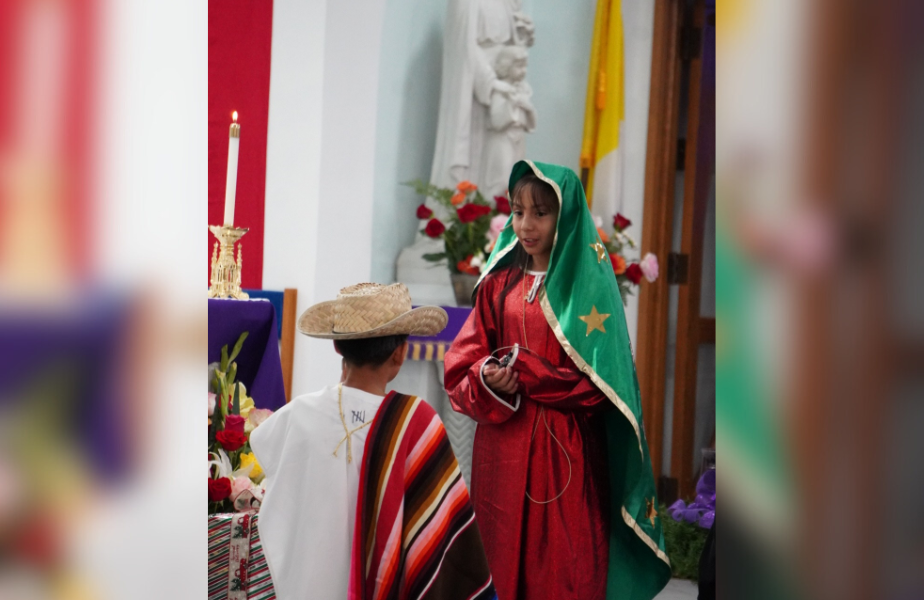
This year’s celebration included a schoolwide Mass, flowers brought in honor of Mary, a procession to the church singing “La Guadalupana” and a student-led reenactment of the story of Juan Diego and the Blessed Mother. Together, the liturgy and the dramatization did what Catholic education does at its best: it formed hearts through beauty, making faith tangible, memorable and shared across generations.
(Photos provided)
Why Our Lady of Guadalupe Resonates So Deeply
The story of Our Lady of Guadalupe is inextricably linked to the faith and cultural identity of millions of Catholics across the Americas. In 1531, Mary appeared to a humble Indigenous man, Juan Diego, and asked him to carry her message to the bishop. The bishop doubted the young man until Juan Diego opened his tilma to reveal fresh roses, which were out of season, and also Mary’s miraculous image.
For many Latin American Catholics, Our Lady of Guadalupe is not an abstract symbol; she is a mother who draws us close, especially those who feel overlooked.
Guadalupe celebrations traditionally include a festive Mass and a reenactment of the story, often with children carrying roses placed before her image. At Escuela, the reenactment is led each year by fifth graders.
Alexa Guadalupe portrayed the Virgin Mary this year. She had been thinking about it for a long time.
“I told Miss Miriam last year that I wanted to be the Virgin,” she explained, remembering how moved she felt, watching a fifth grader do it the year before.
When asked why it mattered to her, she didn’t hesitate: “Because it’s my saint and because I really like the Virgin Mary.” She spoke, too, about the miracle and the image on Juan Diego’s tilma, describing it with the straightforward awe of a child encountering something holy and mysterious.
Solomon portrayed Juan Diego. Like Alexa, he asked for the role well in advance. He told his teacher he wanted to be Juan Diego because his brother had played the part before, which inspired him to do it, too. When asked what he thought of Juan Diego’s story, Solomon said simply, “I think Juan Diego’s story is amazing,” describing Juan Diego as “a messenger for the Virgin Mary.”
These aren’t “performances” in the usual sense. They are acts of faith formation — students entering the story with their whole selves.
Dr. Freeburg explained why this matters: when students participate in Mass as lectors, choir members and gift-bearers, and then watch peers reenact the Guadalupe story, faith becomes something they can do, not just something they hear about. It’s especially powerful, she said, because younger students are “locked in” watching older students, not adults on a stage, not a video, but kids who are “more or less their own age.” In this way, students see themselves in the role, and the reenactment becomes real for them.
Why Escuela is Named for Our Lady of Guadalupe
Escuela de Guadalupe was founded to serve families in a community that desperately needed hope and opportunity. In 1996, Father Tom Prag, SJ, was sent to Denver with a simple mission: listen. He and Sister Susan Swain, SL, learned that what parents wanted most was a quality education for their children. In 1999, that vision became Escuela de Guadalupe.
So why was it named Escuela de Guadalupe?
Dr. Freeburg says that the reason is deeply consistent with the school’s purpose: honoring faith, language and culture in a way that reflects the people the school serves.
“The community that we serve has a deep devotion to La Virgen de Guadalupe,” she shared.
She also pointed to the way Mary appears in the Guadalupe story: as La Virgen Morenita, looking like the people of that region, and appearing to Juan Diego, “this normal, average person.” For Escuela, that’s not incidental. It’s a model.
As Dr. Freeburg describes, Escuela de Guadalupe offers an “integration of language and culture and faith” that is authentic, embodied and rooted in families’ sacred cultures and traditions.
That same integration is visible in the school’s everyday life. Escuela de Guadalupe welcomes families from over 15 different countries, and it is Denver’s only dual-language, Catholic school of academic excellence. The school’s mission is to provide an academically excellent Catholic education in English and Spanish, cultivating the next generation of community leaders.
And the outcomes are as remarkable as the story is inspiring: Escuela students outperform their peers in Denver Public Schools and across Colorado in reading and math. The school also boasts a 12:1 student-to-teacher ratio, offers over $1.4 million in scholarships annually, and 97% of eighth graders are accepted into their first-choice high schools.
Priests, Novices and a Living Picture of Vocation
This year’s Mass was celebrated by Father Drew Kirschman, SJ (a member of Escuela’s board and the novice director for the Jesuits USA Central and Southern Province), Father Daniel Mora, SJ, and Deacon Pablo Salas. Approximately 15 Jesuit novices also attended the Mass.
For students, seeing a community of young men actively discerning the priesthood makes vocation real. Dr. Freeburg called it “a really good model of vocation that’s right there for our kids to see.” She also shared that Jesuit novices serve throughout Denver as part of their formation, including time spent at Escuela.
This representation of vocations means that Escuela students learn about the Catholic faith not only through instruction, but through proximity, watching people live it with courage and joy.
A Living Devotion, Not Just a Feast Day
For more than 20 years, Principal Mariella Robledo has maintained the presence of the Virgin Mary as a visible and intentional presence across campus. Outside, a statue of Mary greets the surrounding neighborhood. Community members walking by often pause, making the sign of the cross, leaving flowers and offering quiet prayers. Inside, near the main office, a tall statue of Mary stands as a daily reminder of who this school belongs to. Robledo keeps fresh, blooming flowers there year-round.
Asked what Mother Mary means to her, Robledo answered without hesitation: “Well, she’s my mother, she’s my intercessor, she’s my messenger, and I believe that through the Virgin Mary, all our messages reach their destination — God — directly.”
She added, “And of course, for us, she is always the mother.”
That is the heart of what students witnessed at Mass: a faith that is not distant, but close. A mother who listens. A people who bring flowers. A story reenacted so children can remember that God still meets us in ordinary places and still chooses humble messengers.


