
The Archbishop Who Walked the Way

Archbishop Aquila’s Journey of Faith, Humility and Mission with the Neocatechumenal Way
A large group of young pilgrims drew near the center of the historic city of Santiago de Compostela when, from a nearby alley, they were suddenly attacked. As objects flew and insults filled the air, one man stood at the head of the group, calm and undisturbed. That man was Denver Archbishop Samuel J. Aquila, who had joined a group of 700 youth from the Neocatechumenal Way during the 2023 World Youth Day in Lisbon.
“His face was serene; he had no problem being attacked for the name of Jesus Christ. It was something amazing and beautiful to see,” recalled Francesco Gennarini, who, with his wife Seila, leads the Neocatechumenal Way in Colorado.
For those who witnessed it, the moment remains unforgettable: a powerful image that both reveals and conceals the depth of his character. It stands as a testament to the care and example he offered his flock as Archbishop of Denver, and, in particular, to those whose faith has been shaped by the Neocatechumenal Way.
As he steps into retirement, one may ask young and old alike about his impact and consistently see the pillars that will define his legacy among the brothers and sisters of the Way: his fatherly closeness and care, his extraordinary zeal for mission, and the humility and prayerfulness with which he did it all.
This was not his original attitude, however. As he would later confess, he initially approached the Way with a degree of skepticism and had to pass through the uncomfortable process of exploration and encounter. The process was not immediate, but for Archbishop Aquila, it proved definitive.
The Change Along the Way
“The Neocatechumenal Way is an itinerary of Christian initiation which is comparable to OCIA [Order of Christian Initiation of Adults], but it’s not only for people preparing for Baptism; it’s also for those who have already been baptized,” Gennarini explained. “Many people are baptized today, but the gift of divine life doesn’t appear in them. That’s why it’s foundational to rediscover the immense graciousness and the gift of divine life that is given to us in Baptism through a catechumenate.”
This is especially true in a time in which the Church is not only combating secularization, but also the rise of new creeds and neo-pagan practices, he said. It was precisely the immense fruits borne amid modern challenges that led Pope St. John Paul II to recognize the Way “as an effective means of Catholic formation for society and for the present time” (Letter “Ogni Qualvolta”).
But what exactly led Archbishop Aquila to do the same in the Archdiocese of Denver?
Participants of the Way recall, with particular affection, his 2018 Denver Catholic column titled, “From skepticism to gratitude: My experience of The Way,” in which he shared his journey of discovery. He recounted his first encounter with the Way and the mixture of amazement and hesitation he felt upon hearing the testimonies, to the point that he was compelled to ask himself: “Who do I believe, the world or Jesus Christ?” This question marked the beginning of a journey that, many years later, would move him to pray for the growth and acceptance of the Way in the Archdiocese of Denver.
“It was a bold statement and a big sign of love,” recalled Abel Corral, a parishioner of St. James Parish in Denver, where he serves with his wife, Christine, and their six children. “I was happy to see that the Holy Spirit touched him in that way and that he was able to recognize the fruit of this charism. The Lord calls people in many different ways, and this is one way in which he calls people to be recatechized and live out their Baptism.”
This breakthrough was accompanied by another act that required no less courage. During a retreat of the Neocatechumenal Way attended by many United States bishops, several expressed reservations. Having listened attentively, Archbishop Aquila then spoke.
“In front of the doubts of many bishops, he stood up in support of the Way and this itinerary of Christian initiation, and he shared his experience to help them understand its nature,” Gennarini said. “It was beautiful.”
What many don’t know is that these acts of public approval were the fruit not only of what he had heard, but of the journey he himself had walked. In fact, many recall, with amazement, that their own archbishop lived the entire itinerary of Christian initiation through the Neocatechumenal Way like any other person.
Derek Abrahamson, an active parishioner at St. Louis Parish in Englewood, along with his wife, Luisa, and their children, clearly remembers the impression this left on him.
“I remember seeing him coming to these meetings, many of them in the seminary, and seeing how he was just one of us,” he said. “It reminded me of St. Augustine, who said, ‘For you, I am a bishop; with you, I am a Christian.’ I saw that clearly in him. He wasn’t above anyone. He was there to nourish his spirit. I saw a man who was being nourished — and that was my archbishop. It was very touching to see.”
(Photo by Kaylee Stoll/Denver Catholic)
The Man Behind the Miter
For Gennarini, the loving attitude and openness he showed toward the Way point to something deeper: they reveal a character shaped by a desire to follow in the footsteps of the Good Shepherd.
“There are often prejudices and divisions even among Catholics about how to live the Christian life, and he went beyond all that and looked at the needs of each person and each reality with a pastoral heart,” he said. “He would accompany anyone. The Good Shepherd carried the lamb on his back, and that’s what Archbishop Aquila desired to do with everyone that he encountered.”
According to those who encountered him, even briefly, his closeness, humility and fatherly care stood out. While a bishop can often seem distant, many faithful experienced quite the opposite.
Derek and Luisa recall how, in moments of closeness, formalities quickly disappeared because of his simplicity and sincerity. They especially remember the joy of being able to cook for him on several occasions.
“For me, it was always a privilege to be asked to cook a meal for him,” Luisa said. “I see him like a father, and whenever I come across him, I always feel a strong urge to say hi. I’m Italian, and from the beginning, that created an immediate bond. Now he always speaks to me in Italian.”
“I remember when I cooked for him and our pastor for the first time in the backyard of St. Louis Parish,” Derek added. “It didn’t feel like I was cooking for the archbishop but just for my pastor and his friend. He shows a spirit of humility, but it’s genuine humility. It’s hard to describe. It’s not that he tries to display it because he’s the archbishop. There’s just a natural humility that is very touching to see.”
Like many others, Gennarini also experienced firsthand the joy with which Archbishop Aquila interacted with families.
“Personally, I was amazed that he would come to our house and spend time with our kids in a fatherly and even grandfatherly way. It was enriching for us, and he found it enriching as well. It was always encouraging to us that he would spend time with us, join us in a moment of prayer, and give us his blessing,” he said. “To have his personal blessing and support in moments of difficulty and even crisis has always strengthened us in our marriage and mission without giving in to discouragement.”
A Heart for Mission
The encouragement he gave to priests, seminarians and families flowed in large part from his life of prayer and missionary zeal.
Father William Clemence saw it firsthand as rector of the Redemptoris Mater Seminary, an archdiocesan missionary seminary rooted in the Neocatechumenal Way.
“Archbishop Aquila has had a great heart for the evangelization of the world, such that he has sent priests ordained from the Redemptoris Mater Seminary on mission throughout the world more than all his predecessors combined!” he said. “Archbishop’s prayers and support for the seminaries have been visible, and the Lord has answered with the blessing of an increase in vocations lately. Other fruits are the men who have been ordained to the priesthood during his years as Archbishop of Denver and the priests who are currently serving the Church in mission in different places, like Italy, South Africa, Latvia, Chile, Ecuador, Philadelphia, Florida and Oregon.”
Father Clemence and many seminarians at Redemptoris Mater always appreciated that Archbishop Aquila would celebrate the Eucharist with them regularly and join them for dinner afterward.
“I have seen his loving concern for each of the seminarians. He knew them and prayed for them. As the archbishop, he accompanied them and was present for the different important stages of their seminary formation. He always had a word of encouragement for them,” Father Clemence added.
Similarly, many priests have been uplifted by his leadership and support in challenging matters, his constant calling to develop a deep relationship with God, and the urgent need to evangelize. Father Felix Medina, pastor of Queen of Peace Parish in Aurora, considers this to be one of the greatest spiritual marks that the archbishop leaves in the Archdiocese of Denver.
“He has set the archdiocese on a path to evangelize on solid foundations: foundations of faith, a true relationship with God and fidelity to the teachings of Christ, the Church and Tradition,” he said. “Much of the ministry of Christ consisted in forming true disciples and witnesses of the Gospel. And this has been a great aspect of the ministry of Archbishop Aquila: his desire to form apostles, authentic witnesses of Christ, which requires training, catechesis, not settling for how things are now, but bringing the Church to an apostolic age, a missionary age.”
Gennarini observed that these important decisions were the fruit of much prayer.
“I’m sure the governance of a diocese is quite an impossible task, with its challenges and difficulties,” he said. “But as a good shepherd, Archbishop Aquila was always very prayerful before making big decisions. He allowed the Holy Spirit to show him the way. And this had a great impact in guiding the Archdiocese of Denver to become a missionary diocese, one that continues the New Evangelization that St. John Paul II proclaimed here in Denver.”
A Fruitful Itinerary
The fruits of the Neocatechumenal Way, greatly strengthened by Archbishop Aquila’s support and closeness, are too many to count. From a rise in vocations to the priesthood and consecrated life, to numerous marriages and a greater openness to life, his witness has encouraged families to hand on the faith to new generations and to proclaim the good news with renewed fervor.
“The bishop is instrumental because he gives permission to give catechesis, so without his support and blessing, we can’t go catechize,” Carrea said. “Not only has Archbishop Aquila encouraged us, but he has also allowed us to knock on doors, to announce the Good News, to talk to pastors and ask if they’re willing to have catecheses begin in their parishes. Because of that, there are now many parishes and communities in the archdiocese. There are many families that would have never heard the Good News, a lot of marriages that would have ended in divorce, many children who either would not have been born or who would have been aborted, and many people who would have committed suicide. Along with vocations, I think this is the greatest fruit.”
As many would testify, those who have followed the itinerary of the Way do not say these things lightly, as many of them, or their closest friends, were once on the verge of these catastrophic ends.
For Abel Corral and his wife, Christine, this journey not only saved their marriage but also breathed new life into it, giving them a missionary purpose and a growing family. For Derek Abrahamson, it entailed leaving the emptiness of atheism and marrying Luisa. And for Francesco Gennarini, this entails working alongside his wife, Seila, to pass on to their eleven children — and to numerous other families and individuals — the great fruits he himself received from his parents.
A Fitting Farewell
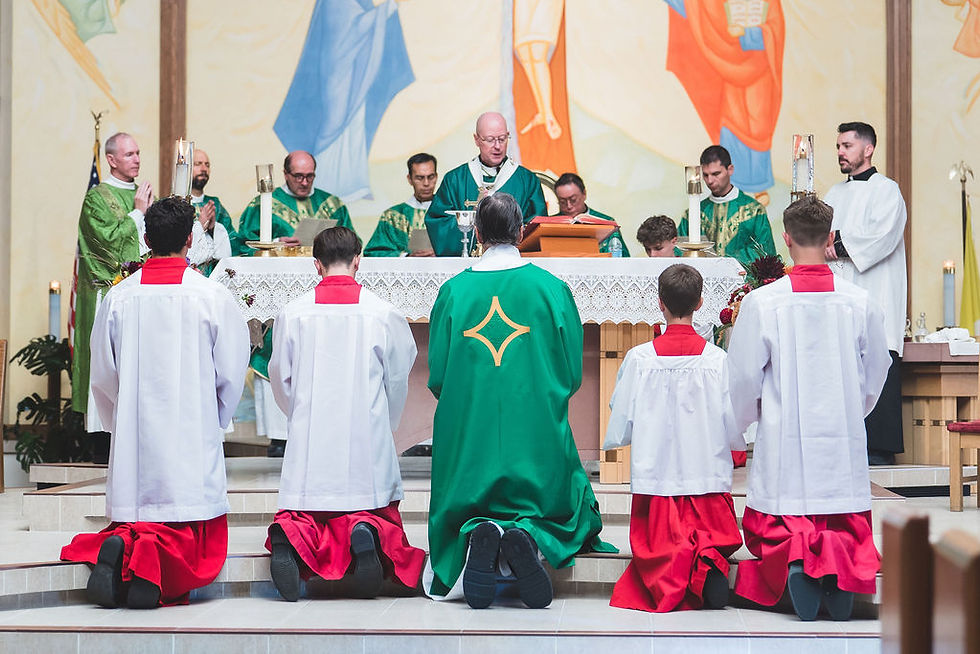
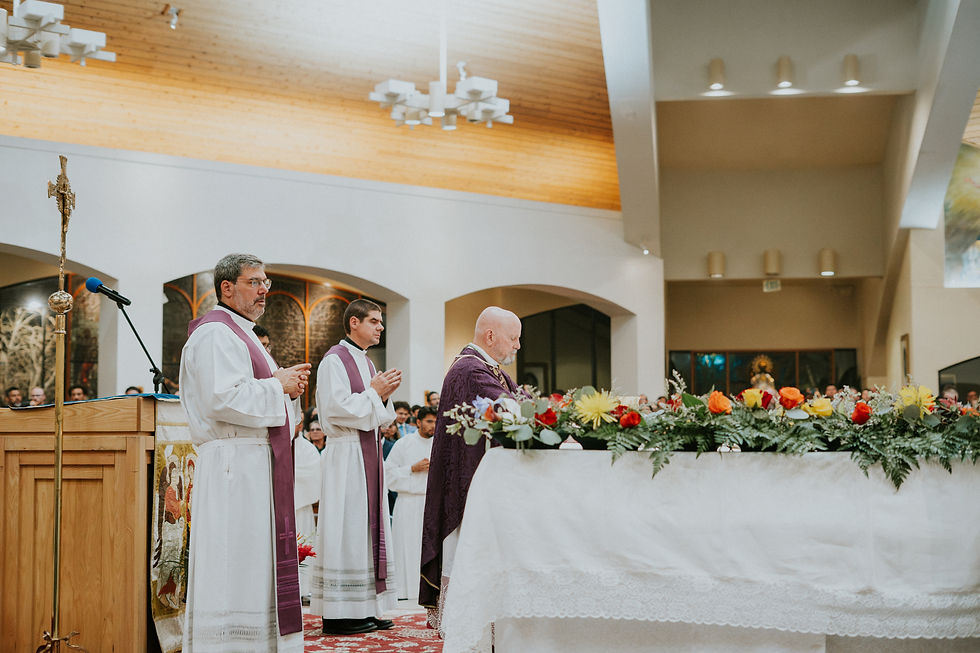
Offering all these fruits to God in thanksgiving, Archbishop Aquila brought his journey with the Neocatechumenal Way to a heartfelt culmination on March 21, joining priests, catechists and many participants of the Way for a farewell Eucharistic celebration at Queen of Peace Parish.
Reflecting on the resurrection of Lazarus and the promise of resurrection in the Book of Ezekiel, he reminded the faithful that God is always faithful to his promises, even in times of suffering and persecution.
“[God] says, ‘I have promised, and I will do it.’ Do we truly believe that? This does not mean that he promises us an easy life, because the Cross is at the center of the Gospel. Instead, he says: ‘As the world has hated me, so it will hate you.’”
Reflecting on their door-to-door evangelization and the animosity they experienced in Santiago de Compostela, he encouraged them to continue and not give up.
“As he was persecuted, so will you be persecuted,” he said. “But we can rejoice in that. As the Lord tells us: rejoice when they do these types of things to you, for the sake of his name.”
Archbishop Aquila concluded by expressing his gratitude for the Neocatechumenal Way and assuring his continued prayer for all the faithful as he concluded his time as Archbishop of Denver.
“My sisters and brothers, one of the great gifts of the Neocatechumenal Way is the deepening of the encounter with Jesus Christ, with the Father, with the Holy Spirit, with Mary our Mother,” he said. “My biggest prayer in these thirteen and a half years that I have served as your shepherd is that you have come to know in a deeper way the love of the Father, of Jesus, and the Holy Spirit; that you have come to know the Good News and the kerygma; that you are being filled with the joy of the Gospel, and that you will bring that, as missionary disciples, to others.”
A farewell is never easy for someone whose presence has become like that of a father. In the overflow of affection and the silence that often accompanies moments too great for words, the faithful of the Way may simply be able to utter, with Luisa, a deep and heartfelt: “Grazie, ci mancherai! — Thank you, we will miss you!”