


‘Be Not Afraid’: How St. John Paul II’s Legacy Keeps Forming Colorado

Across Denver and Northern Colorado, schools, a camp and a parish find their mission in the life of a Polish priest-turned-pope and saint.

As we celebrate Pope St. John Paul II’s birthday, May 18, at least four Colorado ministries bearing his name are living out a legacy that reaches well beyond his iconic 1993 World Youth Day visit to Cherry Creek State Park. From high schools to a parish in Thornton to a camp in the mountains, the great saint’s vision continues to take root, often in unexpected places.

From a Cafeteria to a Church
In Thornton, Father James Spahn has spent nine years building a parish in a school cafeteria, doing so gladly.
St. John Paul II Parish began when the Archdiocese asked Father Spahn, then-pastor of Immaculate Heart of Mary Parish in Northglenn, to start a new community to fill a gap in the north Denver metro area. The parish met first in the gymnasium, then the cafeteria, of what is now Frassati Catholic Academy.
The cafeteria was eventually converted into a proper chapel, which Archbishop Emeritus Aquila dedicated in September 2025. As the community grew around them, the parish needed a larger space. Construction is underway, with the new church expected to open in roughly 18 months.
“We do have a great community, and we have a great patron saint,” Father Spahn said.
In 1993, as a young seminarian, he served every papal Mass during John Paul II’s Denver visit, helped coordinate the world’s cardinals and bishops at their hotel and drove Cardinal Eduardo Pironio, the man in charge of World Youth Day, through the city all week. He was in John Paul II’s presence every day. He shook his hand. He kissed the papal ring. Sometimes, in the fog of holy awe, he forgot.
“I was in such awe being in his presence,” Father Spahn said. “This is the pope, the successor of St. Peter, but also, his holiness radiated. It made me in a state of just utter, complete awe.”
That experience shaped the priest he became. Father Spahn draws on John Paul II’s Theology of the Body when preparing couples for marriage, and on the New Evangelization when he considers how to reach adults who arrive at his door, having never been baptized. They've gone even deeper into this, as their director of faith formation is currently pursuing a degree through the Theology of the Body Institute to teach theology of the body.
Every summer, the parish hosts the Totus Tuus (Latin for “Totally Yours, Mary,” a phrase popularized by Pope St. John Paul II) program for youth, which draws a tremendous turnout. A number of the parents have attended multiple World Youth Days around the world and are raising their children based on their experience with the Holy Father.
“When people come to me, God’s already been working in their life,” Father Spahn said. “The Holy Spirit has already been touching their heart and mind, or they wouldn’t be coming to our door.”
He sees that as evidence of John Paul II’s ongoing intercession for an archdiocese he once called a personal highlight of his entire pontificate. According to Father Spahn, the late pope shared with Cardinal Francis Stafford, years after World Youth Day, that his time in Denver was “a real highlight for me, a real blessing for me as pope.”
“It was a profound time for him,” Father Spahn said, “and it continues to bear fruit.”
The Camp That Bears His Name
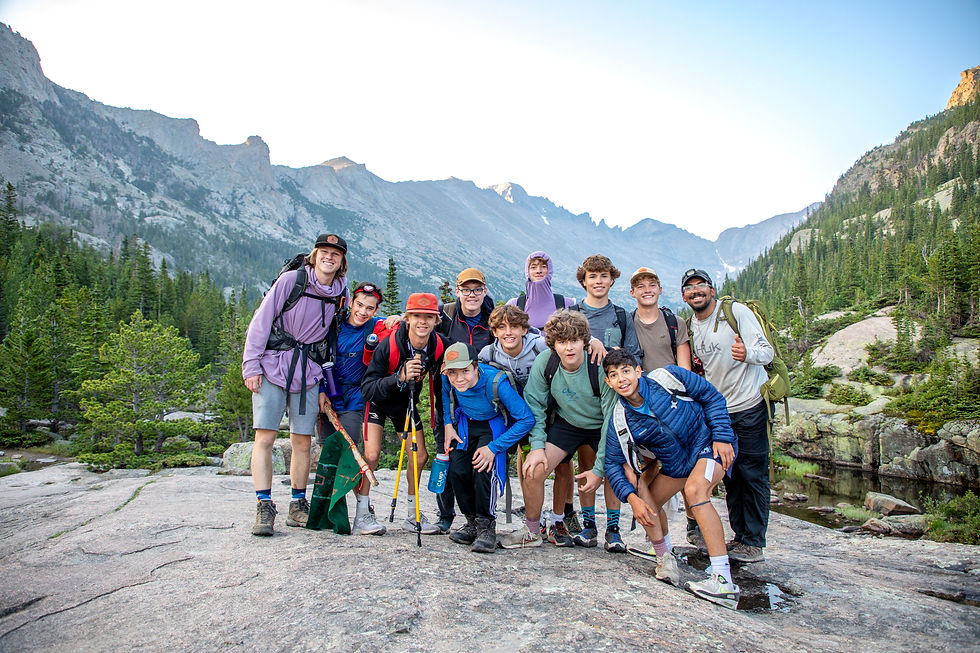
Annie Powell was in high school when a speaker at a youth conference asked her to write a mission statement for her life. She wrote down her loves: the Lord, adventure and the outdoors. Thus the idea for Camp Wojtyla was born, even if she didn’t yet have a name for it.
“It’s a story of the Holy Spirit,” Annie said. “I really feel like camp exists because God wanted camp to exist.”
She and her husband, Scott, who met while both were serving as FOCUS missionaries, launched the camp in 2006, welcoming their first group of 48 campers the following summer. That first year was held at Camp St. Malo, precisely the location the saintly pope visited and hiked during World Youth Day 1993.
Jeff Hoeben, the camp’s director of mission sustainability, says this camp is a way of sharing that legacy with a new generation.
“So many of us witnessed the power of all of these Catholics coming together [for World Youth Day], and I think it just implanted in us a desire to have that experience, and to share that experience, and to provide that experience, for our kids, for our campers," he shared.
For co-founder Scott Powell, World Youth Day had already planted a seed years earlier, one that would eventually grow into the camp itself. The experience left him with questions he couldn’t set down.
“Hearing the words of John Paul II, seeing him rally all of these youth like a rockstar, began to make me ask bigger questions,” Scott recalled. “Who am I, really? What is the Church all about? And what is this ‘life to the full’ that the pope keeps talking about? All of this began to fuel the dream that would eventually take shape in Camp Wojtyla.”
That spirit of adventure as formation, creation as classroom, is what drew the founders to the name Wojtyla rather than John Paul II. It honors the man he was before the white cassock, the young priest who skied, kayaked and led students into the Polish wilderness during communist occupation, teaching them the truth about their dignity when the state had made it illegal to do so.
Today, Camp Wojtyla serves roughly 575 campers each summer, drawing participants from all 50 states. Since its founding, the camp has served more than 6,400 young people, and the fruit is measurable: 22 ordained priests, 13 religious sisters, five religious brothers and 21 young people currently in seminary trace a significant part of their vocational journey to the camp’s trails and teepees. Three of the four men ordained to the priesthood in the Archdiocese of Denver this spring were Camp Wojtyla alumni.
Camp Wojtyla is believed to be the only camp in the country bearing that name, a distinction Hoeben acknowledges with some pride.
“Nobody was brave enough to take that Polish name on,” he said with a laugh.
Built on the Man Behind the Pope
In Windsor, a young classical high school bearing John Paul II’s name is preparing for its most significant milestone yet: its first permanent campus.
John Paul II High School, which began in 2019 and welcomed its first students in 2021, is set to open its newly constructed building in August, just in time for the incoming class. Tim Gallic, the school’s president, describes the institution as classically minded by design, a choice that naturally connects with the intellectual tradition John Paul II himself embodied.
“Much of the way John Paul II was taught would be considered classical today,” Gallic said. “You look at his writings, and they reflect the man who knows those who came before him, who goes back to the original sources.”
Theology of the Body, he said, is the clearest example, a fresh synthesis built on ancient foundations.
“He took this wonderful base of knowledge and formulated it in a remarkably new way,” he explained.
For Gallic, the school's connection to its patron is less about the papacy than it is about the man, Karol Wojtyla, who grew up under Nazi occupation, lost his parents young, studied for the priesthood in secret and refused to let any of it extinguish his joy.
"One of the things we can show the kids is you're not bound by the circumstances of your birth," Gallic said. "Here's a guy who could easily have said, 'Oh, the heck with it.' My parents are dead. I live in a slave country. I've been attacked. And instead, he said, ‘No, I'm going to have hope in Christ Jesus.’ And we've all benefited because of it."
That’s what Gallic says he most wants students to carry from the school’s patron: not the fact of the papacy, but the person behind it.
“John Paul II was amazing, and he was pope,” Gallic said. “He wasn’t amazing because he was pope. He was amazing, and he was pope.”
Among the school’s handful of graduates so far, two are already in seminary. Others, Gallic said, are simply living as joyful young Catholics, which, in his view, is exactly the point. The school plans to mark its patron’s feast day on Oct. 22 with a Feast Day Fest, an open house welcoming the community to its new campus.
Formed for Something Higher
In Denver, a second school bearing the same saint’s name is asking similar questions through a different lens.
“Our mission states that we exist to form disciples of Jesus Christ, and in many ways that mission is directly inspired by Pope St. John Paul II’s deep love for young people,” said Ed Lugo, John Paul the Great High School’s vice president of human formation. “He never viewed young people as problems to manage, but as men and women capable of sanctity, leadership, courage, and transforming the world around them.”
That conviction shapes something concrete about the culture of the school, Lugo said, an environment designed to support students while also holding them to something higher.
“Young people today are often underestimated,” he said. “Pope John Paul believed the opposite. He believed they were hungry for truth, purpose, beauty, sacrifice and authentic relationships, and we have found that to be true as well.”
For Lugo, that distinction shapes everything.
“We try to avoid reducing education to simply academics, college placement or extracurricular success,” he said. “Those things matter, but our deeper mission is to help students discover who they are before God and who he is calling them to become. Everything we do, in the classroom, in athletics, on retreats, in service opportunities and in the ordinary life of the school is ordered toward helping students encounter Christ and grow into mature disciples who can live their faith with confidence and joy.”
John Paul II’s own example, Lugo said, makes one thing clear: holiness and human excellence are not in competition.
“Pope St. John Paul the Great had an extraordinary ability to call young people beyond comfort and mediocrity,” Lugo said. “We want our students to understand that holiness is not opposed to adventure, excellence, intellect or joy; it is what gives those things their deepest meaning.”
Ultimately, Lugo said, the school hopes to send graduates into the world carrying a conviction that was central to John Paul II’s relationship with youth.
“We hope our students graduate knowing that the Church believes in them, that they are deeply loved by Christ and that their lives have a real purpose and mission in the world,” he said. “That conviction was at the heart of John Paul II’s relationship with young people, and it remains at the heart of our school today.”
A Legacy Still Unfolding
Reflecting on the first 20 years of the camp that bears John Paul II’s given name, Annie Powell said the organizations seem to share something more than a patron saint.
“The way John Paul II really saw the whole person and really taught people of their dignity, he elevated everything,” she said. “He helped everyone understand more the very special quality of where God was present in their everyday. And I think those missions probably all play on that, and we want to give that to young people.”
She paused.
“He was, like, our grandpa, you know? He was the only pope we ever knew,” she continued. “And he really formed our understanding of the Catholic faith.”
On the mountain, in the cafeteria-turned-chapel and soon-to-be new church, in new school buildings, the lesson of human dignity Pope St. John Paul II spent a lifetime teaching continues to take root and flourish, generation by generation.
Be not afraid.


