
Russian reset required in Rome

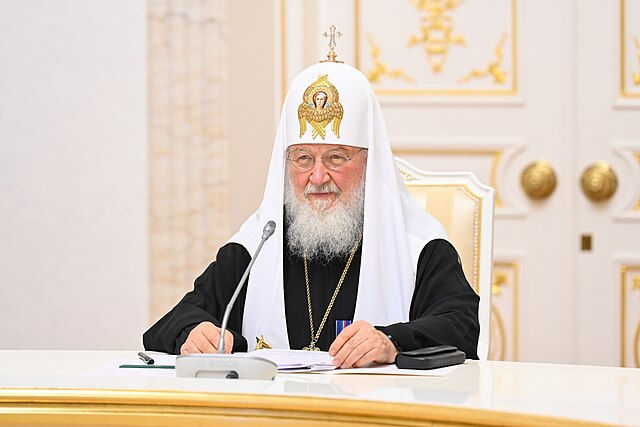
When Patriarch Kirill of Moscow and All Rus’ was head of the Russian Orthodox Church’s external relations department, he would occasionally come to Washington, where the Librarian of Congress, James Billington, a distinguished historian of Russian culture, would host a small dinner for him. I was a guest on one such occasion, and the impression Kirill left that night remains in my mind: sophisticated and clever (in the British sense of the word); linguistically gifted; capable of charm; and a politician to his chromosomes. This should not have been surprising. A few months short of his 26th birthday, then-Archimandrite Kirill was posted to the World Council of Churches in Geneva; and in 1971, the only way a young Russian cleric would get that plum assignment was if he were on the leash, and perhaps the payroll, of the KGB, the Soviet security service.
As patriarch, Kirill has allied himself with another old KGB hand, the mass murderer and child-kidnapper Vladimir Putin, in Russia’s war to destroy Ukraine. What that has meant for his Church is detailed in a report from the Free Russia Foundation, The Russian Orthodox Church and the War. The gist of the report is contained in the Introduction:
In early March 2022, as Russian troops occupied Bucha and Hostomel, Patriarch Kirill declared during a sermon at the Cathedral of Christ the Savior: “Russia is waging not a physical, but a metaphysical battle against the forces of evil in Ukraine.” He framed this war as a struggle against sin, stating that it “has not only political significance” but is directly connected to the salvation of humanity — thus giving it religious and sacred justification. Since then, the Church has engaged in the war on several fronts: Propaganda and ideological support; Direct interaction with the military and presence at the front — “mystical support” involving sacred artifacts, prayers, and rituals to sanctify the war effort; Diplomatic manipulation abroad — advancing Russian interests within international ecumenical organizations, Orthodox countries, and through espionage activities.
The Moscow Patriarchate has a TV channel, “Spas,” which reaches every Russian household free of charge. A few months after the war began, Kirill preached a sermon on “Spas” in which he declared that any Russian soldier who died in the war would have all his previous sins automatically washed away — a heresy. Even worse was the “Spas” documentary entitled “God at War,” which is blasphemy.
One may well question how many of the Russian soldiers Putin is feeding into the meat grinder believe this vile propaganda. Irrespective of how that question is answered, it seems to me that The Russian Orthodox Church and the War is essential reading for everyone in the Holy See who is involved in Vatican diplomacy or Vatican ecumenism. Diplomacy and ecumenism may seem two distinct fields of Vatican endeavor. In this instance, they are closely related.
When I was a rookie Vaticanologist in the early 1990s, extensive conversations with the leaders of what was then the Pontifical Council for Promoting Christian Unity made me aware of a strategic concept that had become bureaucratically embedded in both the ecumenism shop and the Vatican “foreign ministry,” the Second Section of the Secretariat of State. That concept began to form in the mid-1960s and might be summarized in the phrase, “The road from Rome to Constantinople runs through Moscow.” In other words, the re-composition of Christian unity and the restoration of full communion between the Bishop of Rome and the Ecumenical Patriarch of Constantinople required, as a prerequisite, reconciliation with the Russian Orthodox Church, the largest of the Orthodox churches.
Whatever pragmatic sense that might once have made, “The road from Rome to Constantinople runs through Moscow” is now theologically absurd, because the leadership of the Russian Church has abandoned Christian orthodoxy, as demonstrated by Kirill’s heretical and blasphemous statements over the past three-plus years. Clinging to that strategy has also impeded the moral witness of the Holy See, as seen in the hesitancy (to put it charitably) of the Vatican to name and condemn the aggressor when Russia invaded Ukraine in February 2022.
Had a Russian blitzkrieg conquered Kyiv back then, the Catholic leader of Ukraine, Major-Archbishop Sviatoslav Shevchuk, was scheduled for immediate liquidation. Ukrainian bravery prevented his martyrdom. But some people never quit: during the recent papal interregnum, Major-Archbishop Shevchuk was being tailed in Rome by agents of the FSB, successor to the KGB.
Those instructive experiences, plus a close reading of the Free Russian Foundation’s report, should lead to a bottom-up review of Vatican ecumenical strategy toward the Christian East, and its relationship to Holy See diplomacy vis-à-vis a revanchist Russia.