

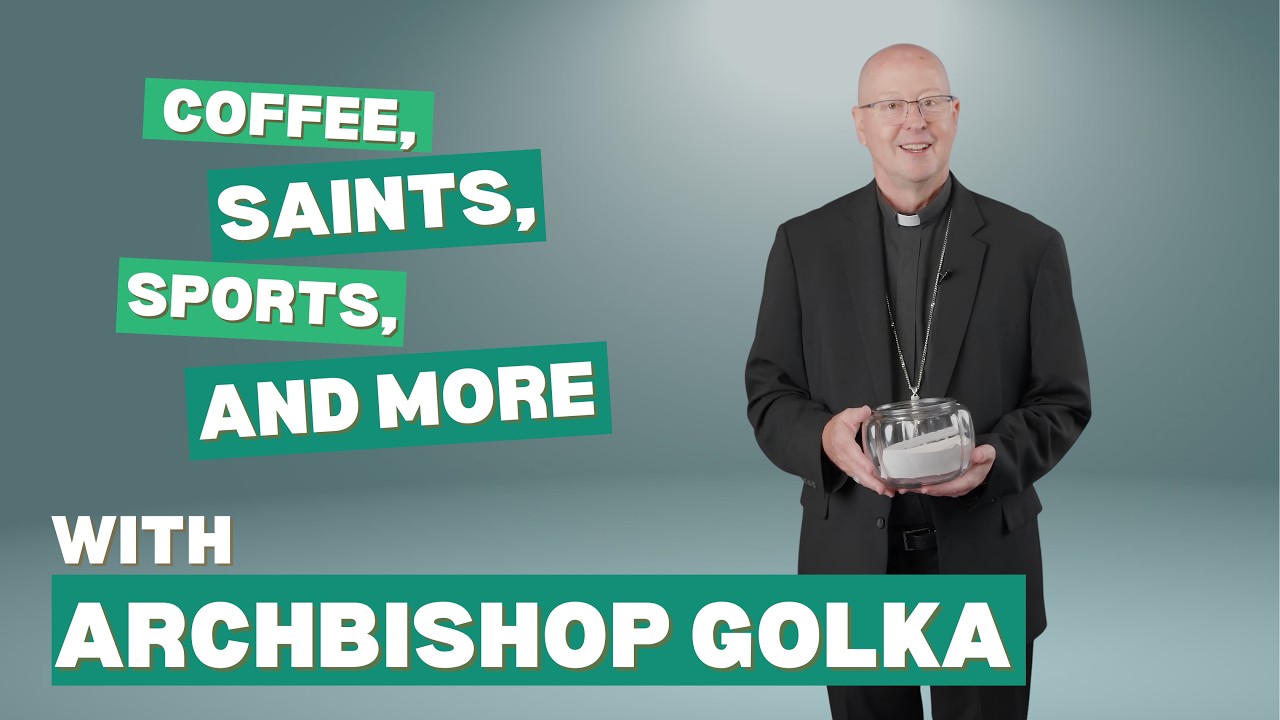
Q&A: Archbishop-designate Golka Shares His Heart

Denver Catholic sat down with Archbishop-designate Golka ahead of his March 25th Installation as the sixth Archbishop of Denver.

Before being installed as the sixth archbishop of Denver, Archbishop-designate James Golka spoke to the Denver Catholic on Feb. 24 in Colorado Springs about his family, faith and vocation.
From a large Catholic family in Grand Island, Nebraska, he most recently served four and a half years as Bishop of Colorado Springs. His mother, Patricia Golka, died Jan. 5. His father, Robert Golka, died on March 5, a few days after this interview.

DC: What was it like growing up in Nebraska as the fourth of 10 children in the Robert and Patricia Golka family?
+Golka: I'm so blessed to be born into the family that I had. My mom and dad were incredible parents. They somehow passed on the faith to their children. I say somehow, but it was because they practiced their faith regularly and lived it daily in the house.
I learned how to pray by watching my mom pray at night. She would come into our room, sit on the bed and talk directly to Jesus. I would think, Oh, she really thinks Jesus is there. He must be there. And I learned to do the same thing.
The day my mom's mom died, my grandma, I was maybe 11 years old. I remember clearly thinking, This must be the worst day of my mom's life. She got us together, put us in the car, drove us to church, went in and knelt in the front row where we normally would sit. She just talked out loud to God, thanking God for the gift of her mom and giving her mom back to God. I thought, Huh, this must be how you do it.

DC: What were you like as a boy, and what did you like to do?
+Golka: I’m a shy introvert by nature. God made me a bishop and now an archbishop, so I kind of laugh at that. It’s a big arena for a shy introvert.
I loved playing sports. We were outside all the time. There were kids all over the neighborhood, and we would gather regularly. Sports were an easy avenue for me.
Next door was a boy who was a month older than me. He and I were best friends growing up and did everything together. It was great to have that. And with a family of 10 children, there were always kids around to do things with, which could be chaotic. I’m sure we tested mom and dad’s patience, and we siblings didn’t always get along, but there was always togetherness. We always had a family meal together. We went to each other’s games. There was a feeling of support there.
Jim Golka graduates from Grand Island Central Catholic, photographed here in 1985 with his parents.
(Photos courtesy of the Diocese of Colorado Springs)
DC: How did your family pass faith on to you?
+Golka: By practicing regularly. Sunday Mass was not an option; it was just what we did. As we got older, we could have five kids having a sporting event on the weekend somewhere, so it would often begin on Saturday when mom would ask us, ‘Which Mass are you going to?’ We would plan who was going where — some Saturday evening, some Sunday. And that was just part of a built-in thing.
When we were younger, my mom was the pray-er. I remember a time when a cousin was sick. My mom was one of 13 siblings, so I've got over 60 first cousins on her side of the family. Mom gathered us all together — my cousins and all of us — and just prayed out loud to God for my cousin who was sick.
Later in life, my dad became the pray-er. For Thanksgiving, we have about 150 cousins, and they would always look to me to do the prayer. One Thanksgiving, I said ‘Dad, how about you?’ And dad offered the prayer. And we all thought, Gosh, Dad is the pray-er! So now he does the blessings.
DC: Is there anything else you would like to say about prayer?
+Golka: The habit of nightly prayer has continued. Especially while growing up in junior high, high school and college, I would talk to God from my heart. I would usually tell him something I was grateful for and something that I was worried about or needed forgiveness for. I would go through a list of names of people, plus most of my family. I could never go to sleep until I had offered those prayers first.
Jim Golka as a seminarian for the Diocese of Grand Island, Nebraska. Newly ordained Father Jim Golka smiles with Bishop Lawrence McNamara of Grand Island in 1994.
(Photos courtesy of the Diocese of Colorado Springs)
DC: When did you first feel called to the priesthood, and what helped you answer that call?
+Golka: When I was in the eighth grade, my second-oldest brother went to seminary. He was one of my heroes. I thought if he could do it, I could do it. He discerned out at the end of one year, but it just stayed in me.
I went to visit him for a week while he was in seminary [St. John Vianney Seminary in St. Paul, Minnesota]. While visiting, I thought, These are people I relate to; maybe this is what I’m called to do.
When I graduated from high school, I wasn't ready for seminary yet. I wanted to have children and be married because of my mom and dad's example. So, I went to Creighton University [in Omaha, Nebraska]. I wanted a Catholic school to study theology and philosophy. I thought I would either get a PhD and teach at the university or come back and teach theology at a Catholic high school and coach sports, which one of my brothers did. I thought I'd love to do that or be a priest.
I'm glad I went to Creighton because I had a lot of life experiences. I fell in love with a girlfriend that I could have married, but I just felt called elsewhere.
Jim Golka celebrates his 1989 graduation from Creighton University with family. Jim Golka smiles during his Jesuit Volunteer Corps mission in South Dakota in 1990.
(Photos courtesy of the Diocese of Colorado Springs)
DC: You attended Creighton University and, after graduation, served a year in the Jesuit Volunteer Corps working on the Pine Ridge Reservation in South Dakota. Tell me about your college years and your missionary experience.
+Golka: College was great. When I left high school, I remember telling my mom that I was too involved. I was the student body president, class speaker and all these things. I said, ‘I'm just going to go to college to be a student and to make friends. I'm not going to get involved.’ And she laughed and said, ‘We'll see.’
I became a daily Mass goer. It’s easy to go to daily Mass when you have friends to go with you. In my freshman year, I went on a spring break service trip. Creighton sent out about 120 kids to 15 different sites. By my sophomore year, I was organizing those for the college, which I did for the next three years and became very active in campus ministry. Many dear friends helped me on the way. One of those spring break service trips was to Pine Ridge, South Dakota. One of my mentors was Jesuit Father Ed Mathie, who is now at Marquette University [in Milwaukee, Wisconsin]. He lived on the reservation for a long time. He recommended I consider volunteering there for a year.
I knew I wasn't ready for graduate school yet, and I didn't know if I was called to the seminary or something else. I wanted more life experience. I wanted to work among the poor and in a culture I wasn't familiar with. I remember my first day there, looking around at all the Lakota Sioux. I was the only white person in the gathering of 200 people. I thought, Oh, I'm going to learn something here! I thought I would be there for two or three years, but by Thanksgiving, I felt called to become a priest for the Diocese of Grand Island. It was very clear. I thank God for that clarity.
DC: What did you learn from the Jesuits?
+Golka: At Creighton, especially being a theology and philosophy major, the Jesuits became my friends, because I was very active and involved. So, they all assumed I wanted to be a Jesuit. I joke that I wanted to be a Jesuit once for about 10 minutes. Nothing against the Jesuits, I just had a different call — I really felt called to a parish and diocese. I did not feel called to be part of a religious community. Part of that was I saw the most talented Jesuits were put in charge of other Jesuits, which helped their community, but I always thought those gifts maybe should go to the bigger Church.
My first year, I met with their vocations director who was in town, and I said, I think I'm called to be a priest, but not a Jesuit — a diocesan priest. So, every semester, their vocations director would come and take me to lunch and talk about diocesan priesthood. I learned from them how to pray and how to discern. I did a number of five-day and eight-day retreats with the Jesuits. Also, I learned how to think.
I joke that the first theology test I took as a freshman, I aced it, and when the teacher gave it back to me, it had a B on it. He said, ‘I know what I think. I want to know what you think.’ And I thought, Well, this is different. I don't just spit back what I heard someone else say. I really have to consider this. I really appreciated those things.
I've really learned that I don't choose. I need to hear what God wants for me. And that's different. I ask that of my priests: I want to know what you think, but I want to know more what you think God wants of you. My last four assignments are things I never would have chosen myself. But I felt very clear that God wants this, so I have to say yes. And I said this at the [February 7] press conference: Every time you say yes, God prepares you for the next yes. I would never have chosen Denver, but I'm so grateful that God chose it for me, and I can't wait to see what he has in store for us.

DC: Explain what fascinates you about Jesus Christ and how he wants us to live.
+Golka: That's a gift God gave me as a boy, probably from my parents. I wanted to know more about what made Jesus do what he did and say what he said. He saw something nobody else saw. And in him is the presence of the reign of God. And he knew that and lived it. I want that. I want to participate in that with him and to see the world the way he does, because that way, your sight and your mind are toward eternity.
The Church has prayers that I often say to help me to live in this world of passing things with my mind and heart set on those things that never pass. I want to live that way. That's the definition of hope — you live oriented to the things of Heaven. When I live that way, it makes me feel more fully alive, helps me draw closer to him, and I feel his joy when I do that.
DC: What do you like to do in your free time?
+Golka: I have less free time these days. I used to be more active in sports. I used to run, play basketball and softball, and bicycle, but I had a bicycle accident about 17 years ago and broke my neck. It fractured vertebrae in my neck. That limits what I can do. That changed my lifestyle quite a bit. Now I have arthritis in my neck and some chronic pain, so I have to watch that. But I try to golf regularly. That keeps me outside and doing something. When I came to Colorado, I stopped keeping score, and it's just more fun and relaxing. The competitive nature kind of moved away.
I enjoy watching sports, reading, walking and hiking. I enjoy being with family and friends. I try to do annual reunions with seminary classmates. My family gets together regularly, so I try to keep time aside to do that; I need them. I enjoy getting to know people. I'm a shy person by nature, but I love being invited to people’s homes for dinner and just seeing families.
My staff here early on said, ‘We need to get you out of the office more because you are more alive when you're around people.’ They could see that.

DC: What has been the greatest challenge in your four and a half years as bishop in Colorado Springs?
+Golka: I joke, but it's true, that I thought I trusted God totally, then he made me a bishop, so I had to start all over again. It's rarely comfortable to know you need to trust God, but it's always a good endeavor to do so and learn how to do it again. So, on a spiritual level, just that.
And the different level of administration. I'm responsible for every soul in the diocese and for caring for the people of God. The priests have a special place in my heart. If the priests are doing well, if they are growing in holiness, and if they're healthy and happy, then their parishes are going to be that way, and so I'd like to invest in priests to help that happen.
When I came here, we have 39 parishes. It's a challenge to get out to everyone and get to know them, now even more so in Denver.
DC: What has been the greatest joy in your four and a half years as bishop?
+Golka: Learning how to trust God. [Laugh] And having a team around me. When I got here, there were some really good people. And then over time, just developing my own team. People who know I'm utterly committed to them, and I know they're utterly committed to me. Together with that synergy, you can fly farther. God had things in mind that I could not have done myself when I came here. It's been a great joy to watch God do that in and through us. I'm excited to see that happen on another level in the archdiocese.

DC: How do you feel about being named archbishop of Denver?
+Golka: Yesterday, while walking around in Denver, people kept saying they were so excited, and I said, ‘Give me a month, I'll be very excited then. But right now, I'm grieving leaving [Colorado Springs], and I’m still adjusting to it.’ Underneath, I feel a lot of trust and hope, so I trust that.
DC: What are your hopes for your upcoming ministry shepherding the Archdiocese of Denver?
+Golka: I keep coming back to, I don't know why God made me the archbishop, but he knows. I hope we can hear him tell us why and hear him tell us his plan. We don't have to make up a plan. He has one. But we do need to invest in discernment and listening together. So, having a group of people around me to help do that. I've experienced that enough in my life where if you're with a group of people who together discern and know clearly God has revealed such and such to us, it's exciting to go do it.
DC: Is there anything you would like to add or emphasize?
+Golka: Prayer is so important, like individual prayer to listen to God, but also praying for each other. So I've really come to depend on intercessory prayer. I humbly ask people's prayers for me and for the archdiocese. St. John Vianney said something like this, ‘There are no bad priests, only priests for whom enough prayers have not yet been offered.’
There are priests who have done horrible things, and that breaks my heart. But I do encourage people to pray for their priests. We know that social media can be helpful, but also divisive. I encourage people who read news sites that make them angry and upset, and put them against their archbishop or against their priests, to move away from that, because the presence of the Holy Spirit unites us and fills us with joy. It's the other spirit, the Evil One, that leads us to division and anger. In our culture, I'm afraid that's becoming more commonplace, the division and anger. And I would encourage us all to live in a different place than that.


