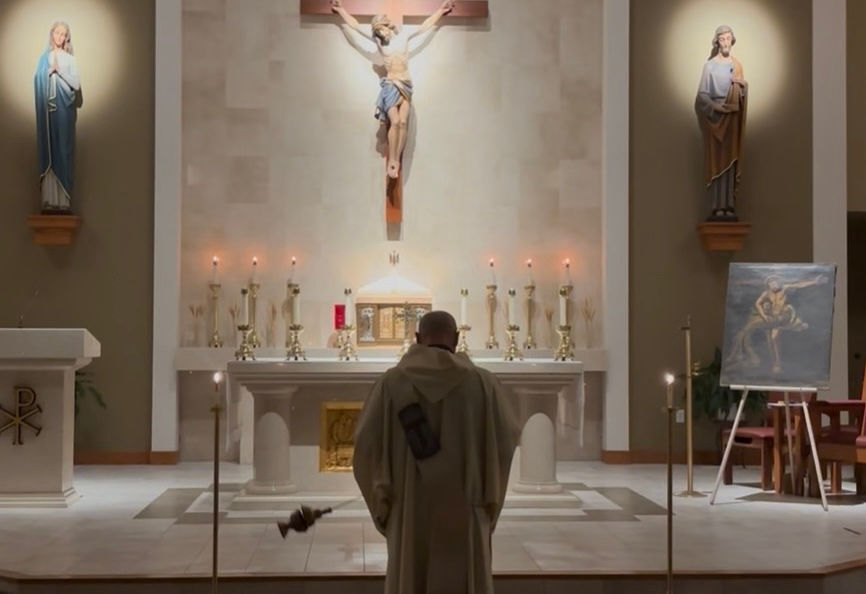
Hospital Hallways Become Holy Ground: Extraordinary Ministers Share Christ’s Healing Love
Updated: Apr 16
Through the ministry of extraordinary ministers of Holy Communion, hospital rooms become places of grace and quiet encounter with Jesus.

Sometimes, they give Jesus to a patient who is recovering and ready to return home to their family. At other times, they give the Eucharist to someone who is receiving Jesus for the last time before returning home to the Father.
Teresa Doyle has been bringing Christ in the Precious Body to patients at St. Anthony Hospital in Lakewood, as well as at the former St. Anthony Central Hospital in Denver, on a mostly weekly basis for 23 years.
“Every time I leave the hospital after doing the ministry, I'm just so grateful and thankful,” said Doyle.
For Doyle and for fellow hospital volunteer Ron Schreier, Jesus remains the same. Each patient, condition and story is different — even as every one of those patients displays the face of Christ.
“Each time we go into a room, it's a totally different experience, with the unknown of what you're going to encounter when you go in there,” said Schreier, who has been doing the same for the last 13 years, all after his own encounter receiving Christ in the hospital after surgery. “I was diagnosed with prostate cancer in late 2010 and had my prostate removed in 2011. That was kind of the moment that I said, ‘Well, the Lord's telling me that I need to do more.’”
Schreier joined the volunteer team of extraordinary ministers of Holy Communion to help fill a dramatic need when the hospital relocated to Lakewood.
“It was just a time in my life where I just decided that I needed to be more actively involved. That's when I volunteered to do it at Notre Dame Parish [in Denver], of which Teresa and I are both members,” he shared.
Most hospitals in the Denver metropolitan area offer Eucharistic ministry to hospitalized Catholics regularly.
Doyle, Schreier and the team of 20 volunteers at St. Anthony encounter the difference each unique patient brings, as well as the unique care and compassion required to be interpersonally present to them, just as Christ is in the Eucharist. They typically meet the Eucharistic needs of approximately 25 to 30 patients at a frequently full hospital.
“Some people are very emotional, and you can just tell that they're there. You have to just be able to adapt to each scenario each day when we're making the rounds,” said Schreier. “You have to pay attention to where they are. You really have to think on your feet and just be ready because some people are under medications where they're not really cognizant.”
Often, a family member will help intercede with the patient to help them understand Christ is present for them if they want.
“If there's a spouse or somebody in the room, the patient will turn to that person and say, ‘What do you think?’” said Schreier. “Everyone's different.”
Hospital patients are often going through some of the most traumatic experiences of their lives. Those can bring incredible times of poignancy and emotional response from patients who need to share their story.
Doyle trains volunteers to understand that a fine line exists between offering Christ in the Eucharist and being as equipped to act as a professional counselor or clergy member would in those situations.
“We're not there to be a priest to get real deep into their situation,” said Schreier. “We try to stay within the bounds of bringing Jesus Christ, the Body and Blood, Soul and Divinity of Christ. I always view it that Christ would want me to listen if they want to talk, and occasionally, you will get a patient that wants to pour out. But we try to be respectful of their situation.”
“It takes a special person to go into a hospital, because you see a lot of different situations.”
Training for this unique ministry at St. Anthony’s begins by contacting the hospital, where Emily Gingerich serves as the manager of volunteer services.
“There is a day of meetings, training for just being able to serve in the hospital,” said Doyle. “When they get that done, they come to me and I start the process with them.”
Doyle and Schreier recognize that this type of volunteering, with the often trauma-centered experience each patient brings, requires a higher level of mental and spiritual readiness.
“It takes me about 15 minutes to get over to the hospital from my house, and I listen to the Rosary on the way over,” said Doyle. “That helps prepare me for distributing [the Eucharist], to get me in a better frame of mind that I am there serving Jesus.”
“I try to prepare myself as I go over between 8 and 8:30 a.m. I always ask Jesus to accompany me on my rounds because he's the one that's really bringing the healing and the comforting. I'm just his representative to do that,” Schreier said. “I always walk away after I've completed the rounds with a sense of how I need to be grateful for everything that I have, for my health.”
In the end, it is the action in itself of offering the Eucharist to others who resemble Christ so uniquely that brings satisfaction.
“It's so rewarding and fulfilling for me, and for all of the people that do this ministry, not only St. Anthony, but at homebound ministries and hospital ministries throughout the nation where faithful people are available to do that,” said Doyle. “There are some patients that are really sincere. Their eyes well up. Their chin quivers. That's my reward for doing this ministry, to bring Christ to the patients in the hospital.”