
Honoring Jesus in the Womb: Advent’s Hidden Mystery

Why contemplating Christ’s first nine months reveals the dignity of unborn life — and deepens our Advent devotion.
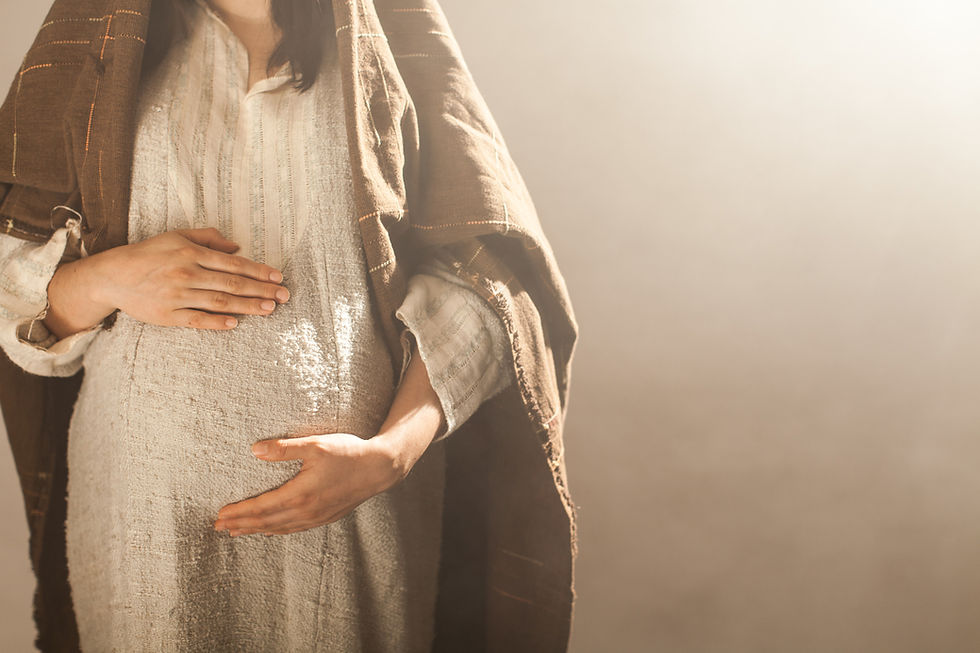
Advent draws us to contemplate Christ’s first coming, even as we expect his coming again in glory. The season contains an almost incomprehensible reality: God has become man, “infinity dwindled to infancy,” as Gerard Manley Hopkins put it. Israel’s centuries-long yearning for the Messiah blossomed in the first Advent as Our Lady became God’s tabernacle in the world. Even as we look toward the manger, Advent can become a time to honor Jesus’ time in the womb, when he initiated his sanctification of human life.
Life in the womb remains mysterious, even with the advancement of science. It is hidden, as new life begins behind a veil with an incomprehensibly small beginning. In the ancient world, it was believed that the soul did not enter the body until it was sufficiently developed to sustain it, an opinion that was abandoned by the Church as soon as conception was first understood in the late nineteenth century. Ideologically, some remain committed to this outdated position as a means to deny the personhood of the nascent child. Embryology confirms, however, that from the first moment of existence, a new and distinct organism of the human species immediately emerges.
All living things possess a soul as the principle of life, which both animates and provides the coherence of development and growth according to the telos, or goal, of that being. The human soul, among all material beings, alone acts in a manner that exceeds the matter it informs, capable of contemplation and self-transcending love. Because we are embodied beings, unlike angels, our souls depend on our bodies, using our senses and brains to receive and process information from our surroundings. The soul, however, as a spiritual substance, begins its life complete at the moment of conception, immediately capable of rational action, even though it must wait many years for the body to develop, slowly advancing in its understanding and action in relation to it. Because there are many materialists in our culture, we overlook the rational and spiritual nature latent within the enwombed person, not yet capable of exercising it.
The Son of God, in becoming man, entered into this mysterious phase of life. The Church has traditionally affirmed that Jesus, even in the womb, possessed full access to his human rationality. This has struck many today as anachronistic, an exaggeration meant to honor Jesus, though completely out of sync with modern understanding of gestation. When we recall, however, that the soul does not develop in the same way as the body, but, in itself, is complete at conception, it would make sense for Jesus’ rationality to awaken immediately since it was united to the divine Word. Though Jesus’ human mind would later draw upon his senses and brain in an ordinary way, it could immediately reason and act through the grace of the hypostatic union, as the Son of God thought and prayed as man even in the womb.
There is much to unpack in the mystery upon mystery of Our Lord’s time in the womb. TAN Books has released a new edition of a nineteenth-century work to help us reflect on the beginning of Jesus’ life, Father James Henry Coleridge’s Devotion to Our Lord in the Womb: The Divine Nine Months. The time in the womb is marked by activity for everyone, with immense, even staggering, growth from a microscopic embryo to a baby ready for birth. With Jesus’ human soul united to the Second Person of the Trinity, Father Coleridge explains how he used this time to begin his work of adoring the Father on behalf of all humanity:
“The soul of Jesus was perfectly conscious of, and took immense delight in, its own elevation, its union with the Divine Person, its immense gifts and privileges, its prerogative as the source of all spiritual blessings to Our Lady, St. Joseph, all the saints and all the faithful. It began at once its life of interior work for God. The soul of Our Lord at once saw God perfectly with the plenitude of beatific vision, and here again it had this not only for itself but also for others. To see God was to understand his infinite greatness, to adore him with the most perfect worship as a creature, to love him most intensely, and all creatures in him and for him, and especially men who had been made Our Lord’s brethren by the Incarnation. Then followed gratitude, thanksgiving in his own Heart, and in the heart of his mother” (73-74).
Because Jesus calls us all to become like children, humble and surrendered to God's care, his time in the womb proves remarkably significant for assuming this spiritual posture. In fact, our entire life bears some resemblance to the womb, as we are remade and grow into the divine life to be, like Jesus, children of the Father.
The Visitation, in particular, manifests how we should recognize Jesus’ divine presence in the womb of the Virgin Mary. Elizabeth speaks for all humanity, welcoming the Son of God into the world with the words, “Blessed is the fruit of your womb,” a line that echoes throughout history in our daily prayers. She is overwhelmed by the presence of her incarnate Savior, speaking with awe and gratitude, “Who am I that the Mother of my Lord should come to me?” Ghirlandaio depicts her reverence so fittingly in his painting of the Visitation:
Even the still-developing fetus, John the Baptist, could be enlivened by the Holy Spirit to acknowledge him, a prophet who speaks for all the unborn who implicitly long for the happiness for which they were created, brought to them by another baby, who humbled himself for their salvation.
Jesus’ hidden, silent adoration before his birth sanctified life in the womb. Father Coleridge explains, “He chose to cleanse and sanctify by his own touch and presence all that had been corrupted by the fall of Adam, conception, childbirth, infancy, the miseries and weaknesses of our gradual growth, our years of helplessness” (31). This is part of the reason why we need to increase our devotion to Jesus in the womb, asking him to continue to protect and sanctify the little ones who have become ever more vulnerable.
The Advent season, focused on expectation, offers a surprising witness to the dignity of life in the womb and its greatest moment of sanctification. Let’s honor Jesus in the womb of the Virgin Mary and pray for all the unborn.