


From Altar to Earth: A New Church Rises in Gypsum

A bilingual Mass and groundbreaking mark the start of St. Mary, a long-awaited parish built to serve a rapidly growing Catholic community.
By Ryan Brady
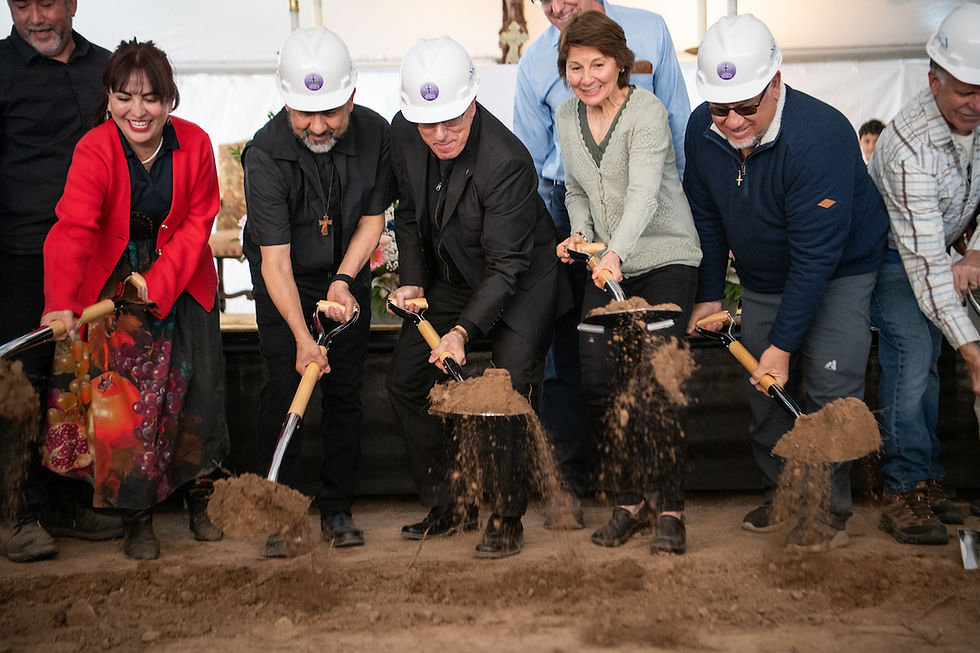
The morning began at the altar and concluded in the earth. On May 2, Catholics from across the Vail Valley gathered in Gypsum for a bilingual Mass, groundbreaking ceremony and parish celebration marking the formal start of construction on a brand-new church to be called St. Mary. The morning was years in the making — shaped by demographic growth, sustained fundraising and a clear pastoral need for more space in a rapidly changing region of the archdiocese.
A Church Built of Living Stones
The Mass, celebrated by Father Jose Maria Quera, the parish’s pastor, framed the day not simply as a construction milestone but as a spiritual act grounded in continuity and mission.
In a statement prepared for the occasion, Archbishop Golka further emphasized the deeper significance of the moment.
“What you celebrate on this day has been born from faith, sacrifice and generosity, signs of a people who trust in the Lord and in his providence,” he said, noting that for many years the community had “longed for a place worthy of the sacred mysteries we celebrate.”
The decision to build, the archbishop continued, reflects both real need and a collective response “with courage and conviction,” entrusted to Christ as its foundation and “under the loving care of the Blessed Virgin Mary … that what rises from this ground build up the Body of Christ for generations to come.”
That Marian emphasis was echoed within the Mass itself. Father Quera formally entrusted the new site and the future church to the Virgin Mary, crowning a statue of her that usually resides in the current church but was brought to the site that morning. The tradition, devotional and symbolic, linked the community's history to its future, invoking Mary’s intercession and motherly care in the life of the parish as it enters a new phase.
In his homily, Father Quera extended that connection, describing the day as the beginning of a journey rather than its culmination.
“We set out on a journey, building this new church, not only so that people may come here, but that Christ may go from here to the whole valley,” he said, emphasizing that the Church is not defined primarily by its structure. “The real stones of this temple are already here. We are the living stones.”
Deacon Gelasio Velasco-Chavez (left) and Father Jose Maria Quera (right) lay the church cornerstone.
(Photos by Ryan Brady/Denver Catholic)
A Growing Community in Need of Space
That theological framing corresponds to a very practical reality. The Vail Valley Catholic community has long outgrown its existing facilities, which include a school in Edwards, two small churches in Minturn and Gypsum and two interfaith chapels at Vail and Beaver Creek. The combination of full-time residents, seasonal workers and year-round visitors has produced sustained demand for Masses, sacraments and parish programming. Spanish-language liturgies in particular regularly draw large congregations.
“They’ll have a thousand people at the Spanish Masses,” said Peter Nowicki, a member of the Knights of Columbus at St. Clare Parish in Edwards. “This is the only game in town.”
Across the valley, multiple Masses each weekend still strain to accommodate attendance in the limited space.
The decision to construct two new churches — St. Mary in Gypsum and St. Clare in Edwards — reflects the Archdiocese of Denver’s coordinated response to sustained growth. Each site serves a distinct but overlapping population. Gypsum, once considered peripheral to the valley’s resort centers, has become a residential hub, particularly for working families. Edwards, comparatively, remains central for both locals and visitors.
That growth is visible not only in population but in the composition of the community itself. Today, approximately 60 to 65 percent of the parish is Hispanic, a reality that shapes both liturgical life and parish culture.
“It’s a very vital community,” Father Quera said. That vitality has been evident throughout the building process, from volunteer preparation efforts to sustained participation in the capital campaign that made the project possible.
Renderings of the new St. Mary Parish church in Gypsum. (Photos courtesy of the St. Mary, Gypsum, capital campaign committee)
Years of Discernment, Planning, Sacrifice and Shared Investment
The road to this point has been neither short nor straightforward. Father Quera noted that the desire for a new church in Gypsum extends back nearly two decades. Earlier plans had acquired the current site, but later pivoted to focus on expanding another. To Father Quera, those proposals ultimately proved insufficient.
“It would have been born small,” he said, describing the limitations of the previous location. A parish-wide survey confirmed that a new, larger site in Gypsum would better serve both current needs and future growth.
“Gypsum has grown incredibly,” he said. “This is the future.”
The financial dimension of the undertaking has required coordinated effort over several years. Alba Padilla and her husband, Ronaldo, who serve as vice presidents of the capital campaign, described the experience as both demanding and deeply communal.
“It’s almost three years we’ve been working,” Padilla said. “And today — it’s happening. I can’t believe it.”
The campaign has raised approximately $22.5 million, with a goal of reaching $23 million to fund both St. Mary’s and St. Clare’s construction. Large gifts have played a role, but organizers emphasize that the project rests equally on smaller, consistent contributions.
“From one dollar to one million — it all counts,” Ronaldo said.
Padilla recalled a parishioner who brings an envelope each Sunday. “She says, ‘This is my donation.’ That’s the heart and the faith.”
The result, as participants described it, is a convergence of resources: major donors, local families and volunteers contributing according to their means.
“You need both,” Nowicki observed. “People who can give, and people who can build. Hands and feet.”
Nowicki also pointed to the rarity of the moment.
“You get one chance to do this, to build something that lasts,” he said. “Where people get married, receive the sacraments — this becomes the center of the community.”
Building Something Meant to Last
For those responsible for constructing the building, that sense of purpose is not incidental. Yari Neitenbach, project manager with Horizon West Builders, described the project as distinct from typical commercial work.
“Some people build gas stations — it’s about money and going fast,” he said. “That’s not this. We get to take our time and build something beautiful. It’s more than just a building.”
His firm, which works extensively with the archdiocese, has experience in both new construction and ecclesial renovation, bringing to life both liturgical requirements and regional elements, including a mountain-influenced aesthetic with timber features.
The project has also been shaped by community input, with lots of feedback via surveys and community conversations. Construction is expected to take approximately 12 to 14 months, depending on weather conditions.
“You don’t want to rush it,” Neitenbach added. “You want everything as perfect as you can do it.”
After the final blessing and ceremonial turning of the soil, the liturgy led straight into a community picnic featuring tacos, burgers, pizza, fruit desserts and live music. Families lingered, children moved between activities and volunteers continued to coordinate logistics — an informal extension of the same communal effort that made the project possible.
David Mehr, who has been to numerous groundbreakings and serves as the archdiocese’s director of capital campaign services, said he’d never seen anything like this one, from the celebratory atmosphere to the six hundred faithful who showed.
For many, the day marked both culmination and beginning.
“It’s a historical event,” Father Quera said. “I hope this does not happen again in more than 100 years — because that means this church will serve generations.”
The second phase of that vision will begin in July with the groundbreaking for St. Clare in Edwards, completing the dual-church plan intended to expand access to the sacraments and strengthen Catholic life across the valley.
Yet even as construction begins, parish leaders remain clear about what ultimately defines the work. The Church, as Father Quera emphasized, precedes the building itself.
“The Church begins not when walls are raised,” he said. “It begins when a community decides that Christ is the center.”
In Gypsum, that decision has already been made. The land has been entrusted, the work has begun, and what rises from it — under the care of Christ and the Blessed Virgin Mary — aims to serve not only the present generation but also those for decades and, hopefully, more to come.


