PHOTOS: The Blessed Ulma Family, Inspiring Hope from Poland to Denver

Updated: Aug 31
St. Joseph Polish Parish receives relics of the Blessed Ulma Family from Poland with a special Mass and celebration.

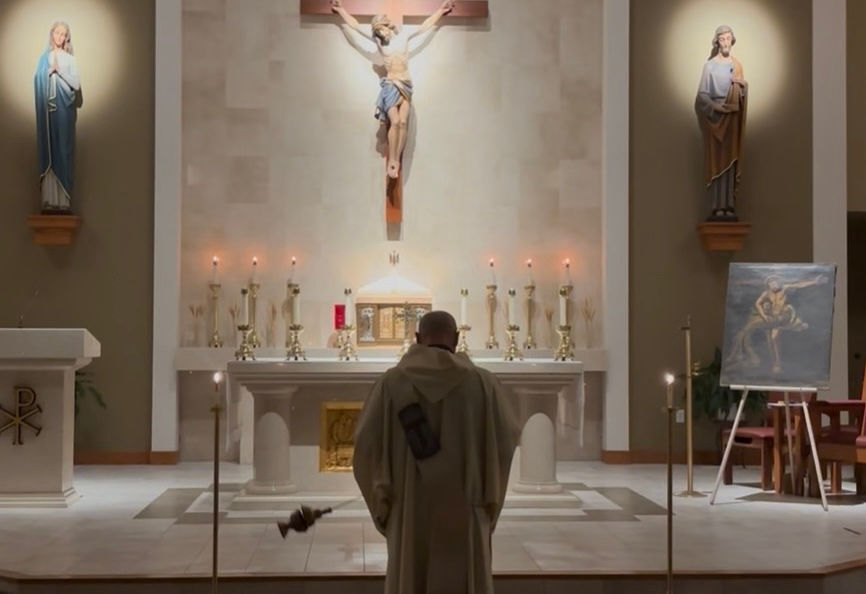
On Saturday, May 2, St. Joseph Polish Parish in Denver celebrated a special Mass in Polish as relics of the Blessed Ulma Family, from Markowa, Poland, were installed.
Father Wojciech Pepera, a now-retired priest in the Archdiocese of Denver, brought the relics from Poland. Father Piotr Baraniewicz was invited from the Archdiocese of Przemyśl, where the Ulma family’s cause and beatification took place, to celebrate the special occasion.
“Many graces are already happening through the intercession of this holy family,” shared Father Stanislaw Michalek, the parish’s pastor and a member of the Society of Christ, a religious community founded to serve Polish emigrants worldwide.
The Blessed Ulma Family
Józef and Wiktoria were married in 1935 and resided in Markowa, in southeastern Poland. In the following years, the Ulma family welcomed six children aged eight and under.
In 1942, the Nazis began deporting Jewish families to death camps after the Germans decided on a “Final Solution of the Jewish Question.” Among the 4,500 residents of Markowa, about 120 were Jewish. Amid such darkness, the Ulma family courageously sheltered eight Jews from two local families for two years, hiding in the attic at night and lending a hand on the farm during the day.
“That love made people be able to live with dignity for two years in some way,” said Father Baraniewicz in his homily.
“This ordinary family [from Markowa] became a hope for the Jews,” he continued. “They cunningly read what St. Paul wrote that hope cannot fail, because God's love is poured out in our hearts.”
Józef and Wiktoria were pregnant with their seventh child in 1944, when a local collaborator denounced the Ulmas to the German police. A squad of Nazis surrounded the farmhouse on March 24, 1944, shot the eight Jews, Józef and Wiktoria, and then the six children.
The villagers were forced to bury the dead. The Ulmas’ bodies were later taken from a mass grave to be properly buried in a local cemetery. It was discovered then that Wiktoria had begun giving birth to their seventh child when the execution took place.
In recognition of their holy courage, a light in the darkness, the Ulmas’ cause for their beatification was introduced in 2003. Twenty years later, in September 2023, Józef, Wiktoria and their seven children were beatified in Markowa, Poland. Their beatification is an unprecedented event as the entire family was beatified together. It is also the first time an unborn child was beatified. Some images of the family depict Wiktoria with a halo around her womb.
“Everything that they were doing, it was rooted in their meditation of the Scripture and prayer life… everything was rooted in a deep faith,” said Father Michalek. “Also, it teaches a lot about the value of life.”
“The Ulmas became a light in those shadows of death. In this danger, they bravely [upheld] life to save the Jews,” added Father Baraniewicz.
As martyrs for the faith, Pope Francis signed the decree recognizing their martyrdom, allowing the family to be beatified. To become canonized saints, a miracle must occur after beatification, be attributed to the Ulma family’s intercession and be verified by the Church.
“As Pope Francis said on the day of the beatification, these are the saints of the neighborhood,” said Father Baraniewicz. “Here is Józef, honest, hardworking and full of passion; here is Wiktoria, kind, gentle and sensitive.”
And these “saints of the neighborhood” have made their way to a new neighborhood in the newly installed relics at St. Joseph Polish. The gift to the parish is meant to go beyond the liturgy and inspire hearts across the world, Father Baraniewicz shared.
“May their Christ-like life and love inflame each of us, so that we may be a light to others, so that we may be a hope for those who have lost it, and may the glory of God be revealed in every gesture of ours and in our word,” he said.
(Photos by Madisen Martinez/Denver Catholic)
An Occasion to Celebrate
Following the special Mass, the parish community celebrated with a family picnic featuring Polish dishes, appetizers and desserts.
“I’m so happy that we’re actually part of the 1,500 churches that have their relics,” said Kasia Zak, an active parishioner at St. Joseph. “This church is 120 years old, and this is the only Polish church in Colorado and the neighboring states.”
Zak has been involved in the Polish community since 2011.
“What I really like about this community is that we try to preserve the Polish heritage and traditions,” she said. "This is what’s really important to us, and this is all based on the Catholic faith.”
The installation of the Blessed Ulma Family relics is significant to the community, as St. Joseph adds another heavenly friend to their crew, alongside Pope St. John Paul II and St. Faustina, two other renowned Polish saints.
“This relic is special for me with the relics of Pope John Paul II and Sister Faustina,” said parishioner Stanley Gadzina. “I know about this family and where the relics come from.”
Gadzina, originally from the same hometown as Pope St. John Paul II, was an altar server for then-Father Karol Wojtyła. Today, Gadzina has been actively involved at St. Joseph’s for 30 years, where his children and grandchildren also attend.
To Be a Light of Hope
The blessed family, newly welcomed into Denver’s Polish community, shows forth the hope and heavenly joy of following Christ, even in dark times.
“When I immerse myself, when I delve into the life story of the blessed family, I realize more and more that Józef and Wiktoria, in their daily lives, in their spirituality, in this falling in love with the Lord, they recognized that as Christians they should care for the glory of God,” said Father Baraniewicz. “So that through them others might believe, so that through their testimony of love God might be surrounded by glory.”
Through their rich prayer lives and intimacy with God, the Ulmas made a courageous decision to love their neighbors and gave their lives in service, which can inspire us to do the same, Father Baraniewicz said.
“Someone else led me to make my life more beautiful,” said Father Baraniewicz. “It was more worthwhile. And we can say that this gesture of accepting Jews under the roof [of the] Ulmas' was not a one-off, spontaneous impulse… They became, as everyone noticed, Samaritans in the ruins. And therefore, brothers and sisters, we can learn from the Ulmas of this hope.”