

Education: Empowering Parents and Protecting the Right to Choose

Updated: 5 minutes ago
The Catholic Church teaches that parents are the primary educators of their children. Here's how that principle shapes the Colorado bishops' approach to educational opportunity, school choice and public policy.
Part 7 of a 10-part series on the Colorado bishops' public policy priorities
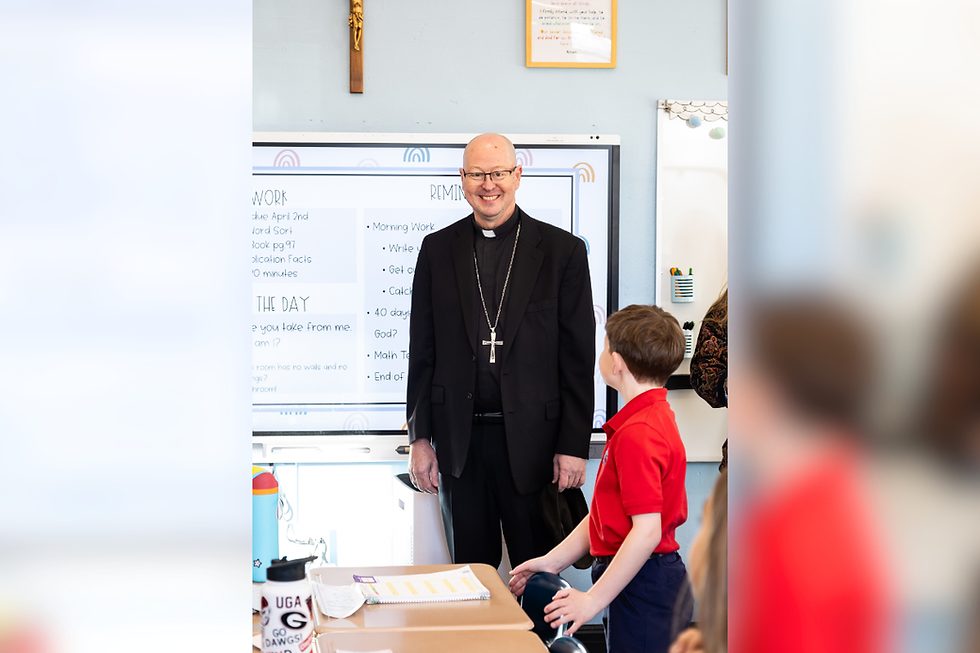
Parents are the primary educators of their children. Therefore, education policy should empower parents to choose the best learning options for their children.
The Catholic Church teaches that education is not simply the responsibility of schools or government institutions. Parents have the primary right and duty to direct their children's education, while schools, the state and the Church serve in supportive, complementary roles.
As the Catechism of the Catholic Church explains, “As those first responsible for the education of their children, parents have the right to choose a school for them which corresponds to their own convictions. This right is fundamental” (CCC 2229).
Education is also a powerful tool for lifting individuals out of systemic poverty and for building a just society. Ensuring that families have access to quality education, regardless of their financial circumstances, is therefore an important part of promoting the common good.
The Church's teaching on education
The Church's teaching on education is rooted in the dignity of the human person, parental responsibility and the principle of subsidiarity.
In his 1929 encyclical Divini Illius Magistri, Pope Pius XI emphasized that parents are the primary educators of their children, while schools, the state and the Church have important but complementary responsibilities.
The Second Vatican Council reaffirmed this teaching in Gravissimum Educationis, its 1965 Declaration on Christian Education.
The document states that parents have the “primary and inalienable right and duty to educate their children” and must enjoy true liberty in choosing schools. It also teaches that public authorities have a responsibility to protect this right and to provide conditions that allow parents to choose schools in accordance with their conscience.
This is the principle of subsidiarity in education: Parents are their children's first teachers and should be empowered to direct their education. The responsibility for a child's education begins with the family and extends to schools, local communities and government institutions.
Catholic teaching, therefore, supports educational policies that give parents meaningful choices in how and where their children are educated.
In 2005, the United States Conference of Catholic Bishops (USCCB) reaffirmed that advocating for parental school choice is not simply the responsibility of parents and teachers, but of the entire Catholic community. The bishops encouraged Catholics to support parental choice and educational tax credits that help families fulfill their responsibility to educate their children.
Education in Colorado
In Colorado, the debate over educational policy has often centered on school choice and parental authority.
The Colorado Education Association (CEA), the state's largest teachers’ union, has been a powerful voice at the Capitol, advocating for more public education funding and opposing school choice legislation that data show would increase financial support for both public and private school students. In recent years, efforts to expand school choice have faced significant opposition from the CEA and CEA-backed lawmakers, who hold a majority in both chambers in the state General Assembly.
However, a major development in federal education policy has created new opportunities for Colorado families.
On July 4, 2025, Congress established a federal scholarship tax credit through H.R. 1, the One Big Beautiful Bill Act (OBBB). Beginning in January 2027, the Education Freedom Tax Credit (EFTC) will allow eligible taxpayers to receive a federal dollar-for-dollar tax credit for qualifying donations to scholarship-granting organizations (SGOs). The amount of that credit depends on tax liability, but could extend up to $1,700 for individuals or $3,400 for couples.
These SGOs provide scholarships to K-12 students for a range of educational expenses, including private school tuition, tutoring, transportation, instructional materials and certain courses at public and private schools.
States may choose to participate in the program through action by their governor or legislature. In December 2025, Colorado Gov. Jared Polis announced that Colorado would participate in the federal program.
However, the program has also raised concerns about the religious integrity and autonomy of faith-based schools.
In 2026, Colorado lawmakers attempted to require faith-based private schools participating in the scholarship program to violate their religious beliefs concerning sexual orientation, gender identity and gender expression, or not participate in the program. This attempt aimed to limit student education options and would have infringed upon the First Amendment rights of parents and education institutions.
Although HB26-1292 was defeated, its sponsors indicated that state regulations could be introduced to establish similar requirements for participating schools which would again discriminate against faith-based education. While IRS regulations indicate that states may not impose additional regulations, it is likely the program may have vulnerabilities given the current state of nondiscrimination law.
These developments have raised concerns about whether Catholic and other faith-based schools will be able to participate in the new federal scholarship program while maintaining their religious identity and autonomy.
Catholic education accounts for more than half of private school enrollment in Colorado, and Catholic schools serve students from a wide range of backgrounds. Through scholarships and a commitment to academic achievement and the development of the whole person, Catholic schools provide families with educational opportunities rooted in faith and the dignity of the human person.
Putting the Church's teaching into practice
For Catholics, supporting education begins with recognizing parents as the primary educators of their children. When parents struggle with school bureaucracies or educational decisions, Catholics can remind them of their inherent right and responsibility, under the principle of subsidiarity, to guide their children's upbringing.
In everyday conversations about schools, Catholics can shift the focus from grades, prestige or future salaries to character formation, service to others and the development of the whole person. Even discussions about local property taxes, school board decisions or education funding can highlight the Church's preferential option for the poor and its concern for every child's future.
When engaging lawmakers, Catholics should share their experiences with education, including their ongoing education and explain how policies affect children and families. Advocates can frame their arguments around equity and the common good, emphasizing that access to quality education should not be determined by a family's ZIP code or financial circumstances.
Ultimately, the Church's vision for education calls Catholics to recognize parents as their children's first educators, support educational opportunities for all families and protect schools' ability to operate in accordance with their religious convictions.