


American Holiness: 5 Catholic Saints and Witnesses Who Gave Everything for the Gospel

From the first missionaries on North American soil to a Colorado teen who died protecting his classmates, these witnesses remind us that holiness means laying down one’s life in love.

In every age and time, though much differs and changes, one thing remains steadfast: God raises up saints to manifest his loving kindness to his people. He inspires people to live holy lives, following him even to the Cross, in love for God and neighbor.
The same is true here, on our shores. In the United States’ 250 years, the Lord has called individuals, both canonized and uncanonized, to follow him and to lay down their lives for their neighbors.
And we are called to do the same.

St. Isaac Jogues and Companions
Sts. Isaac Jogues, Jean de Brébeuf, René Goupil and their ministerial companions, known collectively as the North American Martyrs, were radical witnesses to the Gospel in the days before the United States existed. These seventeenth-century martyrs were sent from France to evangelize Canada and northern New York, a viciously hostile environment.
They quickly learned the Huron language and customs, preaching the Gospel to those who had never heard it before. And they suffered greatly for it. When the Mohawk Nation, part of the Iroquois Confederacy, attacked the Hurons, they were imprisoned, tortured, beaten and eventually brutally killed for proclaiming Jesus Christ. One even suffered the amputation of the fingers he used to consecrate the Eucharist, an act that, at the time, meant he was no longer to celebrate Mass — until he received a dispensation from the pope.
But, as the ancient saying goes, “the blood of the martyrs is the seed of the Church.” Through their faithful witness to Jesus, even in suffering, the North American Martyrs and other contemporary missionaries inspired conversion and faith among all those they encountered, not least among them a Mohawk/Algonquin girl who would become St. Kateri Tekakwitha.

St. Kateri Tekakwitha
Known as the “Lily of the Mohawks,” St. Kateri converted to Catholicism at 19 through the instruction of the “Blackrobes” or Jesuit missionaries present in the region.
Before then, she’d suffered greatly: smallpox claimed both her parents and her little brother, and had left her disfigured and partially blind. After her conversion, she was treated poorly: denied food on Sunday since she wouldn’t work and lived in danger as a Christian in a hostile culture.
Yet, her holiness only increased. She prayed and meditated deeply, grew in love for the Lord, and even took a vow of virginity at 23 — radical at any time, but all the more so in seventeenth-century North America.
Through her ordinary but profoundly holy life, St. Kateri gave witness to “the things that are above” (Matthew 6:19, 24; Colossians 3:1). Following her passing on Holy Thursday in 1680, witnesses noticed a miracle: her pallid, disfigured face, covered with pockmarks from smallpox, was suddenly healed and appeared healthy. A smile came upon her lips — a manifestation of the Heavenly joy she must have experienced upon meeting the Lord.
She is the first Native American woman to be canonized a saint.

St. John Neumann
The fourth bishop of Philadelphia, Pennsylvania, St. John Neumann was a Redemptorist priest from Bohemia inspired by the need for priests in the nascent United States. He learned English, immigrated to the United States and was ordained a priest, and later, in 1852, was named bishop of Philadelphia.
There, he was known for his pastoral care for his people. Seeing the need of new Irish immigrants, he learned Gaelic — his seventh language — to hear their confessions. He founded a Catholic school system, one of the first in the nation, and opened dozens of parishes and schools. Even his death came in service to his people: he collapsed on a cold Philadelphia street in January, after visiting a local post office to sort out a misunderstanding so that one of his priests would receive a chalice.
Through his life, witness and generous service, St. John Neumann witnesses to our role in God’s divine plan to save and love his people.
“Each person brings some unique dimension to helping the world hear and respond to the Good News,” he once said.
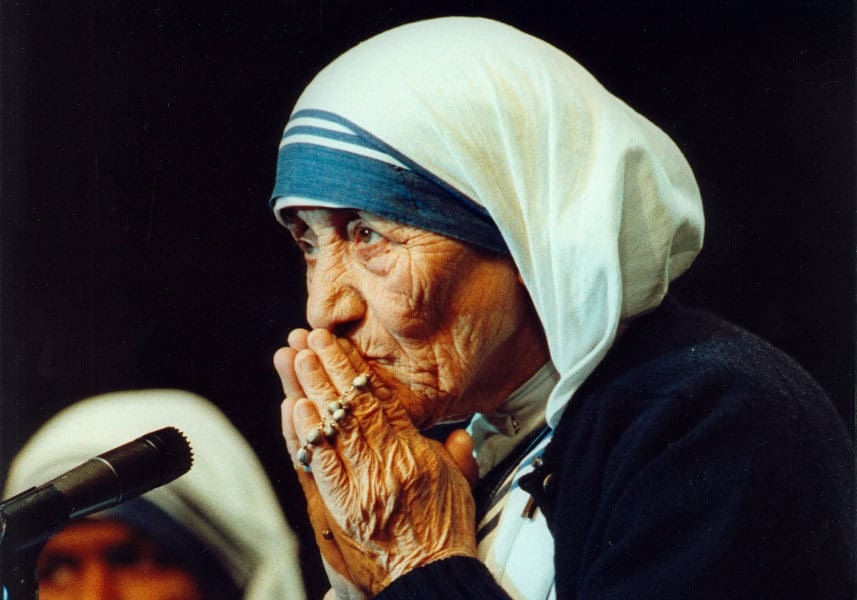
St. Teresa of Calcutta
Wait… what’s Mother Teresa doing on this list?? Fun fact: everyone’s favorite five-foot-tall sister received honorary U.S. citizenship in 1996! She is one of eight individuals to have received the honor, one of two to have received it while living, and one of two for whom the honor was proclaimed by an act of Congress.
St. Teresa of Calcutta is best known for her work among the poorest of the poor in India. In her lifetime, she cared for “those who have been rejected as ‘unacceptable’ and cared for them when no one else would,” Congress’ resolution stated.
Together with her sisters, the Missionaries of Charity, Mother Teresa worked “to provide comfort to the world’s neediest,” even in the U.S., Congress noted, where a “poverty of loneliness,” as Mother would call it, took root and spread insidiously.
“She has affirmed more so than any other single person of our age, and as few persons have throughout the course of human history, the intrinsic value and dignity of every human life,” Congress went on to say in their joint resolution. “Whether with the poorest of the poor in Calcutta, the victims of sectarian violence in Beirut, or those suffering from AIDS in New York, Washington, D.C. and other American cities, she has defined the reach of human compassion. Through her loving service of all of God’s children, she gave witness to the Gospel across the world.”
St. Teresa of Calcutta’s witness in the United States and abroad has surely transformed hearts, “[inspiring] millions to realize that in their own daily lives, they too are capable of doing ‘something beautiful for God.’”

Kendrick Castillo
Born in Denver in 2001, Kendrick Castillo was a faithful Denver Catholic, a dedicated Knight of Columbus and an engaged young adult.
When shooters entered the Highlands Ranch STEM School on May 7, 2019, Castillo laid his life down to protect his classmates, in imitation of the Lord whom he followed.
“Kendrick gave everything he is, and everything he had — family, a future, a degree, his life — so other young men and women could go back to their families, have a future, graduate and live,” Denver Auxiliary Bishop Jorge Rodríguez said in his homily at Kendrick’s funeral. “Kendrick’s life is like the echo of Jesus’ words: ‘Greater love has no one than this, that one lay down his life for his friends.’
“Only a young man with God in his heart and possessing a big, good heart can do what he did: to lay down his life to save his friends,” he continued. “I’m sure [Kendrick’s parents] John and Maria, that you feel proud of your son. God, too, is very proud of his child, Kendrick.”
On July 29, 2025, the Diocese of Colorado Springs received a request to open his cause for canonization. In a statement, then-Bishop James Golka noted that “Kendrick was an exceptional young man” and asked the faithful to privately invoke Kendrick’s intercession, praying especially for the youth in our diocese, that they emulate his example of fortitude and generosity.”
No matter how the canonization process turns out for Castillo, it’s clear that his witness of sacrificial love is inspiring others to follow Jesus in love of neighbor, even to the point of laying life down for another.
A New Generation of Saints
We might not live in seventeenth-century New York or nineteenth-century Philadelphia, but just like St. Isaac Jogues, St. Kateri Tekakwitha, St. John Neumann, St. Teresa of Calcutta and Kendrick Castillo, we’re called to be saints. Today, right now, in our own homes, families, cities, towns and communities.
The more we become like God, the more different we become from one another, the saying goes, because the more we become the people that God calls us to be.
We might not know exactly how God’s plan to save his people will take shape, but one thing is for certain: God wants to raise up saints. Here. Now.
As the United States approaches her next 250 years, how might God be calling you, dear reader, and me to become the saints that she needs right now?


