

What Horror. What Hope. Reflections From an Alabama Civil Rights Pilgrimage

During Black Catholic History Month, a journey through the painful history of slavery and racial injustice becomes an invitation to listen, accompany and embrace the courageous hope that continues to inspire the work of reconciliation.
The sound of waves crashing still rang in my ears. My eyes were haunted by the sculptures of those who’d been tossed overboard.
As I came to a wall of what looked like urns, I was overwhelmed by the display of countless jars containing soil from the sites where individuals had been lynched.
What horrors had these souls endured.
Making my way through The Legacy Museum in Montgomery, Alabama, which explores the legacy and impact of slavery on the United States and on Black communities nationwide, I felt the weight of centuries of suffering. Of whippings, assaults and mutilations. Of bondage, cruelty and hatred. Of lynchings and terror.
What horrors had these souls endured.
I had been invited to join the Archdiocesan Committee for Racial Equality and Justice (ACREJ), along with Denver Archbishop James Golka, Denver Auxiliary Bishop Jorge Rodríguez and other archdiocesan leaders on a civil rights pilgrimage through Birmingham, Montgomery and Selma, Alabama.
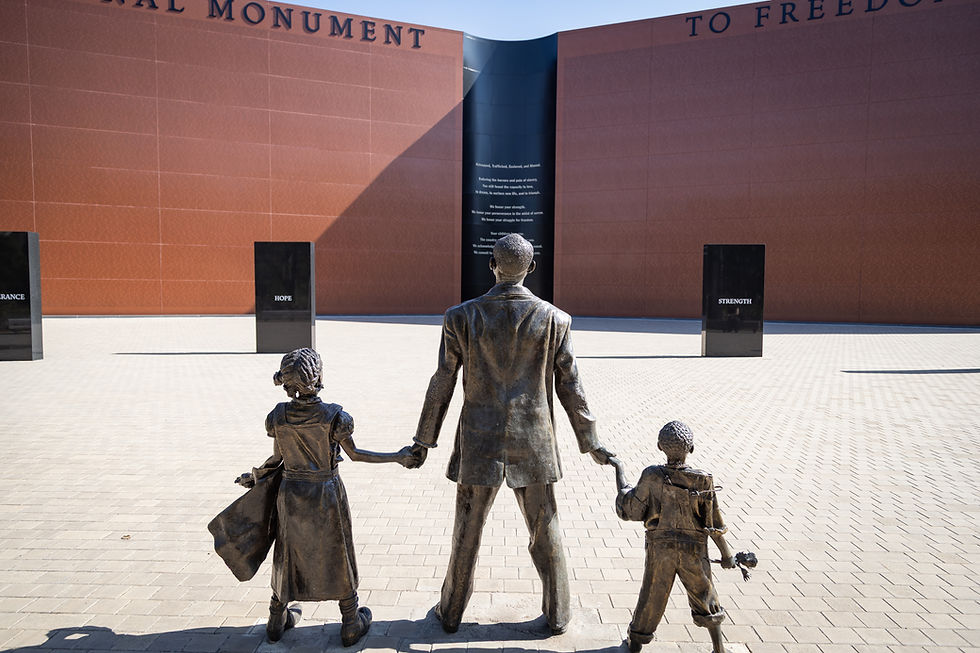
Whether at The Legacy Museum, the National Memorial for Peace and Justice, Montgomery Square, Freedom Monument Sculpture Park, the Edmund Pettus Bridge, City of St. Jude Parish or Resurrection Catholic Missions of the South, for a few days, we had the opportunity to listen, learn and walk alongside our Black brothers and sisters. In that time, we encountered a small measure of the burden they and their forebears have carried for generations.
Archdiocesan pilgrims smile for a photo at Resurrection Catholic Missions of the South in Montgomery
(Photos by André Escaleira, Jr./Denver Catholic)
And my, what a heavy burden it is, as millions were kidnapped, trafficked and abused.
Turning a corner in the museum, I stepped into a magnificent reflection room with soaring walls covered with the names and faces of courageous heroes: Frederick Douglass, Martin Luther King Jr., Rosa Parks and more.
What horrors had these souls endured.
But what hope they sowed, too.
Each of the men and women on these walls had seen atrocity and pain, suffering and terror, to be sure. Some saw it as recently as a few decades ago.
For some of the pilgrims traveling with me, the experience of prejudice and discrimination was even more recent.
But the faces on the walls and the souls at my side have also striven to maintain an eternal vision, seeing beyond what was to what could be, if only they dared to co-create it with the Almighty.
That hope was anything but passive. Each of the men and women featured on these walls had worked wonders, great and small, in their lives, in cooperation with grace and in profound, courageous hope. Through words, decisions and actions, they daily witnessed to the fact that injustice would not have the final word.
Each of the women and men on pilgrimage with me, too, had dared to hold fast to hope and to faith in their own lives, striving to build a better world alongside God.
What hope these souls sowed, even amid horror.
My life has not been one punctuated by the kind of horrors these heroes had to endure. The weight they carried is not mine.
But in the divine mystery, in God’s compassion — compassion does mean “to suffer with,” after all — I was invited to stand for a moment at my brothers and sisters’ Calvary and to glimpse the hope of the Resurrection that they have carried through it all.
What horror. What hope.
The tension between those two continues today, beyond the history books and in the lives and communities around us, even as faith communities work toward healing, reconciliation and justice. That work is part of the ACREJ’s mission since its foundation in 2019.
Perhaps that is something that each of us can grow in during this Black Catholic History Month. Perhaps I and we can strive to listen better, to exercise compassion more, to work for a better world, to intercede for each other and to love our neighbors out of our love for God.
Perhaps then we’ll join these men and women, who, like their forebears, have lived a courageous hope to look beyond the broken world that we inhabit towards the New Jerusalem to come, “where every tear will be wiped away…” (Revelation 21:4).


