
The Threshold of Hope: The Freshness of Faith in the Third Millennium

"No matter how many times the Church seems destined for destruction, or at least precipitous decline, Christ is born anew in the world."
“Remember that you were at that time separated from Christ, alienated from the commonwealth of Israel, and strangers to the covenants of promise, having no hope and without God in the world” (Ephesians 2:12).
Like the Gentiles, to whom Paul was writing, the evidence of hopelessness without God surrounds us. Hope gives surety, based on God’s promises, that overcomes our fears and leads us beyond the presumption of life without a Savior. As we cross the threshold of the new year, marking the end of the Jubilee Year of Hope, we can look forward with the confidence that comes from our faith, knowing that Christ will be with us, no matter what happens.
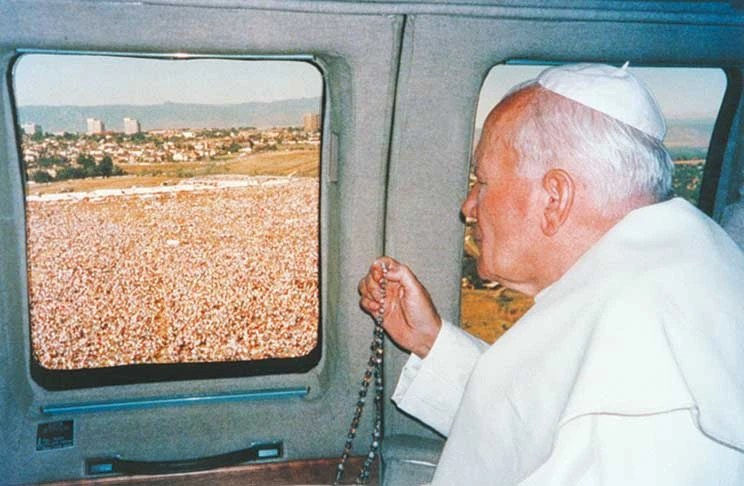
When St. John Paul II ascended the papal throne in 1978, the “auto-destruction” of the Church described by St. Paul VI raged with full force. The Cold War showed no signs of relenting, let alone coming to an end a little more than a decade into the future. “Be not afraid,” he proclaimed at his Installation Mass, echoing Jesus’s own words, introducing a theme that would mark his pontificate. Despite persistent wounds and weakness, the Church continues to show herself young and full of hope to those searching for meaning. Even after the bloodiest century ever, faith can still unexpectedly change the course of history, bringing down atheistic regimes.
The Polish Pope’s proclamation of hope culminated in the Great Jubilee Year 2000, marking two millennia from Christ’s Nativity. The world scoffs at the helpless child proclaimed king in the poverty of the manger, mocking the faith of his followers, deemed outdated and superstitious. No matter how many times the Church seems destined for destruction, or at least precipitous decline, Christ is born anew in the world. Martyrdom, revolution and ideology rock the lives of believers, but their suffering only makes the work of sanctification more present to their persecutors, sowing seeds of new growth. And St. John Paul II prophetically viewed the opening of the third millennium as a new springtime of growth for the Christian faith. It may have seemed slow to come, but the Church continues to grow in the third world and to sprout new shoots even in the decaying West.
The Great Jubilee is particularly important for us as we finish a Jubilee Year of Hope. We are still in the second millennial commemoration of Christ’s life, which will culminate in the years 2030-2033. Two thousand years ago, Jesus was a young man in his prime, working in his adoptive father’s workshop and living a hidden life, already sanctifying the world through his divine presence. His work of building culminated in fashioning a new Temple for the glory of the Father, one that would not reign triumphantly in the world but would continue his sacrificial work of self-emptying charity. His Church would have to live by hope, knowing that Christ reigns even as everything seems stacked against the progress of his Kingdom in the world.
When the Jubilee Year 2000 came to a close, St. John Paul II exhorted us in Novo Millennio Ineunte (§58):
“Let us go forward in hope! A new millennium is opening before the Church like a vast ocean upon which we shall venture, relying on the help of Christ. The Son of God, who became incarnate two thousand years ago out of love for humanity, is at work even today: we need discerning eyes to see this and, above all, a generous heart to become the instruments of his work. Did we not celebrate the Jubilee Year in order to refresh our contact with this living source of our hope? Now, the Christ whom we have contemplated and loved bids us to set out once more on our journey: ‘Go therefore and make disciples of all nations, baptizing them in the name of the Father, and of the Son and of the Holy Spirit’ (Matthew 28:19). The missionary mandate accompanies us into the Third Millennium and urges us to share the enthusiasm of the very first Christians: we can count on the power of the same Spirit who was poured out at Pentecost and who impels us still today to start out anew, sustained by the hope ‘which does not disappoint’ (Romans 5:5).”
The promise of a new springtime continues to unfold as our hope sustains us through personal and societal challenges.
The Church may be a continuing source of hope, but it can also discourage and scandalize us when we focus on the failings of its members. Bishop Erik Varden, who has emerged as a powerful spiritual writer in recent years, offers the best reflection I’ve seen on how to reconcile these realities. His new book, Towards Dawn: Essays in Hopefulness (Word on Fire, 2025), offers much insight into how we can strengthen our faithfulness to the mission Christ has entrusted to us while also engaging modern culture without succumbing to it. He faces the failings of the last sixty years with refreshing honesty, devoid of pessimism and full of hope in the freshness of faith for the next generation.
I will conclude with Bishop Varden’s articulation of hope as a threshold we must cross in our great pilgrimage toward Heaven:
“To have Christian hope is not to expect everything to work out all right. Not everything does. To hope is to have confidence that everything, even suffering, disappointment and injustice, can be purposeful. The light ‘shines in the darkness’ (John 1:5). It does not obliterate the dark — yet; that will be for the new heaven and the new earth, in which ‘there will be no more night’ (Revelation 22:5). Here and now, hope glimmers. That is not to say it is inconsequential. There is a blessed contagion in hope, enabling it to spread from heart to heart. Totalitarian powers always work to obliterate hope and induce despair. That is significant. To school ourselves in hope is to exercise ourselves in freedom. In a wonderful poem, Péguy describes hope as the flame of the sanctuary lamp. This flame, he says, ‘has traversed the depths of all the night’. It lets us see what is now, yet envisage what may come about. To hope is to stake one’s existence on the possibility of becoming. That is an art to practice with assiduity today, in the fatalist, determinist atmosphere of our so very strange times. … The word ‘hope’, spes, is in the accusative, designating it as the reality towards which we move as towards our natural home, much as the prodigal son of the parable, shocked to find himself enclosed in all-encompassing estrangement, ‘came to himself’ (Luke 15:17), then set out without delay towards his father’s house. To be pilgrims in progress towards hope is to move out of meaninglessness perceived towards sense and purpose incarnate in Christ, God from God, Light from Light. Day is breaking. Why turn away from it disorientedly?” (8-9).