
The Greatest Church in the World: Two Anniversaries for St. Peter’s Basilica

“You are Peter, and on this rock I will build my Church, and the gates of hell shall not prevail against it.” Matthew 16:18
On November 18, 326, 1,700 years ago this month, Pope St. Sylvester I consecrated the Basilica of St. Peter, built by the Emperor Constantine over the grave of the apostle. The building served as a sign that the early Church had overcome all that hell could hurl against it. Roman emperors had tried to stamp out the new faith, yet the blood of the martyrs proved stronger. Christians had kept the memory of Peter’s grave, making it an early pilgrimage site and clearly identifying the location of the new basilica. Constantine leveled out the area encompassing the necropolis where Peter had been buried, along with parts of Nero’s Circus. The basilica stretched 350-400 feet and became a major pilgrimage site for Christians throughout Europe. The feast of the Dedication of the Basilicas of Sts. Peter and Paul commemorates this original consecration, along with its twin basilica dedicated to the Apostle of the Gentiles.
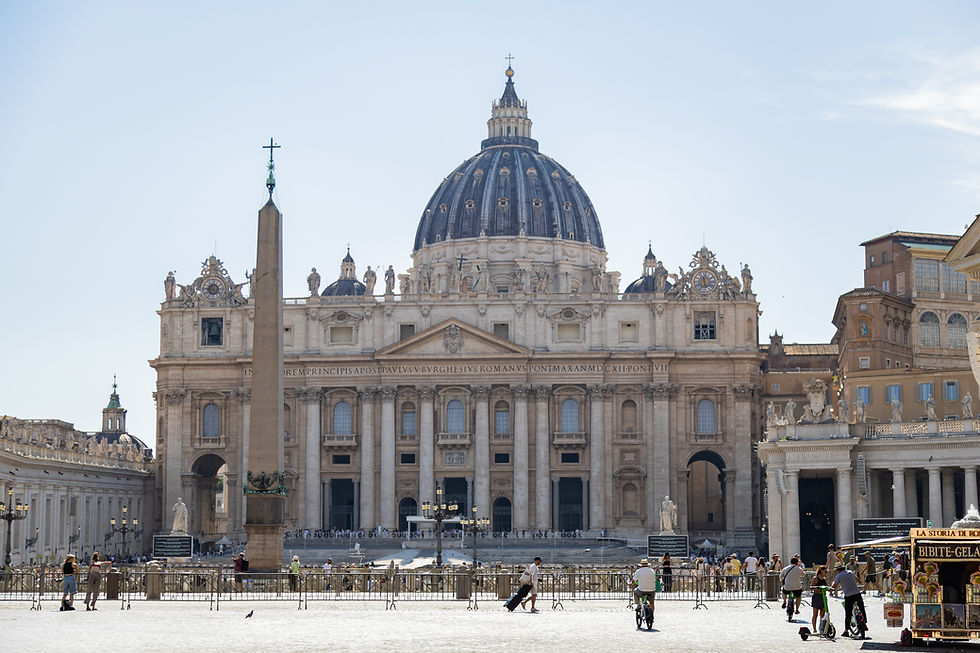
On November 18, 1626, Pope Urban VIII consecrated the new St. Peter’s Basilica, giving us another significant centennial this month. After 120 years, the result was a true wonder of the world, both the largest and most beautiful church on earth. It served as a sign of survival, the overcoming of an internal division that rocked the Church to its core. By constructing such a lavish church, costing 46.8 million Roman scudi (between 5-8 billion in today’s dollars), the popes sought to demonstrate the endurance and splendor of the Church founded on the rock of Peter. Even though the Lateran was built slightly earlier and is the pope’s cathedral church, St. Peter’s is the most recognizable symbol of the Catholic Church, crafted by some of the greatest artistic minds in history: Bramante, Raphael, Michelangelo and Bernini.
Both great basilicas built over Peter's tomb symbolize his confession of faith. Peter was the rock, and his tomb became known as the confessio, the place that symbolizes the enduring foundation of the Petrine ministry. Church buildings, in general, visibly represent the Body of Christ in the world, and their beauty is a sign of God’s presence. The beauty of St. Peter’s manifests to the world the essence of the one, holy, catholic and apostolic church, which communicates God’s truth and grace in the world.
Yet, the building is only a sign of the spiritual identity of the Church, which St. Peter himself describes, as made up of living stones: “Come to him, a living stone rejected by men but in the sight of God chosen and precious, you yourselves like living stones are being built up as a spiritual house, to be a holy priesthood, to offer spiritual sacrifices acceptable to God through Jesus Christ” (1 Peter 2:4-5).
If the Church is truly made up of living stones and the building stands only as its symbol, there is a danger in placing too much value on the exterior. Julius II had the boldness to tear down Old St. Peter’s, seeking to build a new church that would represent the Church’s greatness, as well as his own. Before his death, he approved an indulgence to raise funds that would set off a revolution in Germany, sharply dividing the Church. His successor, Leo X, continued to prioritize the arts and learning over church reform, seemingly reinforcing a focus on the exterior over the essence. It’s common to hear that the building of the new St. Peter’s lost Northern Europe to the Church, but the indulgence simply sparked pent-up frustration, and something else just as easily could have initiated it. Nonetheless, the controversy over financing such a grand church should serve as a lasting reminder of the necessity of keeping God’s glory and the good of souls before all else.
I had the privilege of studying in Rome for a semester during college, and we walked to St. Peter’s weekly for Sunday Mass. Entering the church is simply overwhelming, as you can’t take in the full immensity of the space and the details of its stunning decoration. I would often feel anxiety about the possibility of the church falling into ruins, as if, even amid its grandeur, I sensed the precariousness of any human construction. The reality is, just as the first basilica collapsed, this one will too. In response to the sack of Rome, Augustine remarked, “Why are you astonished that monuments collapse, and civilizations with them? What is mortal is made to die. Nothing is immortal save the Kingdom of Heaven” (quoted in Fr. Molinié, O.P., Courage to be Afraid, 156). In St. Peter’s, the Church has equaled, or even surpassed, the glory of the Romans. Yet everything in this world is passing away.
The splendor of one church must point us toward our true homeland, rather than making us anxious to preserve earthly glory. The double anniversary we celebrate this month truly bears witness to Christ's promise that the Church will endure until the end. While beautiful buildings help the Church communicate the essence of her mission to draw souls into communion with God, we must remember they represent something even more glorious. Walking into St. Peter’s can become a life-changing experience, overpowered by its beauty and grandeur. Its purpose, however, should be to draw us before the confessio, so that we can say with Peter, “You are the Christ, the Son of the living God,” and so become a living stone in the temple whose glory will never fade.