

The Glory and Grief of Motherhood: A Catholic Art Reflection

Through Bouguereau’s Pietà, one mother reflects on Mary, suffering and the staggering beauty woven into love itself during the month of mothers and the Blessed Virgin Mary.
“What on God’s good earth is more glorious than this: to be a mother?” Venerable Jozsef Cardinal Mindszenty
As a mother, I can only answer, “nothing.” And while there are myriad paintings I could have chosen to honor the month of Mary — this month in which we also remember our own mothers — this is the one that would not leave my mind.
Saying yes to motherhood is saying yes to beauty and yes to God. It is saying yes to swords that will pierce your heart and yes to dance parties in the living room. Yes to tree nut allergies, frightening diagnoses spoken in hospital rooms and hearing the word “mama” for the first time. It is saying yes to pretending not to be terrified in the passenger seat beside a fifteen-year-old driver, yes to front-row seats to broken hearts, yes to losing them in temples for three days and watching them grow into fully formed, opinionated human beings.
And somehow, in the midst of it all, there are moments when water becomes wine.
The glory, the pain and the staggering beauty of it all exist together. Mary knew this more deeply than anyone. Her motherhood held immeasurable joy and immeasurable suffering, woven together so tightly that one could not exist without the other. Perhaps that is why mothers throughout history have found themselves in her gaze. She reminds us that love always costs something, but that the cost is never greater than the beauty of having loved at all.
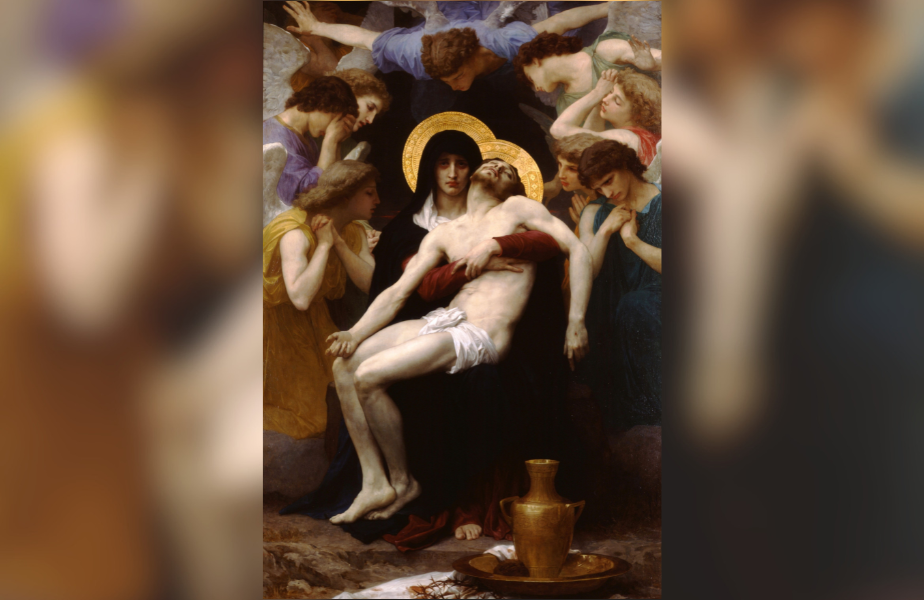
But in this moment that Bouguereau depicts, we see the pain of Mary’s motherhood laid bare. Four of the Seven Sorrows unfold within the suffering, death and burial of her Son, an overwhelming weight carried in so short a time. You can see it in her eyes: red from hours of weeping, fixed and obedient, utterly surrendered to what has been asked of her. Nothing else in her life would pierce her heart like this. “It is finished,” her gaze seems to echo, repeating the final words of her Son.
It is haunting and captivating at once. As spectators, we try to make sense of such grief. We think of our own wounded hearts, our own sorrows, and we place them before Our Lady as we remain with her here. Yet our suffering seems to fade beside the mystery of what she endures: the loss of both son and God.
Of course, one does not have to be a mother to understand this kind of grief. Bouguereau painted his Pietà just one year after the death of his eldest son, Georges, who died at only fifteen years old. It is no surprise, then, that the work feels so saturated with sorrow. In many ways, this was Bouguereau painting his own pietà, working through the anguish of his own loss.
While the painting clearly pays homage to Michelangelo’s Pietà, Bouguereau makes the subject deeply personal. His Mary clings firmly to the body of her Son, whereas Michelangelo’s Mary seems almost to offer Christ outward to the world. Bouguereau’s Virgin bears the rawness of grief in her face — all the stages of mourning present at once — while Michelangelo’s Mary remains composed and serene.
There are certain things a painting can communicate that sculpture cannot, atmosphere being one of them. In Bouguereau’s Pietà, all of Heaven seems to press inward toward the Mother and Child. Even “close” feels insufficient; the presence of the mourning angels is almost suffocating. Anyone who has experienced deep loss knows the feeling well: the strange tension of wanting loved ones near while also wanting to be left entirely alone. Bouguereau was likely drawing from his own grief here.
The angels form an arch of color around Mary and Christ, almost like a celestial rainbow. It calls to mind the rainbow after the flood in the Old Testament, a sign of covenant and finality. As if Heaven itself is declaring: this will not happen again. The sacrifice is once and for all; this grief is enough for all of human history.
Under this rainbow of angels, Mary sits in the deepest darkness. She is the tomb her son is laid in, her emotions the shadow that envelops the scene. Making the purity of his pristine body all the more dramatic. It recalls the Eucharistic Prayer said by the priest during Mass:
“Therefore, O Lord, as we celebrate the memorial of the blessed Passion, the Resurrection from the dead and the glorious Ascension into Heaven of Christ, your Son, our Lord, we, your servants and your holy people, offer to your glorious majesty from the gifts that you have given us, this pure victim, this holy victim, this spotless victim, the holy Bread of eternal life and the Chalice of everlasting salvation.”
The wash basin and bloodstained cloth at the bottom of the scene suggest that Mary has washed her son one final time. She now tends to his body much as she once did in his infancy. It is a kind of muscle memory familiar to mothers and fathers alike, written into them through years of loving care. Even now, with my own children in high school, I can still close my eyes and remember the warmth and weight of their tiny eight-pound bodies, the way their fragile necks rested entirely in the support of my hand.
If we are paying attention, life is filled with both joy and sorrow woven tightly together. To be fully alive is to experience the fullness of both. The first day of school, leaving for college, father-daughter dances, wedding dances, baptismal gowns and burial cloths — they all belong to the same human story. May our hearts remain open enough to receive it all: the entire spectrum, the full rainbow of the human experience.