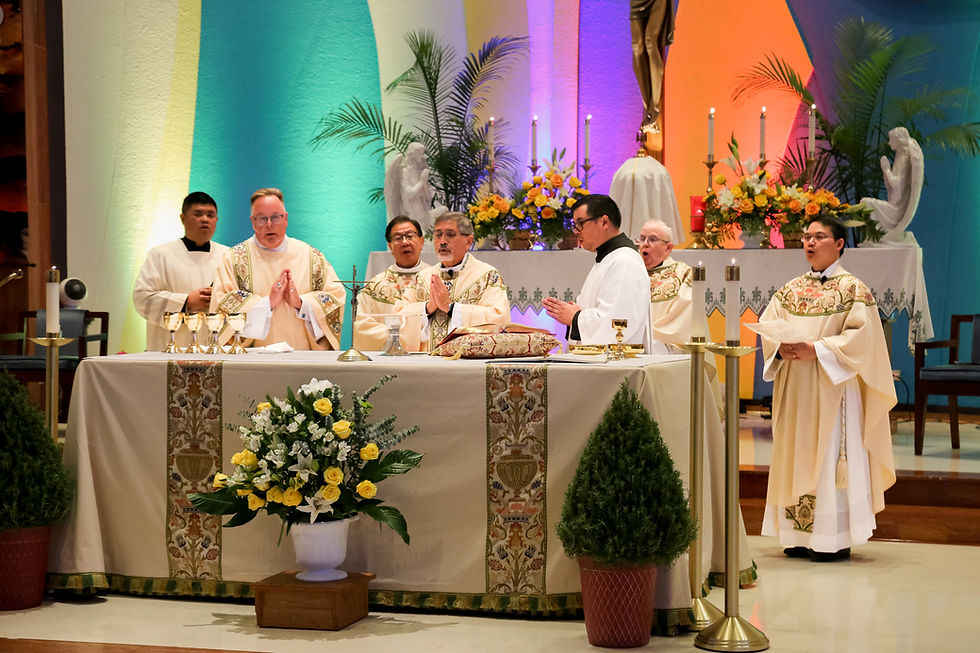

Stay at the Table this Holiday Season

Thanksgiving and Christmas might have tense conversations after an election, but Jesus calls Christians to remain at the table, listening, dialoguing and loving the people in front of us.

One-on-one appointments are a large part of my day-to-day as a priest. Those conversations are usually with people who want to talk about prayer, Catholic teaching or living the Christian life. This is one of the greater joys in my ministry.
I have discovered that every year between Thanksgiving and Christmas, appointment requests skyrocket. Surprisingly, it has nothing to do with the season of Advent or people wanting to know what’s on my Christmas list! It has everything to do with the worry and anxiety that people feel about seeing their families for the holidays.
The story is usually something like this: The family had a meal together on Thanksgiving and it got uncomfortable. Maybe a comment was made that was politically divisive. Maybe an argument about the Church broke out while passing the gravy. The memory is cringe-worthy, and there is a sense of dread about doing it all again a few weeks later on Christmas. Hence, the plea for help.
For many of us, the temptation in those situations is to let the conversation devolve by acting in one of two ways: fight or flight. “Fight” might look like dominating the conversation, threats, name-calling or dismissing the other person. “Flight” might look like silence, sarcasm, avoiding the real issue or walking out of the room. Neither fight nor flight helps maintain a healthy relationship with the other.
Through dialogue, it is possible to maintain relationships and keep the conversation alive, all without abandoning our sincerely held beliefs. We can develop the virtue of staying at the table with people who disagree with us. As with all things, we look to Jesus as our example.
In the Gospels, we frequently see Jesus having meals with people who disagree with him: prostitutes and tax collectors (Matthew 9:10-17), hypocritical religious leaders (Luke 7:36- 50), and his disciples (Luke 10:38-42; Mark 14:17-31). The Gospels show us that sometimes the table conversations got tense, and his listeners did not always like what he had to say. Even among the twelve apostles, it is not difficult to imagine political arguments occurring at times, since the group included the likes of both Simon the Zealot (a fierce opponent of the Roman Empire) and Matthew (a cooperative tax collector for the Roman Empire).
Jesus had to navigate the same kinds of tensions with others that we all deal with. We can learn from his methods. Perhaps we can distill Jesus’ approach to three steps:
See others as God’s beloved children
Meet people where they are
Hold onto hope
See Others as Beloved Children of God
We will never be able to have true dialogue with someone if we do not respect them. Sure, they may be wrong about religion, morality or politics. Even if they are wrong, that does not make them any less a child of God. Jesus treats everyone as beloved children of a Father who longs for a relationship with them. When we start from the recognition that God loves the person we disagree with, it helps to get our motives straight. Instead of trying to be right, or first, or make that person feel bad for being wrong, this recognition reminds me that what I really want is for this person to know the love of God. If we start with that, then we might be able to see the good in the other person’s perspective. We might even discover that the Lord was working through the other person to show us something we hadn’t thought about in the first place!
Meet People Where They Are
God has worked hard to win over your heart. He did not sit far away on a cloud waiting for you to quit sin and choose him. Instead, he has blessed you abundantly, though you did not deserve it. He died for you, even before that meant anything to you. He has offered you the sacraments, and he gives you the gift of his mercy every time you turn back to him. In other words, God has always met you exactly where you are.
Jesus did not stay put in Nazareth and wait for people to come to him. Imperfect as they were, Jesus sought them out. He went into their homes, their workplaces and houses of worship. He heard their stories, healed their ailments and spoke the truth in a way they would best hear it.
To be like Jesus, we have to meet people where they are. That means being willing to listen to others' experiences and perspectives, even if we may disagree with them. Conversions are not often won overnight or in the course of one meal. But when we meet people where they are, it builds goodwill and creates an opening for us to speak even the difficult truths with great love. And do not underestimate the power of a simple act of service. Jesus often performed acts of service (e.g., healings or multiplying loaves for the crowds), which showed people that he cared for them and which helped them open their hearts to him. An act of service can help break down barriers as we try to meet someone where they are.
Hold Onto Hope
Christians trust that the Lord is working through all things to bring about good (Romans 8:28). Yes, that includes uncomfortable dinner conversations and your great-aunt’s beet salad! He will use it all to bring about good! We hold onto the hope that the truth will prevail in the end. We hold on to the hope that God is doing something in our hearts and in the hearts of our family, even if we cannot see what that is right now. We hold onto the hope that God wants the conversion of our loved ones – and ourselves! – more than we do.
As we prepare for the upcoming holidays, we may be feeling the dread of difficult dinner conversations to come. That is understandable. But fear not! The Lord will give us the graces we need to do it well. Jesus will be our model and teacher.
“They’ll never change,” you may say. Perhaps not. That is for God to worry about. Our responsibility is not to change the other person but to love them as Jesus loves them. That begins with staying at the table.