PHOTOS | Something Is Calling Them: A New Generation Finds Its Way to the Catholic Church

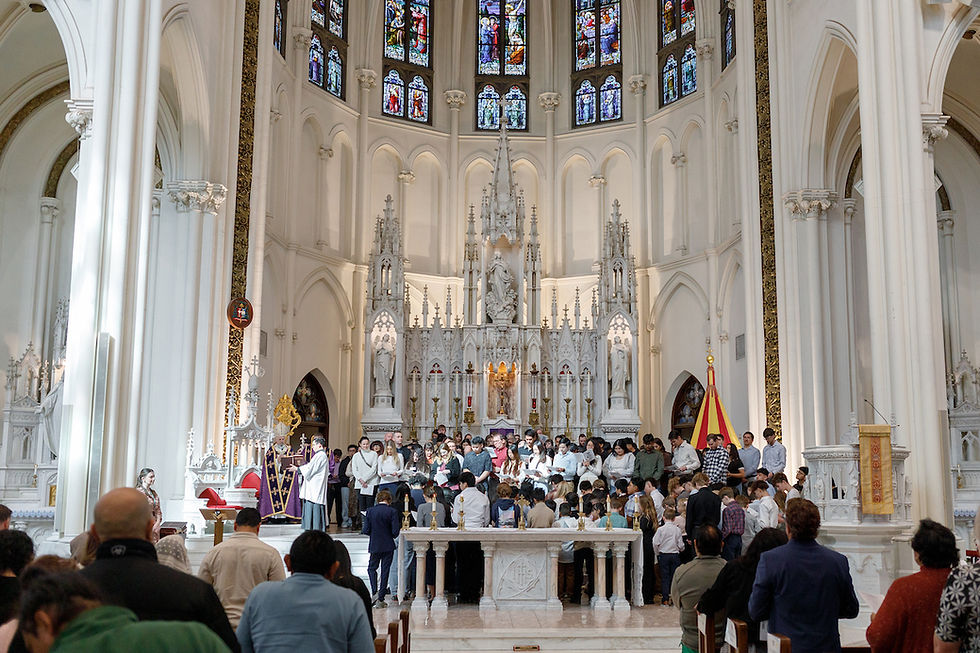
Denver's annual Rite of Election on the First Sunday of Lent saw 200 more catechumens than last year — a 35% rise — pointing to a marked increase in curiosity towards the Church, especially among the young.
Jaret Duft had been a faithful evangelical Protestant his entire life. He had a strong relationship with Jesus. He read his Bible. He never imagined he would find himself standing inside the Cathedral Basilica of the Immaculate Conception in Denver on a Saturday morning in February, waiting to be called forward by a Catholic priest and to meet the archbishop.
But there he was.
“I just became convinced that this was the Church that Christ had established, and the way that they worship, the liturgies, are how God wants to be worshiped,” said Duft, who is preparing to be baptized and confirmed at Our Lady of Lourdes Parish in Denver this Easter. “For us, it’s not turning away from Jesus. It’s following him.”
Duft was one of hundreds of catechumens, those seeking Baptism, who gathered at the Cathedral Basilica on Feb. 21 for the Rite of Election, an ancient ceremony marking the formal beginning of the final stretch of preparation before entering the Church at the Easter Vigil. Presided over by Archbishop Samuel J. Aquila, the ceremony drew people from parishes across Denver and beyond, a visible sign of what parish leaders say is a quiet but unmistakable surge in people choosing to become Catholic.
“To see how many people are joining the Church, the communal aspect of it was really neat,” Duft said, still processing the morning as he stood inside the Cathedral afterward. “It was really cool to go up and stand face to face with the archbishop. To be with all these other catechumens. I never could have imagined this.”
A parish group takes a photo outside of the Cathedral Basilica after the Rite of Election.
(Photos by Madisen Martinez)
A Movement of Faith
He is not alone in that sentiment.
Across the archdiocese, OCIA programs — the Order of Christian Initiation of Adults, the process by which people enter the Catholic Church — are reporting numbers they haven’t seen before, driven by a group that is younger, more spiritually restless and more theologically curious than many parish leaders expected.
At Our Lady of Lourdes, Morgan Rogers, the parish’s communications and OCIA coordinator, has watched the numbers climb in real time.
“Last year, we had about 100 people on average in class. The year before that was about 60,” Rogers said. “This year, we average about 150 people who show up.”
At Sacred Heart of Jesus Parish in Boulder, Henry Schliff, the parish’s director of religious education, has seen his program double in size over the past two years. But it is who is showing up that has surprised him most.
“The definite thing I can speak to is we’re seeing younger and younger,” Schliff said. “This is a very young group, and they’re almost all young. That’s unique.”
Most fall between their early 20s and early 30s, a demographic shift playing out not just in Boulder, but in parishes across the country.
Father Brian Larkin, who has served as pastor at Our Lady of Lourdes for 12 years and has taught OCIA for nearly his entire priesthood, said he sees three forces converging to drive the trend.
The first is cultural disillusionment.
“A lot of people right now are seeing that post-modernism has pushed so far away from the West’s cultural roots in Christianity, and we’re seeing the consequences of that,” he said.
The second is a hunger stirring within Protestantism itself.
“There’s a big movement in Protestantism right now, this longing for actual tradition and depth,” Father Larkin said. “People are hungry for something that has tradition and history and depth.”
The third is COVID-19.
“COVID made people feel like the world is fundamentally unstable,” he said. “People are searching for stability and meaning.”
Rogers said those themes surface repeatedly in the registration forms people fill out when they first inquire about the program.
“People are looking for some depth in a very superficial society, or ‘I feel really empty sometimes. I don’t know what I’m supposed to be living for. There’s got to be more to life,’” she said.
Reading Into the Church
Ryan Sullivan could have written those words himself.
A Boulder tech startup founder who grew up in a completely secular household, Sullivan began his journey toward the Catholic Church not in a church, but in a history book. About five years ago, he picked up Dominion by historian Tom Holland, a history of how Christianity quietly shaped the modern West.
“My initial interests were deeply intellectual,” said Sullivan, who is preparing to enter the Church at Sacred Heart alongside his wife, Anna. “But as I spent more time immersing myself in Catholicism, what I realized was simple: the Catholic tradition captures the human condition in all its complexity better than any other I know. All of the beauty, all of the brokenness.”
One passage from Holland’s book lodged itself in Sullivan’s thinking and wouldn’t let go.
“We can become so used to the Cross as an image that we forget it was the ultimate symbol of degradation and the right of the powerful to do whatever they wanted with the powerless,” he said. “The great inversion of that, the great scandal of that inversion of power has shaped the world’s trajectory.”
Sullivan spent the years that followed reading Augustine, Thomas Merton and other writers before eventually connecting with the OCIA program at Sacred Heart of Jesus. He and Anna welcomed their first child, a daughter, nine months ago, and Sullivan said the two experiences have become intertwined in his mind.
“I felt like my life was so full of love and richness before having a baby, and then you have a baby, and you tap into these reservoirs of love and vibrancy that you never knew existed,” he said. “I found my spiritual journey to be analogous to that. It wasn’t that I felt something was missing. It’s that now that I’ve added this in, everything else feels richer.”
For someone accustomed to living in his head, the fellowship of OCIA pushed him somewhere new.
“I can tend to over-intellectualize things, and I think our OCIA class does a really good job of getting to the heart of the Gospel, which is the point,” Sullivan said. “Learning to not hide behind intellectual ideas that can become abstract, and actually getting to the heart of the matter, has been a really moving part of my spiritual trajectory.”
He acknowledged, with some humor, that putting his faith into words does not come as easily as his professional life might suggest.
“I do a lot of public speaking for a living, but spiritually I feel like I’m still finding my Bambi legs,” he said. “I’m trying to put into words ideas that I might not even have the vocabulary for yet.”
The Path of Love
But not everyone arrives through books and arguments. For Lynette Ortega, 22, the door opened through love.
The Longmont native grew up without any faith tradition. Religion simply wasn’t part of the conversation in her household. That changed when she met her boyfriend five years ago. His mother taught Catholic classes for young children in the community, and Ortega found herself drawn in, quietly, over time.
“I started attending church with them on Sundays, and I really enjoyed it,” said Ortega, who is preparing to enter the Church at Sacred Heart. “I just kept going.”
Nine months into the OCIA program, she said what deepened her commitment was something she struggled to put into words but felt clearly.
“Coming from no religious background, you have a connection from learning how to pray,” she said. “It’s just like a special calling that your soul feels, and that feeling is so beautiful, and it just wants more of that feeling. That feeling has connected me more with Christ, and I’m just thankful for it.”
Her family, she said, has been supportive, a response she partly attributes to her cultural roots.
“Coming from a Latino background, Catholicism is the main religion,” Ortega said. “I’ve gotten support from family that I’m converting, and they’re on their own spiritual journey as well.”
One of the unexpected gifts of the process, she said, has been the friendships formed alongside fellow participants.
“I’ve made some friends, and it’s really awesome to have Catholic friends, especially being young,” she said. “Being young, we can be distracted by so many things in the world. I think it’s important that you have friends who have similar beliefs.”
She paused, searching for the simplest way to describe what she’s found.
“Out of every chaotic thing that’s going on in the world, it’s just like a stillness that you can turn to and lean on,” Ortega said. “It gives you a better feeling within yourself that can affect your whole day.”
A Family Affair
Jessica Gaudreau’s path to the Catholic Church wound through her own family. The Denver native didn’t grow up in a religious household, though she had some familiarity with the Protestant faith through Sunday school as a child and her father’s Catholic roots. When her daughter suggested attending OCIA at Our Lady of Lourdes, she went along as support. She stayed for herself.
“Essentially, I just wanted to grow deeper in my faith with Jesus,” said Gaudreau, who will be baptized and confirmed at Easter alongside two of her sons.
The year in OCIA has quietly reshaped her household. Her partner, who grew up Catholic but had drifted from the faith, began attending Mass regularly. In December, they had their toddler baptized at Our Lady of Lourdes.
“We’re leaning more on God and trying to get away from a lot of things happening in our world,” she said. “We’re trying to be closer to just the church life in general.”
A Eucharistic Journey
For Duft, the journey has not been without friction. Growing up Protestant, he carried assumptions about Catholicism that he had to work through one by one, and so did his family.
“The biggest hurdle has been with our families. They have a lot of misconceptions,” he said. “Telling them about us joining the Church has been difficult. But we’re just trying to help explain that this is not us turning away from Jesus.”
It was attending Mass for the first time that moved something in him that reading alone hadn’t quite reached.
“Seeing how beautiful the Mass is, and the liturgy, that was something that really spoke to me,” Duft said. “It was a moment that propelled me forward to say, maybe I should start to take this seriously.”
What he is most anticipating at Easter, he said, is the Eucharist, the central sacrament of Catholic belief that had once been one of his biggest points of resistance.
“I really want to receive the Eucharist for the first time, fully believing in what it is,” he said.
A Call to More
At the Rite of Election on Saturday, Archbishop Aquila addressed those gathered, acknowledging that what lies ahead will not be easy.
“Even after being a priest for almost 50 years and a bishop for almost 25 years, I am still tempted,” he told the assembly. “Do not listen to the voice of the Devil, who will say things like you will never be able to overcome this temptation, or you are a failure, and you will never, ever stop sinning. All of those are lies.”
He warned against the pull of materialism.
“When you die, there will be no U-Haul truck behind your hearse carrying all your junk,” he said.
And he offered them, as a parting word, the promise he said anchors everything.
“God has loved every one of you from the moment of your conception,” Archbishop Aquila told them. “God has loved every one of you for all eternity, and he desires to be your father.”
Schliff, who has walked alongside people entering the Church for five years at Sacred Heart, said the ceremony captures something that is easy to miss in the day-to-day work of running an OCIA program.
“You see them forming a relationship with Christ, and you just see that continually deepen,” he said. “You get the chance to see them work through the barriers they may not have even known existed when they started the process.
“To be a part of that,” he added, “is just phenomenal. It’s such a gift.”
Ortega’s advice to anyone hesitant about taking the same step is simple.
“Trust your heart, trust your intuition, whatever your calling is, it’s there for a reason,” Ortega said. “Catholicism is just an amazing history, and it is a beautiful one as well.”