


Night at the Cemetery Brings Hundreds to Mount Olivet for an Evening of Catholic Hope

Through saint portrayals, family stories, prayer and Mass, the annual events invited Catholics to see the Wheat Ridge cemetery not simply as a place of death, but as a place of remembrance, mercy and hope.

By Erin Scherer
There may have been rain at Mount Olivet Catholic Cemetery in Wheat Ridge during the annual Night at the Cemetery and Brew Night at the Cemetery events, but there was certainly no shortage of hope.
Over four evenings between Sept. 18 and 25, hundreds of faithful encountered the cemetery not simply as a place of death, but as a sacred place of prayer, remembrance and hope.
For some, it was even a reminder of life.
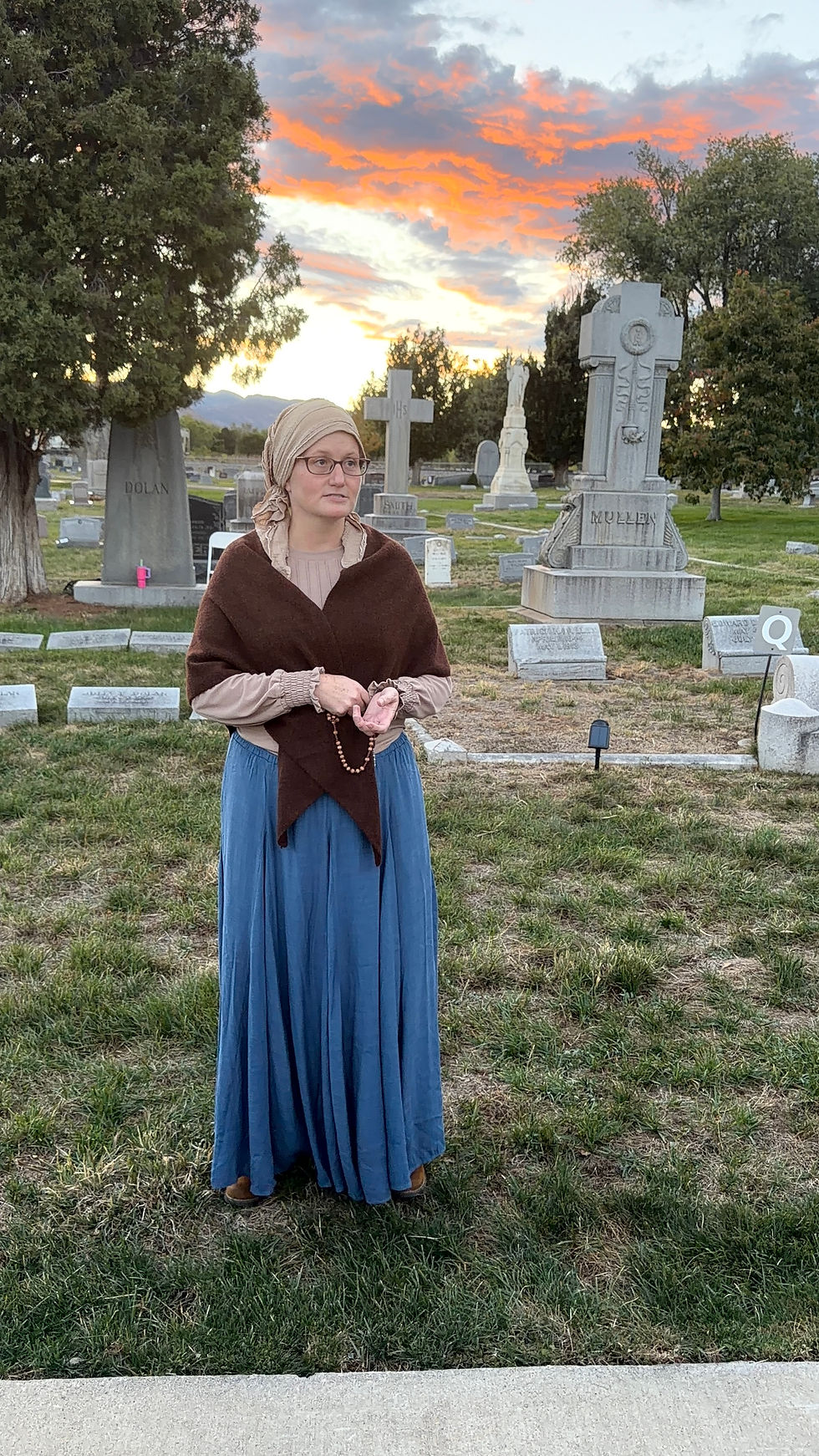
“I feel like being at a cemetery is not for people that are dead, but they’re actually alive in heaven,” said Erica Rodas Montejo, who portrayed St. Catherine of Siena during the Spanish-language Night at the Cemetery. “There are actually a lot of saints. They’re just buried in the cemetery, but maybe they’re actually in heaven.”
That perspective was at the heart of the evenings.

Tours led participants through the cemetery, where actors portraying saints along the path shared stories of struggle, faith, courage and perseverance. The encounters offered a reminder that holiness is not reserved for the people whose names appear on stained-glass windows or statues.
“It wasn’t necessarily experiencing death because we’re at the cemetery,” Aide González said, “but it was also reflecting on life, especially with the saints going around and telling their stories. It was a nice reminder, seeing it vividly, to strive to be a saint.”
More than a place to bury the dead
That interplay between death and life is central to the ministry of Mount Olivet itself.
“We do bury the dead, but we do so much more than that,” said Deacon Marc Nestorick, assistant director of mission advancement. “For all of those family members and friends that are surviving, we fill that void of loss with faith.”
That accompaniment takes many forms.
Mount Olivet provides burial services for families who otherwise might not be able to afford them, as well as for families who experience the loss of a child through stillbirth or miscarriage. Through the Precious Lives service, these children are given a dignified burial.
The cemetery also receives cremated remains at no cost and provides a committal service and interment in the Crypt of All Souls.
“We’re not just like any other cemetery that buries the dead,” Deacon Nestorick said. “We’re going beyond that and filling the void of loss with faith. That’s what drives me to come here every day.”
Night at the Cemetery gives the broader community an opportunity to see firsthand the ministry of praying for the dead, a spiritual work of mercy.

Remembering family
But for some who came, those buried at Mt. Olivet weren't strangers.
Renee Martin recently discovered through genealogical research that her great-great-grandmother was buried there.
“It took me a minute,” Martin said, “but I found her, and she’s here.”
Renata Anderson shared a similar story. A relative who died as a baby in the 1800s had been moved to Mount Olivet from Denver’s first Catholic cemetery, Mount Calvary, which is now the Denver Botanic Gardens. Decades ago, Anderson’s brother found documentation identifying where the child was buried and placed a marker there so she would no longer lie in an unmarked grave.
Darlene Rasmussen has been coming even longer. She has visited her dad at the cemetery since the 1960s and described Mount Olivet as a peaceful place where families can continue to visit and remember those they love.
“I know they’re not here,” she said. “But it’s just a nice place where you can come to visit. You just feel peace and at ease.”
“It’s just the beginning”
Remembering the dead also means confronting the reality that each of us will one day die.
For Shelley and Tom Enders, who traveled from Windsor for the evening, the experience offered a different way to look at that reality.
“You get scared at the end of life, but it’s not the end of life,” Tom said. “It’s just the beginning. It’s just the beginning of eternity.”
That hope is at the center of the Catholic understanding of death. We mourn because we love, but we do so with the hope that death does not have the final word.
As Father Daniel Ciucci put it simply during his homily, “Jesus makes it safe to die.”
For Manuel Marmolejo, attending Night at the Cemetery was something he almost decided against at first. But he came and found himself deeply moved.
“I was like, ‘I don’t want to go,’” he recalled. “And I’m here, and it’s amazing. I love it. We ended with the Mass. It was amazing.”
Natasha Alizad, a frequent participant, also treasures the Mass and the experience of celebrating it in a cemetery.
“Being surrounded by all those who have celebrated Mass with us, before, in time and history, it really adds a little something,” she shared, hopeful to return to the outdoor Mass in the future.
Jeannette Flynn described the evening as a spiritual homecoming.
“For me, it spiritually reconnected me to my Catholic roots in a very inspiring way,” she said.
And for those who braved the weather on the final night, the rain eventually gave way to something beautiful: a rainbow stretching across the cemetery.
It was a fitting end to four evenings spent among the dead, reflecting on what it means to live.
Every life has a story. Every person has dignity. And every Christian is called to holiness.
At Mount Olivet, the cemetery is not defined solely by endings. It is a sacred place where the Church continues to pray, remember and hope, proclaiming the promise that death is not the end; it is the beginning of eternity.

