
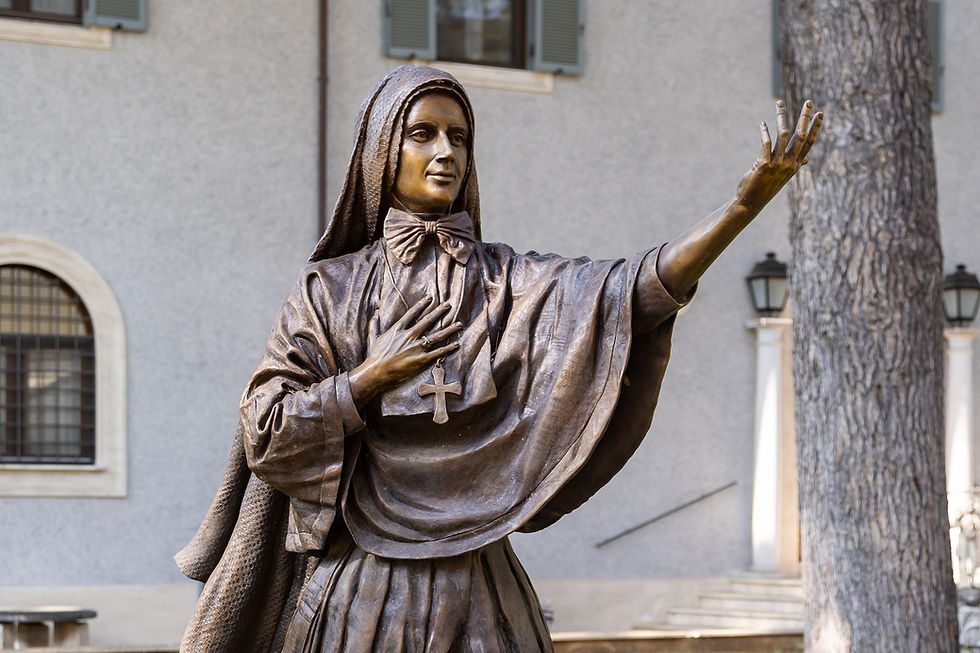
Doves, Mules, the Titanic and a Miraculous Spring: 12 Extraordinary Things to Know About Mother Cabrini

By Claudia Cangilla McAdam
Born two months prematurely in Italy on July 15, 1850, and plagued by poor health, Maria Francesca Cabrini hardly seemed destined for missionary work. Yet she became one of the Catholic Church’s most remarkable saints. Here are 12 things you may not know about Mother Cabrini, whose feast day is November 13.
A flock of doves heralded her birth
On the morning of her birth, her father, Agostino, was threshing wheat when a flock of white doves descended. He tried to shoo them away, but one allowed him to pick it up. He brought it inside as his daughter was born. Fearing for her health, her parents had her baptized that day. Perhaps the visitors foreshadowed the blessings she would bring the world.
She nearly drowned — and feared water for the rest of her life
As a child, Francesca dreamed of becoming a missionary to China. She made paper boats, placed violets in them to represent missionaries and sent them downriver, praying they would reach faraway lands. One day she toppled in and nearly drowned. She was found on the riverbank, but no one knew who had rescued her. Francesca carried a lifelong fear of water — a curious burden for someone who would cross the Atlantic more than twenty times.
Rejected by religious communities, she founded her own
The Daughters of the Sacred Heart refused Francesca because of her frail health. The Canossian Sisters also declined to accept her, reportedly because a priest wanted to retain her as a teacher. The five-foot dynamo persisted. In 1880, with seven companions, she founded the Missionary Sisters of the Sacred Heart of Jesus and became the congregation’s superior.
The pope sent her west instead of east
Francesca implored Pope Leo XIII to send her to China.
“Not to the east,” he reportedly told her, “but to the west!”
He believed Cabrini could help the many Italian immigrants in New York. She set aside her dream of China — and her fear of water — and crossed the Atlantic.
When she and six other sisters arrived, no accommodations had been prepared. Their first night was in a dingy tenement; bedbug-infested mattresses forced them to take turns sitting in chairs. Archbishop Corrigan suggested they return to Italy, but Cabrini presented her authorization from Rome and insisted they would stay. They faced prejudice, language barriers and little financial support.
The archbishop restricted their fundraising to the struggling Italian community, rather than allowing the sisters to solicit donations from wealthy New Yorkers. Cabrini was obedient, but resourceful: she reached out to reporters and influential people who could help launch her mission. Her dream would require courage, ingenuity and perseverance.
She was supposed to sail on the Titanic
In spring 1912, Cabrini was in Italy, planning to visit communities in France, Spain and England. Her English sisters bought her a ticket aboard the Titanic.
Then she learned that Columbus Hospital in Chicago, which she had founded, was overcrowded and needed to expand. She returned early, sailing from Naples on another ship.
In a May 5, 1912, letter, she reflected on her narrow escape: “If I was going to London, I might have left with it [the Titanic], but Divine Providence, which is constantly watching, did not allow it. God be blessed!”
A bullet narrowly missed her head
While traveling by train near Dallas, Texas, Cabrini’s train came under gunfire from men described as enemies of the railroad. A bullet pierced her compartment. She reported that the bullet “aimed at my head fell to my side, while it should have pierced my cranium.” She credited the Sacred Heart, “to whom I had entrusted the journey.”
She crossed the Andes on a mule
Boats, trains ... and mules! At age 45, Cabrini traveled with another sister to establish a mission in Argentina. From Panama, they sailed along South America’s Pacific coast, stopping in Lima at the tomb of St. Rose before continuing to Chile, where they began the arduous overland crossing of the Andes. By train, coach, and mule, they faced deep snow, narrow trails and dizzying precipices.
They reached Buenos Aires on December 1, 1895, where she established a girls’ school that opened the following May.
She found water (twice!) where there was apparently none
In 1890, Cabrini purchased a former Jesuit novitiate in West Park, New York, along the Hudson River. It lacked fresh water. The Jesuits had tried digging without success and instead hauled water from the river. But Cabrini noticed a damp area on the property and ordered a well dug. It yielded enough water for the orphanage she established, which eventually housed about 200 girls.
In September 1912, at her summer camp for orphan girls on Lookout Mountain near Golden, Colorado, water again had to be hauled up from a canyon stream. Cabrini pointed to a large rock and instructed the sisters, “Lift that rock over there and start to dig. You will find water fresh enough to drink and clean enough to wash.” The spring they found still flows at the Mother Cabrini Shrine.
She prayed for what she needed ... and frequently got it
At times, Cabrini seemed able to accomplish the impossible through God’s grace. Once, she sent a sister to a merchant for supplies she hoped would be donated, but he demanded payment. The sister had none. Back home, she turned out her pocket: it held only a rosary, a handkerchief and a small notebook.
Cabrini knelt before a statue of the Sacred Heart, prayed and bowed her head in thanksgiving. She asked the sister to check her pocket again. Inside were two twenty-lire notes — the exact amount needed.
Another time, the milk can was empty, and the cook needed milk immediately. Cabrini looked toward the Sacred Heart statue, smiled, and told a sister, “Go look again.” The can was full of milk!
Her work spanned continents
Cabrini founded 67 institutions on three continents, including schools, orphanages and hospitals. She managed major construction projects — even when opponents resorted to sabotage and arson — and attended to practical details. Accounts describe her protecting Italian immigrants from being cheated when buying property. She used shoelaces and a clothesline to measure property boundaries.
Although Cabrini never set foot in China, her dream of bringing Jesus to its people was realized nine years after her death, when six Missionary Sisters arrived there in 1926.
She was the first U.S. citizen to be canonized a saint
After twenty years in America, Cabrini became a naturalized U.S. citizen eight years before her death. The frail premature baby, whom doctors had repeatedly warned might have only a year to live, reached 67 — and had not slowed down. On December 21, the day before her death, she was wrapping Christmas sweets for children.
Pope Pius XII canonized her in 1946, making her the first U.S. citizen to be declared a saint.
Colorado honors her in a special way
In 2020, Colorado replaced Columbus Day with Frances Xavier Cabrini Day, celebrated on the first Monday of October. It was the nation’s first paid state holiday honoring a woman.
St. Frances Cabrini lived by these words of St. Paul: “I can do all things through him who strengthens me” (Philippians 4:13).
Her example reminds us that faith in God can turn daunting challenges into opportunities to accomplish great things.
Claudia Cangilla McAdam holds a Master of Arts in Theology from the Augustine Institute and is an award-winning author of more than 30 books for children and teens, including Mother Cabrini: A Heart for the World (Sophia Institute Press). Visit her website at ClaudiaMcAdam.com.