
Born For Such a Time as This: A Joan of Arc Art Reflection for Parents of College Students

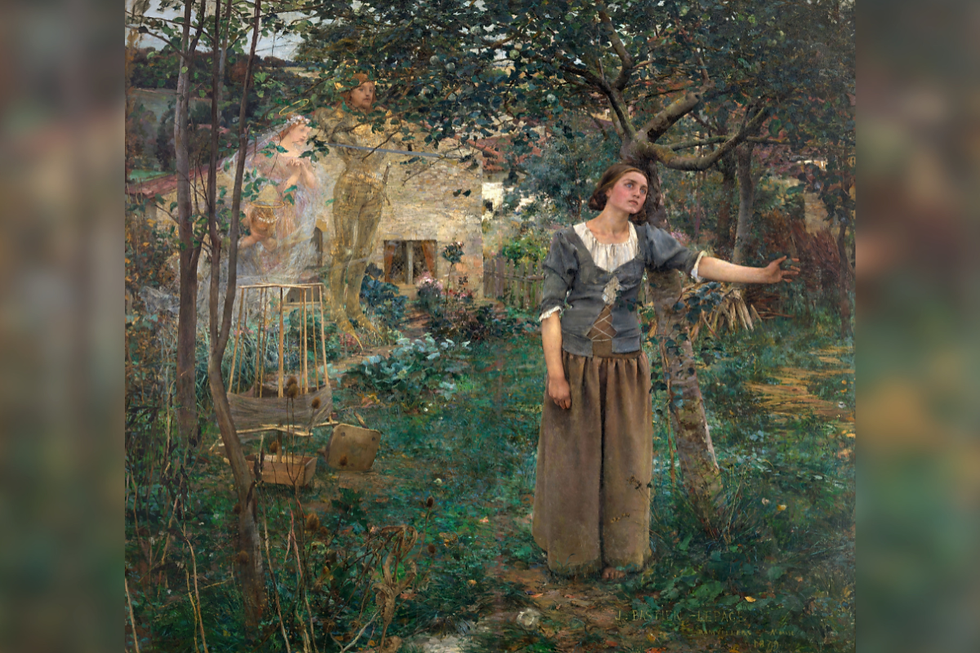
If it is possible to fall in love with someone you have never met, I fell in love with Jules Bastien-Lepage as a young art student in New York City. There have been few painters, in my opinion, that have been able to bring the natural world into sharper focus without being a photo realist painter.
I have never been drawn to photo-realistic paintings. We have cameras to capture such things! I want to know what the painter feels and thinks. Poetically sum up the scene for us in your own words! For me, Bastien-Lepage was one of those painters who checked all the boxes. Some days, I would visit the Met just to sit in front of his painting of Jeanne d'Arc. To figure out how in God’s name he was able to paint the way he did, to become closer to the real human of St. Joan, and to see in my own story what heroism I was being called to, if any.
Bastien-Lepage belonged to the Naturalist, or Realist, art movement. During this era, artists turned away from the idealized, overly dramatic and romanticized depictions of life that the artists before them focused on. They chose instead to capture the world and its people exactly as they were, without shying away from raw, uncomfortable subject matter. Naturalism broke tradition by portraying everyday people from all walks of life, rather than centering solely on the wealthy upper class. Historians suggest this shift was triggered by major mid-19th-century changes, including the suffrage movement, growing class tensions, immigration and the impacts of the Industrial and Commercial Revolutions.
This historical backdrop explains why Bastien-Lepage chose to paint Jeanne d'Arc in her father's garden rather than on a battlefield. While a combat scene would have been historically accurate, depicting her in a quiet, domestic setting conveyed a much more powerful and meaningful message to his audience.
Standing at eight feet high, this image makes you feel as though you are actually present when St. Joan receives the vision of St. Michael, St. Margaret of Antioch and St. Catherine of Alexandria. She has stepped away to think about what they have just called her to: war. They are standing, awaiting her response. You can see clearly in her eyes that the message has hit hard and fast. They are a piercing blue, so piercing in fact that, although they take up little physical real estate on the canvas, they are the central masterpiece of the entire scene. She has left the wool she was spinning so abruptly that she knocked over her chair. Her clothes are those of a poor, yet beautiful young woman who clearly has other things on her mind. You can almost feel how the fabric pulls her in different directions, adding to the psychological tension of the moment. She was quoted as saying, “I would prefer to stay home and spin wool with my poor mother, for this is not my station, but I must do it, because my Lord wills that I do so.”
Almost blending into the house and the background, St. Michael holds out a metal sword to this barefoot child and that one gesture sums up the feeling of her life. Frankly, the entire biography of Joan of Arc is utterly wild, but that is precisely what makes it so significant. It is a Frodo Baggins kind of story with the classic “unlikely hero” archetype. The sort of “Moses, with the speech impediment: you be the one to talk to Pharaoh” kind of moment. This dichotomy bears the unmistakable signature of the divine. Our God is, after all, the God of impossible geriatric pregnancies, virgin births, resurrections, healings and walking-on-water. Her story has his name written all over it.
Though plucked from her father’s garden before she had matured, Jesus did not send her out ill-equipped for battle. Public trial records show she remembered St. Michael instructing her to maintain her spiritual health. He urged her to "be a good child," attend Mass regularly and receive the sacraments frequently, promising that God would protect her. She would tell the angel, who visited her often, that she was “a poor girl who knew neither how to ride [a horse] nor lead in a war.” But St. Michael not only tended to her spiritual needs but also provided Joan with very clear political and tactical military guidance that ultimately secured France's victory. Whenever Joan wavered in her confidence, Michael encouraged her to rely on God's unlimited strength, not her own. He assured her that God would be with her every step of the way.
Looking up at this painting from my 20-year-old eyes, eagerly anticipating the future, I knew my own journey would not involve visions of angels and a war against the English. Yet, isn't there always heavenly aid and an internal conflict to face, even in the absence of an external one? I realized I needed to "be a good child," remaining close to God and the sacraments to fulfill the path he was setting before me as well.
This piece feels like a perfect contemplation for parents whose grown children are leaving for college, embarking on the unique missions God has designed for them. They go out, perhaps not fully prepared, but never alone, and accompanied by divine guidance and inspiration. As we venture out, we all remain fully aware of our human limitations and flaws. It is a beautiful, delicate balance of excitement and fear.
We can comfort them and remind ourselves that we were all "born for such a time as this" — whatever purpose God has laid out before us. He extends the sword to you even in your bare feet. You are the unlikely hero he deeply loves, and he will guide you every single step of the way. Trust him.