
An Embrace, A Kiss, A Betrayal: A Passiontide Art Reflection

“For we do not have a high priest who is unable to sympathize with our weaknesses, but one who in every respect has been tempted as we are, yet without sin.” Hebrews 4:15
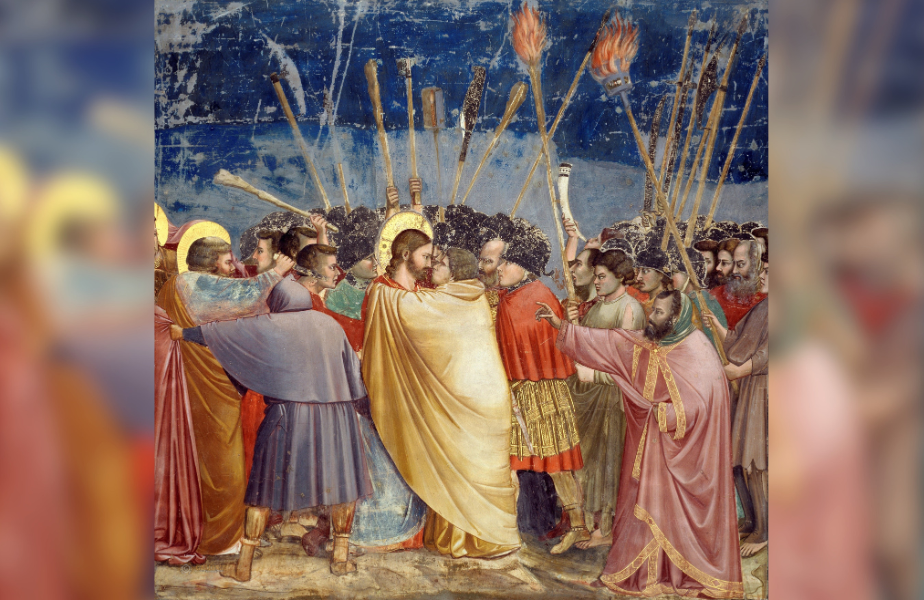
The comfort of a familiar embrace. The closeness of being gathered into another’s cloak. The quiet affection of being near enough to share a kiss. In Giotto’s fresco, Judas not only betrays Jesus with a kiss, but he pulls him near, wrapping him entirely in his garments. Jesus gazes directly into the eyes of Judas Iscariot. His look is deep and penetrating — not marked by obvious anguish, confusion or anger, but by a profound mixture of love and pain. In contrast, Judas looks above Christ’s head, unable to meet his gaze. Of course he cannot. This gesture in Giotto’s work is intentional, even inspired. Many mystics have reflected that the act of Judas betraying Christ with the intimacy of a kiss caused Jesus more pain than any of the physical wounds he would later endure. This rings true to me: I’d rather suffer a broken leg, or even a chest full of broken ribs, than a broken heart.
This moment in Christ’s Passion was so poignant that it inspired St. John Chrysostom to compose a prayer to be said before receiving Jesus in the Eucharist.
O Lord, I believe and profess that you are truly Christ, The Son of the living God, who came into the world To save sinners of whom I am the first. Accept me today as a partaker of your mystical supper, O Son of God, For I will not reveal your mystery to your enemies, Nor will I give you a kiss as did Judas, But like the thief, I profess to you: Remember me, O Lord, when you come in your kingdom. Remember me, O Master, when you come in your kingdom. Remember me, O Holy One, when you come in your kingdom. May the partaking of your Holy mysteries, O Lord, Be not for my judgment or condemnation, But for the healing of my soul and body. O Lord, I also believe and profess that this, Which I am about to receive, Is truly your most precious Body, and your life-giving Blood, Which, I pray, make me worthy to receive For the remission of all my sins and for life everlasting. Amen. O God, be merciful to me, a sinner. O God, cleanse me of my sins and have mercy on me. O Lord, forgive me for I have sinned without number.
“Nor will I give you a kiss as did Judas…” Please Lord, may we never give you the kiss of Judas, neither to your face nor behind your back. Not with our words, our loves, our actions or our belongings. May we call only you Lord, and mean it.
It was recently brought to my attention that when the disciples asked, “Lord, is it I who will betray you?” each of them, in turn, addressed Jesus as Lord. Judas asked, “Rabbi, is it I?” Teacher, not Lord. Given all that time when Judas walked with Jesus, how could he not have truly known who Jesus was? May we, who have eyes to see and ears to hear, come to know who Jesus truly is while we walk with him.
The other wound Giotto sets before us in this image is Peter cutting off the soldier’s ear. He was likely aiming for the man’s head, but in the chaos and rush of the crowd, he missed. Thank God. Jesus immediately healed the man’s ear, reproaching Peter for this act of violence. This healing, occurring in the confusion of the moment, reveals Christ’s nature to us — he is full of mercy, authority and compassion, even in the face of naked aggression. It shows us how Jesus will endure every step of the Passion that lies ahead, accepting each trial with obedience to the Father’s will. Jesus spent three years living out his public ministry, trusting the Father’s plan, and this is exactly how he will drink from the chalice of his coming Passion.
The healing of the ear also points toward the transformative power of mercy over violence, showing that Christ’s mission is not carried out through force or retaliation but through reconciliation and love. In this moment, Jesus models the perfect balance of authority and humility, demonstrating that true strength lies not in the sword but in forgiveness. Even amid betrayal, fear and impending suffering, Jesus shows us how to respond.
The consolation to all of our pain — physical and emotional — is found in the face of Jesus.
In a very human moment of my own life, I told Jesus that I longed for people to apologize for the hurt they had caused me. Just as he reproached Peter for his violence, Jesus turned toward me with complete love and attention and spoke to my heart, saying, “Look at my wounded face; I have said sorry for every pain that has ever been caused — and ever will be caused — to you.”
If, or rather, when you find yourself in a wounded state, I invite you to do the same. It is the only consolation I have ever truly found or felt for harms done to me. In that moment, I was able to walk away from the wound, ear mended, once again calling him not just teacher, but Lord.
This Triduum, embrace Jesus and give him a kiss on his holy face, as a true disciple.