American Holiness: 5 Catholic Witnesses Who Lived Freedom Through Faith

As America marks 250 years, St. Katharine Drexel, Servant of God Nicholas Black Elk, Venerable Edward Flanagan, Venerable Augustus Tolton and Venerable Pierre Toussaint show how true freedom is found in serving God and neighbor.
By Pattrica Serrano-Bann
On Sunday morning, long before many people are even awake, parishioners begin to arrive at church. As the doors open, a quiet calm settles over the sanctuary. Families shuffle in, regulars ease into their usual pews and children swing their legs as they wait for Mass to begin.
A bell rings. Everyone stands, and the priest steps forward to begin the liturgy.
This year, the moment carries a different weight. As the United States commemorates 250 years since the Declaration of Independence, Catholics pause to reflect on religious freedom, not only as a constitutional promise but as a lived reality shaping communities for generations.
From the Thirteen Colonies to distant mission territories, Catholics have shaped the nation's story by living out the faith. Their sacrifices and convictions remain relevant, modeling faithful citizenship in a changing country.
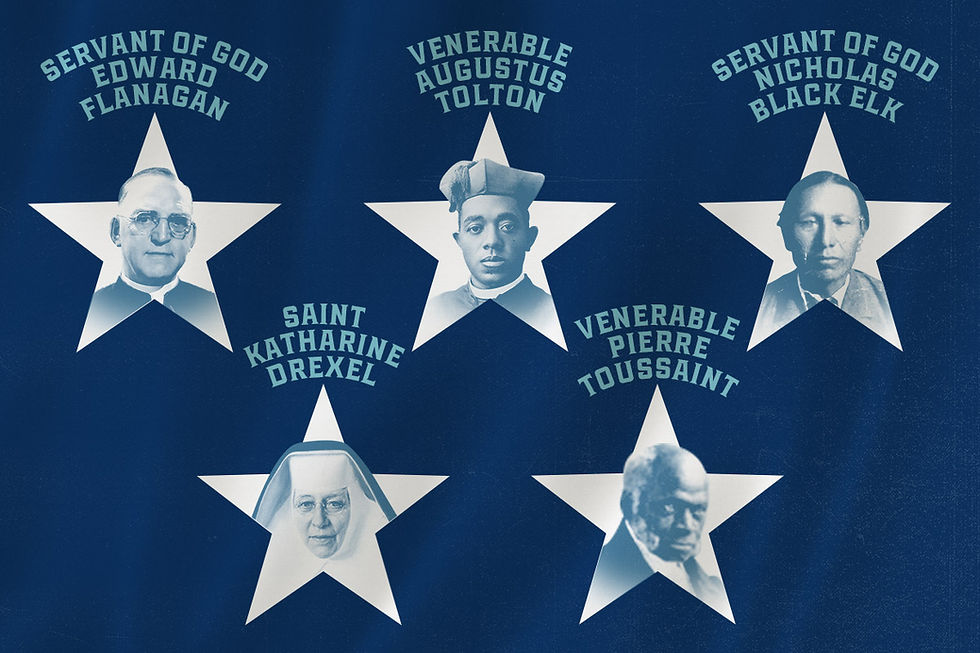
As the nation revisits its founding principles, certain Catholic saints and witnesses stand out for their perseverance, courage and devotion. Five in particular have embodied the life of faith in American history: St. Katharine Drexel, Nicholas Black Elk, Edward Flanagan, Augustus Tolton, and Pierre Toussaint.

St. Katharine Drexel
St. Katharine Drexel, a woman whose life left a lasting impact on the United States, was born into wealth and privilege. Rather than store up treasures on earth (see Matthew 6:19-21), Drexel chose to use her resources to serve others. Moved by the injustices faced by Native American and African American communities, she founded the Sisters of the Blessed Sacrament and dedicated her life to education and racial justice. She used her influence to advance that mission and led efforts to establish schools for other minorities.
Through her holy service, she confronted racism with compassion, built institutions that continue to uplift marginalized communities and modeled the use of one’s gifts for the common good. Her life made the U.S. better by expanding educational access and fostering the mission of Catholic education.

Servant of God Nicholas Black Elk
Among the Communion of Saints is a Servant of God: a Lakota holy man and catechist whose resilience and spiritual vision marked his long life.
Immersed in the rhythms of Lakota life through sacred ceremonies and oral tradition, Nicholas Black Elk experienced visions of Jesus’ Crucifixion — before he was Catholic. He would eventually enter the Church, seeing these visions not as a break from his culture and tradition, but rather, as a continuation of it. They would become part of the bridge he formed between the Lakota and the Catholic Church, as he spent much of his life traveling to teach the faith, baptize and weave the spiritual heritage of the Lakota people into his ministry of evangelization.

Venerable Edward Flanagan
As Black Elk wove faith and culture to lift up his people, another Catholic witness was advocating for God’s children in a very different setting: the Irish‑born priest who founded Boys Town.
Venerable Edward Flanagan founded Boys Town with a simple conviction: that every child, no matter their background, deserves safety and a chance. In an era when society focused on discipline rather than love for one’s neighbor, Father Flanagan advocated that children receive the much-needed compassion, structure and care rather than punishment. His work laid the foundation for national understandings of child protection. His impact on saving children and supporting families continues to exist throughout Boys Town.

Venerable Augustus Tolton
While Father Flanagan worked to protect children, another future saint faced a harsher struggle several decades earlier: the fight for freedom itself.
Venerable Augustus Tolton, born into slavery, spent his earliest years in the weight of a system that denied his family freedom. During the Civil War, his mother grabbed his siblings and him and led them to Illinois to escape.
Knowing he was called to serve God as a Catholic priest, Tolton applied to several seminaries but was turned away from all of them because he was Black. Rather than sink into despair, the rejection clarified his path and fortified his vocational resolve. In 1880, he left for Rome, the only place willing to help him. He expected to be sent to Africa, but Church leaders had other plans. They sent him home so the U.S. could see its first Black priest.
In Illinois and later Chicago, Father Tolton’s ministry drew people of every race. His preaching was warm and his compassion clear. Crowds grew, along with resentment from some white clergy. He died at 43, collapsing during a heat wave. His life was poured out in service, asking nothing for himself and giving everything for others.

Venerable Pierre Toussaint
Father Tolton broke barriers in the church, but he wasn’t the first Black Catholic to reshape the nation through virtuous living. Decades earlier, another man, once a slave and later called “the freest man in America,” lived with radical generosity: Venerable Pierre Toussaint.
Pierre Toussaint was a former slave in New York who became a sought-after hairdresser. Despite his circumstances, he lived with deep faith and used his earnings to help his owner’s widow and to free his sister as well as his future wife, Juliette.
Toussaint was known for his daily devotion, spending hours in prayer and meditation, and great generosity, caring for orphans and supporting Catholic charities. His life embodied a freedom rooted in virtue, earning him the title “the freest man in America.”
A Church for the Future
As the U.S. reflects on 250 years, these five saints remind us that the nation’s reality is built through service, sacrifice and love of neighbor, not just ideas on parchment.
Today, just as 250 years ago, God calls us to serve with the same love that shaped their lives. Their stories show that holiness is not distant; it is lived in classrooms, on reservations, in city streets, in parish halls.
The question remains: How will we answer that call today — in our families, our neighborhoods, our communities and our country?
The example of these Catholic saints and witnesses urges us to choose faith over indifference and charity over comfort, trusting that God can use our lives to help renew the nation we call home.