
A Taste of Heaven: Encountering Pier Giorgio Frassati at His Canonization

By Father Sean Conroy
When the Church canonizes a saint, it isn’t merely adding another name to the litany; it’s affirming that holiness can blossom in our own time. I had the immense gift of attending the canonization of Pier Giorgio Frassati this Jubilee Year, and I can only describe the experience as a taste of Heaven. He was canonized a saint on the centenary of his death, yet to me, he is a friend whom I often talk to and seek his intercession.
I first met Pier Giorgio Frassati in my first year of seminary. I was 18 years old and full of consolation and zeal. I lived on the fifth floor, and we had Pier Giorgio as our patron. At our weekly house meetings, one of the men would give a sixty-second exhortation on Frassati’s life. This doesn’t sound like much time, yet when this happened every Monday night for 2 years straight, I was drawn to him and began to develop a deep friendship with him. Pier Giorgio seemed like someone I would have spent time with, someone who I would have climbed mountains with, and maybe even someone I would have enjoyed a cigar and bourbon with. There was something captivating about his joy and holiness. It felt attainable. It felt like I could be a saint, too. And it was during these formative years in college seminary that I resolved: if Pier Giorgio is ever canonized in my lifetime, I will be there.
A Eucharistic Mountain Man
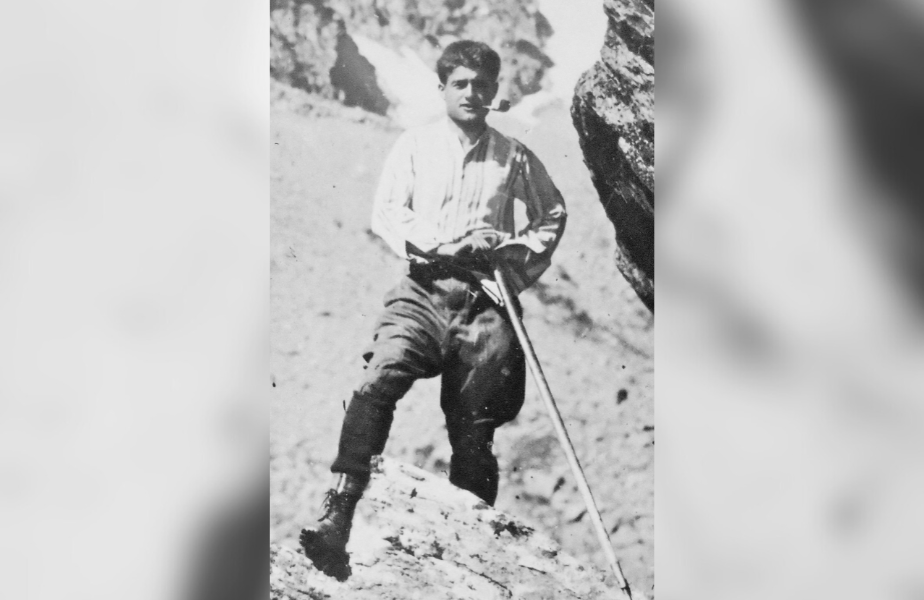
What first attracted me to Pier Giorgio was his deep love for the mountains.
“Every day that passes, I fall more desperately in love with the mountains … I am ever more determined to climb the mountains, to scale the mighty peaks, to feel that pure joy which can only be felt in the mountains,” he once wrote to a friend.
Pier Giorgio was renowned for his mountaineering and skiing skills. The Frassati family would spend their summers in the mountains of Northern Italy, in a small town called Pollone, to escape the city. Pier Giorgio would often wake up early and go for hikes and scale the peaks. But as I began to learn about Pier Giorgio’s life, I realized that it wasn’t his love for the mountains that made him a saint; it was his love for the Eucharist and the poor.
Pier Giorgio had a deep love for the Eucharist. During his middle school years, Pier Giorgio struggled in school, so his parents sent him to a Jesuit school. This was providential because the Jesuits offered Pier Giorgio the chance to attend daily Mass. With some persuasion, his mother allowed him to receive the Eucharist each day. That small permission changed everything. Even in the summers, he would walk three miles each morning to attend Mass at the Marian shrine of Oropa. His heart was being shaped by the rhythm of the Eucharist, the source and summit from which he drew the strength for everything else. Pier Giorgio began to fall in love with God at a deep level through this daily Eucharistic encounter. Towards the end of his life, Pier Giorgio would write to the Catholic youth of Italy:
"When you are totally consumed by the Eucharistic fire, then you will be able more consciously to thank God, who has called you to become part of his family. Then you will enjoy the peace that those who are happy in this world have never experienced, because true happiness, oh young people, does not consist in the pleasures of this world, or in earthly things, but in peace of conscience, which we only have if we are pure of heart and mind."
A Man for Others
Pier Giorgio’s deep love for God and the Eucharist is truly modeled in his service to the poor. Though he came from an affluent family, he wasn’t interested in living an affluent life. He befriended the poor around Turin because it was there he saw Christ. Through his love for Jesus in the Eucharist, Pier Giorgio overflowed with divine charity.
“Jesus comes to me every morning in Holy Communion, and I repay him in the miserable poor,” he once said.
Pier Giorgio recognized that Christ is present in the poor, and so he did everything he could to love them and the outcast. As he wrote in a letter to Isidoro Bonini:
"By drawing closer to the poor, little by little we become their confidants and counselors in the worst moments of this earthly pilgrimage. We can give them the comforting words of faith, and often we succeed, not by our own merit, in putting on the right road people who have strayed without meaning to. Witnessing daily the faith with which some families often bear the worst suffering, their constant sacrifices, and that they do all this for the love of God, often makes us ask why we, who have received so many things from God, have been so neglectful, so bad, while they, who have not been as privileged, are so much better? And so we resolve in our conscience to follow the Way of the Cross, the only way that leads to eternal life."
Pier Giorgio’s life was marked with this love and service to the poor. In many ways, it was in this love and service that he won the crown of Life.
In his final days, Pier Giorgio’s love for the poor reached its ultimate expression. Having contracted polio, almost certainly from one of the sick he tended in the slums of Turin, he accepted his suffering with the same serenity and hiddenness that marked all his acts of charity. The illness that claimed his life was, in a sense, the seal of his vocation: the Eucharistic Christ whom he received each morning had now conformed him fully to himself, even unto the Cross. He who had knelt before the Eucharist became the broken bread of Christ for others. His death was not a tragedy but a consummation, the final “Amen” of a life poured out in Eucharistic love.
A Saint for Our Times
For me, Pier Giorgio’s life challenges the comfortable assumptions I sometimes make about holiness. It’s easy to imagine that sanctity belongs to mystics or martyrs, people set apart by extraordinary visions or sufferings. But Pier Giorgio’s holiness was woven into his daily friendships, study, service and joy. He loved the mountains; he loved scaling the high peaks; he loved the joy of friendship; he loved a good cigar and glass of bourbon. Yet above all, he loved the Eucharist and the poor, and that’s what transformed him to give his life in total abandonment and service to the Lord.
Pier Giorgio’s humility offers a gentle rebuke to our age of self-glorification. We live in a world that measures everything by visibility and success. Pier Giorgio reminds us that the most powerful witness is often unseen. Holiness grows in the small, steady acts of love done without display. His life speaks to a kind of resilience amidst adversity within our age of performance. Pier Giorgio stands as a saint for our times, reminding us that sanctity is not beyond reach, but a path that is possible for ordinary people like us.
When Pier Giorgio died on July 4, 1925, his family expected only a small, quiet funeral. They had known little of his secret life of service among Turin’s poor. But when the coffin was carried out into the streets, they were met by a sea of mourners: thousands of workers, beggars and families who had been touched by his kindness. The alleyways he once walked with bread and medicine were now filled with tears and gratitude. The poor whom he had served in anonymity came forward as his true family, flooding the city in a spontaneous procession of love. It was as though Heaven itself had bent low to honor the man who had made charity his daily worship.
One century later, on September 7, 2025, that same spirit overflowed when tens of thousands gathered in St. Peter’s Square for his canonization. Where once the poor of Turin had carried candles, now young people from around the world carried banners with his face, shouting his motto, “Verso l’alto.” The joy that filled those Roman streets was the same joy that once filled the slums of Turin, a radiant beauty that comes from a life consumed by the Eucharistic love of Christ.
It’s difficult to capture the depth of what I experienced during those forty-eight hours in Rome. It was, without question, the most beautiful and profound weekend of my life: a foretaste of Heaven. I met members of Pier Giorgio’s family and hundreds of pilgrims who, like me, had been shaped by his example and holiness. And we all traveled to Rome to celebrate the Church formally declaring that Pier Giorgio Frassati is in Heaven. The weekend was filled with so much joy and laughter and friendship, a communion of hearts united in Christ. And through it all, one truth echoed within me: surely this is what Heaven will be like.