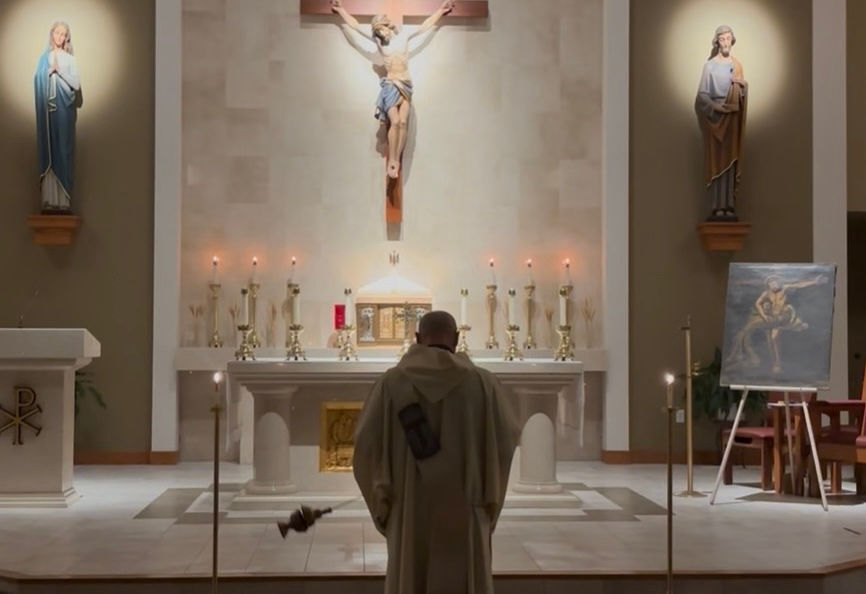
A Hidden Rescue: Archbishop Golka Recounts Jesus’ Radical Resurrection in First Denver Easter Vigil

Referencing Scripture, tradition and an ancient homily from the second century, Denver’s new archbishop shared about Jesus’ Resurrection in a new light, one that changes the way the faithful see the world.

Holy Saturday. A strange day by all accounts: God is dead and buried. Hope might seem far off. It’s quiet and still. What is happening?
It was that very question that Archbishop James Golka walked into as he made his way to his office after the Good Friday liturgy, passing through the seminary. He encountered three St. John Vianney seminarians discussing that very dynamic — what is going on each Holy Saturday?
In his homily at the Easter Vigil at the Cathedral Basilica of the Immaculate Conception in Denver, the archbishop recounted his response.
“I think Holy Saturday is a time to be silent, a time to listen, and a time to have hope,” he shared. “I imagine that's what the disciples and Mother Mary were doing on Holy Saturday, absorbing the jolt of seeing her son and their savior killed the day before, knowing he promised he would rise, but they don't know what that means, and they're waiting.”
On Jesus’ part, Holy Saturday was a busy day even though his body lay in the tomb, Archbishop Golka explained. Referencing an ancient homily preached on Holy Saturday and points of Catholic faith, he noted that, while the earth was “silent and still,” Jesus “descends to hell and knocks down the door.” In response, “the gates of Hell were trembling in fear because Christ, whom we killed, was heading there.”
Jesus’ silent, unseen rescue mission on Holy Saturday shows us something radical about his mission: he comes to seek the lost, even to the ends of the universe.
“Christ went down as low as you could go to find our ancestors and to find us and to break the bonds of death,” he said.
(Photos by Dan Petty/Denver Catholic)
Arriving in hell, tradition says, Jesus goes directly to Adam while carrying the instrument of his death, the Cross. The New Adam, Jesus, shows complete obedience to the Father by dying on a tree, in contrast with Adam, who showed disobedience to the Father by eating the fruit of a tree. In a tender moment that follows, Jesus saves Adam and Eve.
“Christ walks over to Adam, the first sheep to be lost. Christ is always a shepherd, and he comes to find us,” the archbishop said. “He takes Adam by the hand, and many depictions have the other hand with Eve, and he pulls them up, lifts them up, and he says, ‘Awake, O sleeper! Arise from the dead! Christ will give you life.’”
That hidden action 2,000 years ago has eternal weight, even to this day, the archbishop continued.
“At that moment, Adam and Eve and all of us, all of humanity, become who God made us to be. Jesus says, ‘I did not create you to be a prisoner in hell. You are created in my own image and likeness. Rise, leave this place. The enemy led you out of earthly paradise; I will enthrone you in Heaven. That's why I made you,’” Archbishop Golka shared. “Our destiny is Heaven. The saints often said that Christ is working way harder to get you and me to Heaven than we are. He's working overtime for that. Now, tonight that same Christ comes to you and to me, and in all the baptisms we will witness here tonight, we will see his saving action made visible. He will raise you up to a new life that we can only share in him.”
In the quiet stillness of Holy Saturday, something miraculous occurs: Jesus saves, redeems and rises.
Turning to the evening Vigil’s Gospel reading from Matthew 28, Archbishop Golka noted the use of words that convey sudden action — suddenly, behold, look here, come here. Those words, he said, “cannot convey the untranslatable truth that in this sequence of events, light has split a crack in the universe and everything that we thought we knew is now changed. Jesus is risen from the dead.”
As that light breaks forth into a dark world — made darker by the suffering and death of Christ (see Matthew 27:45) — we begin to see things differently, in the light of faith. Noting the theme of vision in the same Gospel reading, the archbishop made the connection between sight and the Resurrection.
“Witnessing Jesus' Resurrection represents a cataclysmic event. This is how faith is shaped,” he said. “We learn to see and recognize the presence of the risen Christ in our lives. We have confidence that he is going ahead of us in our life. He wants to be seen, and he will make himself seen by us. I'm fascinated by this Christ. How awesome to know that he will help us to know him if we but let him.”
For those Archbishop Golka would soon baptize — 33 in number at the Cathedral — this invitation to see, know and love Christ more deeply was all the more poignant. As he concluded his homily, the archbishop invited those gathered — and those across the archdiocese — to pray with and for these newly baptized Catholics, whom Jesus wants to wash, “make you new, help you to see him in a way you never have before.”