
What Makes Good Art? Titian's Assumption Shows Us the Answer

For the Solemnity of the Assumption, a masterpiece of sacred art reveals the relationship between beauty, longing and love.
“What makes good art?”
It was the way my friend asked the question. Knowing him, he wasn’t looking for an answer that included anything along the lines of “sound composition, good lighting, technical mastery in the execution.” And while all those things are a part of “good art,” what was the answer if it wasn’t those things?
I thought for a minute.
I would propose that art is a static thing that possesses a lifetime of dynamic spiritual movement. Though a work may sit quietly in a home or museum, people encounter it and bring with them their lifetime of experience — all the pain, joy, suffering, grief and hope they have lived. And it is when a person opens themselves to the work and what it might say to them that they are moved in one way or another. That stirring in the heart may or may not happen, but when it does, it creates a relationship unlike any other. It is an unrepeatable event, something said from one heart to another, across time, from art to viewer. And that image stays with that person; they carry it with them, sometimes for their whole lives. It’s an idea of encounter that is not static at all.
“So, love?” my friend asked.
“Yeah,” I answered ineloquently. “Love. That is what makes good art.”
It’s not just the love of the viewer who is receiving the work into their soul, but the love of the artist as well. You can feel it (sometimes centuries later!) when the artist loved what they were creating. They loved the way the light was falling across the object; they loved what the subject matter meant; they loved the act of creation itself. Somehow, all of this is conveyed when we open ourselves to the encounter.
Beauty and love are weighty things, and art has the power to bear them, to carry them to us.
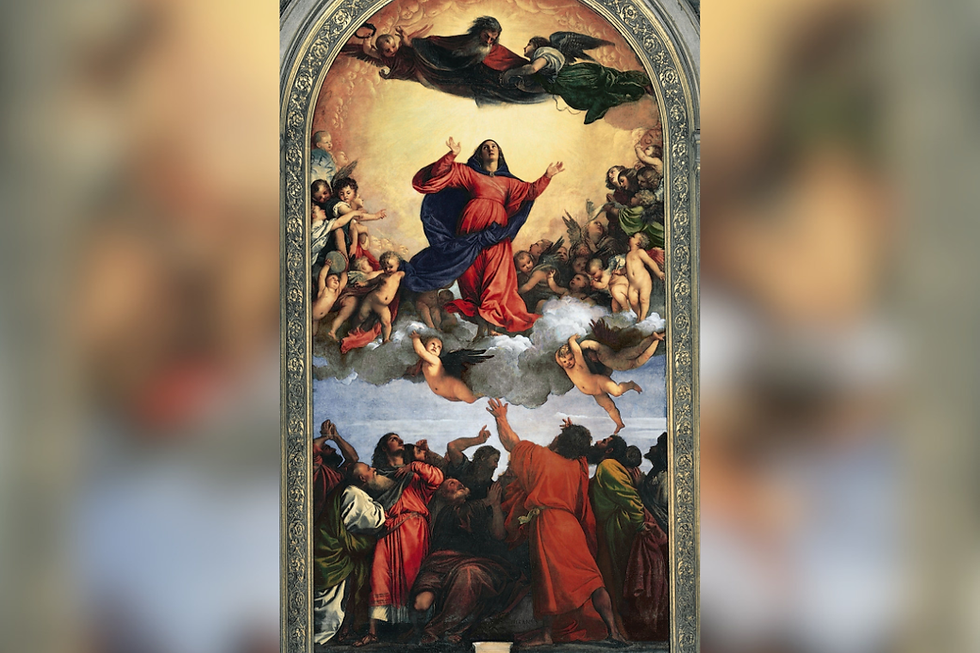
For me, this larger-than-life-size altarpiece by Titian, Assumption of the Virgin, has all the markings of love. You can see the love for Our Lady. You can feel the shared experience and brotherly love of the disciples. And the worship of God the Father is clear as crystal. The technical paint handling isn’t too shabby either.
Could you imagine what it must have been like for the apostles to lose Mary? Oh, sad day! Clearly, they were well-versed in loss and love, but that wouldn’t have made it any easier. I think of their sorrow in this moment, but also their awe. Titian has captured all of it in the drama of his composition. By placing most of the apostles in the darkness and shadow below, Titian creates a tension within the frenzy we are witnessing: they all seem to be crying out, “Wait! Not yet!”
While Mary is focused on God the Father, we know she is carrying us with her. She is clothed in the traditional colors of red for her humanity, and draped in the blue of divinity. Mary’s clothing colors are always shown as the inverse of Christ’s, who was born divine and “clothed” in our humanity.
This painting reminds me so much of Raphael’s Disputation of the Sacrament. If you look up that image, you will quickly see the comparison. Titian painted his Assumption just five years later, and would have been very aware of the young Raphael’s work. The three different realms of this world and the ever-present life that awaits us are remarkably similar to Raphael’s composition, taking up three separate yet closely connected hemispheres in the composition. But where Raphael places the Eucharist, Titian places the hand of an apostle reaching for Mary, moving the viewer’s gaze precisely where he wants it. This moment is the most piercing.
This image was painted by someone who knows what it is to long for something that is just out of reach, and it is that reaching which sums up the human experience. The deep longing we all carry in our bones, the aches that has given birth to centuries of songs, poems and prayers seem to gather into one outstretched hand. It sums up Psalm 63:
"You, God, are my God, earnestly I seek you; I thirst for you, my whole being longs for you, in a dry and parched land where there is no water. I have seen you in the sanctuary and beheld your power and your glory. Because your love is better than life, my lips will glorify you. I will praise you as long as I live, and in your name I will lift up my hands. I will be fully satisfied as with the richest of foods; with singing lips my mouth will praise you. On my bed I remember you; I think of you through the watches of the night. Because you are my help, I sing in the shadow of your wings. I cling to you; your right hand upholds me.
Which brings us back to where we started, trying to define what makes good art: Love. Love is what makes good art.
It is what makes anything in life good. Our longing for and love of God is good. It is good to feel sorrow over someone departing from us. It is good to reach out our hands. Enter into the sorrow and awe of the Solemnity of the Assumption this season. Know that you are not in the dark, but surrounded by the other apostles and the love of God.